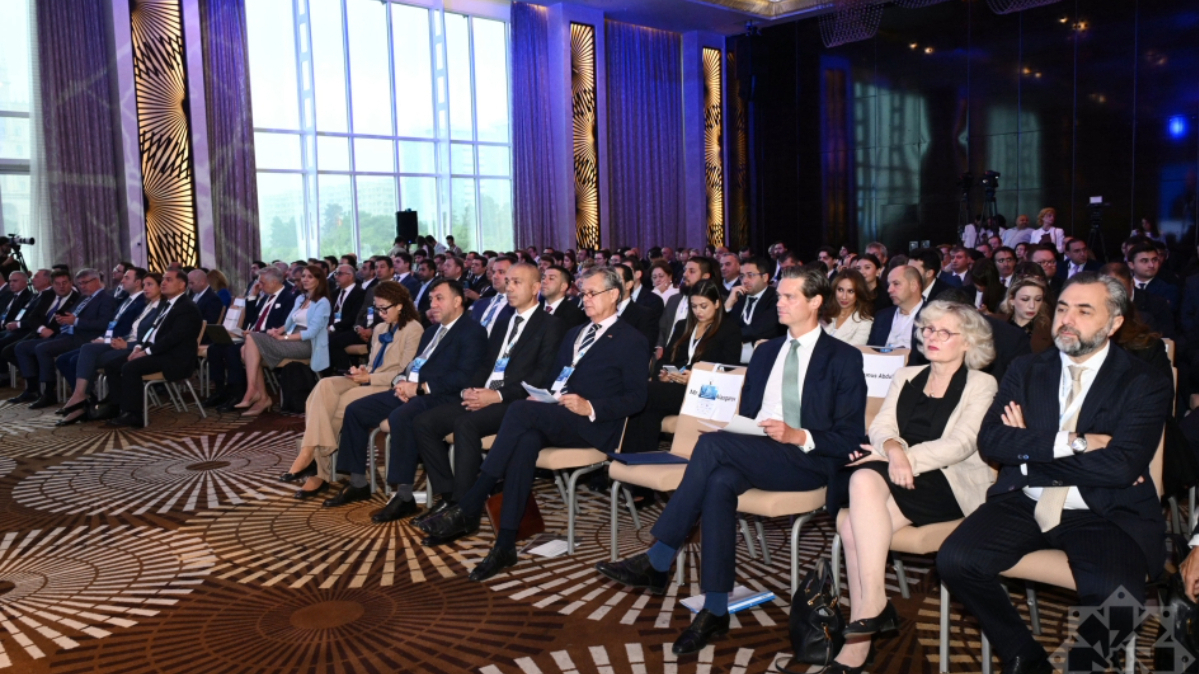
The German-Azerbaijani Connectivity Conference 2026 commenced on 6 October in Baku under the title “Mobilising Finance for Infrastructure, Transport, Logistics, Green Energy, and Digitalisation along the Middle Corridor.”
Azerbaijan and Germany are seeking to deepen economic cooperation, with financing for infrastructure, energy transition and digital connectivity projects emerging as key priorities.
The agenda was highlighted at a conference organised by the German-Azerbaijani Chamber of Commerce (AHK Azerbaijan), bringing together government officials, business representatives, financial institutions and project owners from both countries.
Participants discussed investment opportunities and financing mechanisms for strategic projects, including those linked to Azerbaijan’s role in the Middle Corridor, a major transport and trade route between Europe and Asia.
From dialogue to implementation
The conference placed particular emphasis on turning bilateral political and economic dialogue into practical cooperation.
Business-to-government meetings focused on identifying viable projects, attracting investment and supporting their implementation.
Opening the event, AHK Azerbaijan Executive Director Nargis Wieck stressed the importance of deeper integration between the two economies.
“How can German companies become part of Azerbaijan's economic ecosystem? And how can Azerbaijani companies become more closely integrated into German and European value chains? This is where connectivity comes into play,” Wieck said.
German Ambassador to Azerbaijan Dirk Lölke said connectivity could become an increasingly important component of bilateral economic relations alongside energy.
“I'm quite sure that the connectivity issue will be very soon, let's say, the second pillar next to energy of our bilateral economic relationship,” Lölke said.
Middle Corridor opportunities
Azerbaijan’s role in the Middle Corridor featured prominently in the discussions, with participants examining how investment in transport infrastructure and related services could strengthen trade links between Europe and Asia.
Deputy Minister of Economy Samad Bashirli said the priority was now to convert political momentum into projects capable of attracting financing.
“Together with our German partners, we are now working to translate this political momentum into bankable projects and secure the financing needed for their successful implementation,” Bashirli said.
The Middle Corridor is a multimodal trade route linking China and European markets through Central Asia, the Caspian Sea and the South Caucasus, with connections continuing through Türkiye or across the Black Sea. It combines rail, maritime and road transport.
Azerbaijan forms a key section of the corridor through infrastructure including the Baku-Tbilisi-Kars railway and the Port of Baku at Alat, supported by upgraded transport infrastructure and digital customs systems aimed at facilitating and accelerating transit.
Expanding economic ties
The discussions reflected Azerbaijan’s efforts to attract German and European capital, technology and expertise into major infrastructure, energy and digital projects.
For German companies, closer cooperation with Azerbaijan could provide access to new projects and strengthen links with emerging transport and trade networks across the South Caucasus and Central Asia.
The conference also signalled a shift towards more implementation-focused cooperation, with project financing and the development of bankable proposals expected to play a central role in turning shared priorities into concrete economic outcomes.
Read more:











What is your opinion on this topic?
Leave the first comment