A new freight corridor linking China with Tajikistan via Kyrgyzstan and Uzbekistan has entered pilot operation, marking another step in Central Asia’s expanding transport connectivity.
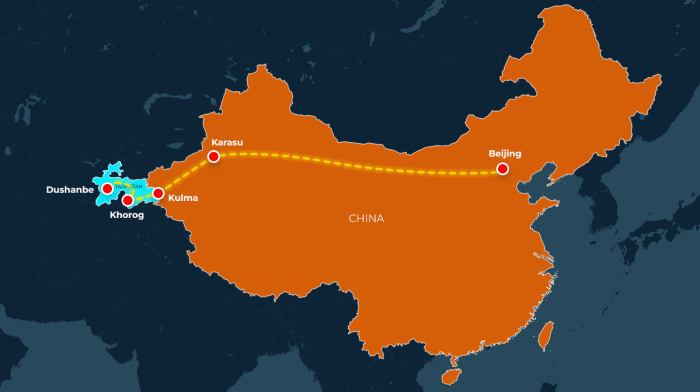
The inaugural train was dispatched by the Uzbekistan–China joint venture UTK International Logistics Co. Ltd, according to its co-founder, Uztemiryulcontainer. It departed from Lanzhou in China and is travelling more than 3,500 kilometres to Dushanbe-2 station in Tajikistan. The journey is expected to take between 18 and 20 days.
The train consists of eight 40-foot containers carrying consumer goods and construction equipment. The route passes through Kyrgyzstan and Uzbekistan under preferential tariff arrangements supported by Uzbekistan Railways.
Part of broader regional transport integration
The corridor is currently operating in pilot mode under regional cooperation agreements between Uzbekistan, Kyrgyzstan and Tajikistan aimed at strengthening trade and transit links.
The initiative builds on earlier rail cooperation between China and Central Asia. In June 2023, the first block train was launched along the China–Kyrgyzstan–Uzbekistan multimodal corridor between Lanzhou and Tashkent, laying the groundwork for expanded regional cargo operations.
In July 2025, UTK International Logistics was formally established as a joint Uzbek–Chinese transport enterprise. The company focuses on cargo consolidation and the development of freight routes between China and Central Asia. A logistics assembly point was also opened in the Lanzhou Free Economic Zone to facilitate transit operations.
Link to major railway project
The pilot corridor also aligns with the broader China–Kyrgyzstan–Uzbekistan railway project, a large-scale infrastructure initiative designed to shorten transit routes between China and Europe via Central Asia.
In December 2025, a financing agreement worth approximately $4.7 billion was signed to advance construction of the railway. China is expected to provide more than half of the funding through long-term loans, with the remaining share divided between Kyrgyzstan and Uzbekistan.
The railway project aims to reduce transit times, diversify trade routes and strengthen Central Asia’s role as a strategic land bridge between East Asia and Europe.
Strategic significance
The launch of the first train along the China–Kyrgyzstan–Uzbekistan–Tajikistan route highlights growing regional coordination in logistics and infrastructure. It also reflects ongoing efforts by Central Asian states to expand export capacity, increase transit revenues and integrate more deeply into Eurasian trade networks.
If the pilot proves successful, regular container services are expected to follow, further boosting cross-border trade and economic cooperation across the region.





















What is your opinion on this topic?
Leave the first comment