The AnewZ Opinion section provides a platform for independent voices to share expert perspectives on global and regional issues. The views expressed are solely those of the authors and do not represent the official position of AnewZ
Poland’s economic and military rise is shifting Europe’s centre of gravity east, strengthening Warsaw’s influence on security and regional policy. But demographic decline and fiscal pressures could test how far - and how fast - it can sustain its ascent.
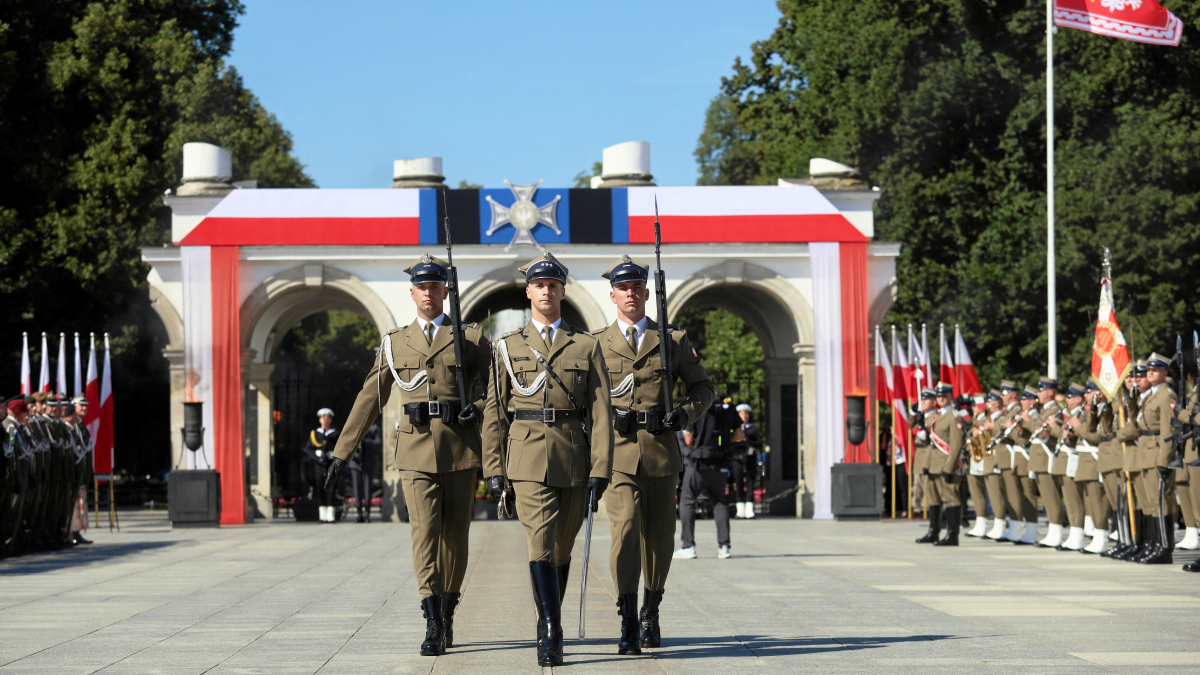
On 15 August, Warsaw hosted Poland’s largest Armed Forces Day parade, commemorating both the national holiday and the anniversary of the 1920 Battle of Warsaw - the “Miracle on the Vistula” - when Polish forces halted Soviet Russia’s westward advance. A naval parade was also held off Gdynia in the Gulf of Gdańsk.
The events were about more than national commemoration. Against the backdrop of Russia’s war in Ukraine, the display of military strength carried substantial political weight. It underscored Poland’s journey over the past three and a half decades: from post-socialist transformation and accession to NATO and the European Union to becoming a central actor in European security.
After the collapse of communist rule in 1989, Poland consistently pursued integration with Western institutions. Accession to NATO in 1999 and the European Union in 2004 established the political and economic foundations for its subsequent transformation.
EU membership opened the single market, encouraged foreign investment and brought substantial European funding. According to the Polish Economic Institute, by 2024 membership had raised Poland’s GDP per capita by around 42 per cent compared with a scenario in which it had not joined the bloc.
Poland’s transformation extended beyond economic development. Following Russia’s annexation of Crimea in 2014, Warsaw began addressing security risks to the east with greater urgency. The full-scale invasion of Ukraine in February 2022 accelerated that process, prompting Poland to expand its armed forces and undertake one of the most comprehensive military modernisation programmes in contemporary Europe.
Security and energy divide
Poland’s approach to security and energy has also diverged sharply from that of several Western European states. For years, Warsaw warned its EU partners - particularly Germany - about the risks of excessive dependence on Russian energy and consistently opposed Nord Stream 2.
Those warnings were largely disregarded as Germany expanded energy cooperation with Russia and phased out nuclear power. The full-scale war exposed the vulnerabilities of that model. Poland, by contrast, had diversified its gas supplies by investing in liquefied natural gas infrastructure and establishing a pipeline connection to Norway.
Historical experience has profoundly shaped this approach. Poland faced pressure from the east for centuries and, in the twentieth century, endured both Soviet invasion and prolonged dependence on Moscow. The Russian threat is therefore perceived differently in Warsaw from how it is viewed in many Western European capitals.
This context also helps explain Poland’s consistent and resolute support for Ukraine since the start of the full-scale war.
One moment has acquired particular significance. In Tbilisi in August 2008, after the outbreak of the Russo-Georgian war, Polish President Lech Kaczyński appeared alongside leaders from several Central and Eastern European countries and warned: “Today Georgia, tomorrow Ukraine, the day after tomorrow the Baltic states, and then, perhaps, my own country, Poland.”
Six years later, Russia annexed Crimea and supported separatists in eastern Ukraine. For Poland, those events validated the conviction that warnings about Russian policy should not be dismissed as exaggeration. From Warsaw’s perspective, 2008 and 2014 form part of the same strategic pattern.
Regional strategy: From the Eastern Partnership to the Three Seas Initiative
Poland’s engagement in Central and Eastern Europe predates 2022. In 2008, Poland and Sweden became the principal initiators of the EU’s Eastern Partnership, a programme designed to deepen relations with Ukraine, Moldova, Belarus, Georgia, Armenia and Azerbaijan. Warsaw sought to reshape the European Union’s eastern policy in line with its broader vision for the region.
At the same time, Poland worked to build a stronger regional centre of gravity within the European Union. The Three Seas Initiative became a principal instrument in that effort, bringing together 13 Central and Eastern European states between the Adriatic, Baltic and Black Seas.
The inaugural summit took place in Dubrovnik in 2016, while Donald Trump’s attendance the following year underscored the initiative’s political significance. Its priorities include regional transport and energy infrastructure, including liquefied natural gas terminals intended to reduce dependence on Russian supplies.
The Three Seas Initiative recalls the Intermarium concept advocated by Józef Piłsudski during the interwar period. Piłsudski envisioned an alliance among states situated between the Baltic, Adriatic and Black Seas to balance pressure from both east and west. That strategic logic endures, although it is now pursued within the institutional frameworks of the European Union and NATO.
The Visegrád Group - Poland, the Czech Republic, Slovakia and Hungary - also plays a role in Warsaw’s regional ambitions. After February 2022, cooperation stalled amid divisions over the war, particularly under former Hungarian prime minister Viktor Orbán.
The group was relaunched in June 2026, following Péter Magyar’s accession to office in Hungary. Meeting in Gödöllő, the four leaders agreed to revitalise cooperation on the EU’s 2028–34 budget, cohesion and agricultural policy, and a proposed Warsaw–Prague–Bratislava–Budapest high-speed railway.
Donald Tusk argued that renewed mutual loyalty could turn the Visegrád Group into one of the European Union’s most influential forces. Together, the four countries represent around 65 million people.
The group will not erase their political differences, but its revival gives Warsaw another platform to influence European debates.
Military power backed by economic growth
Economic growth has enabled Poland’s military expansion. In 2025, Poland became the European Union’s sixth-largest economy by nominal GDP, and its output exceeded $1 trillion for the first time. Real GDP grew by 3.6 per cent in 2025, while the European Commission forecasts growth of 3.5 per cent in 2026 - among the strongest rates for a large EU economy.
A comparison with Germany is particularly striking. Between the first quarter of 2018 and the second quarter of 2025, Poland’s real economy expanded by almost 25 per cent, while Germany’s grew by only about 1.4 per cent.
Poland has not matched Germany in prosperity or total economic weight, but the gap is closing much faster than many expected two decades ago.
This growth directly supports Poland’s military transformation. The country is acquiring U.S.-made Abrams tanks, South Korean K2 tanks, HIMARS artillery systems, Patriot air-defence systems and F-35 fighter jets. It is also investing in its domestic defence industry.
Poland leads NATO in defence spending as a share of GDP, with its 2026 allocation planned at roughly 4.8 per cent.
Poland’s military ambitions are accompanied by a growing recognition that security cannot depend exclusively on the U.S. The country hosts roughly 10,000 U.S. troops, most of them on a rotational basis, but the long-term shape of the American presence remains exposed to political shifts in Washington.
Warsaw has therefore sought to diversify its defence relationships through closer cooperation with South Korea, France and the United Kingdom.
In July 2026, Poland and France held the first meeting of their Steering Group for Nuclear Cooperation. The mechanism followed Paris’s proposal for a strategic dialogue on forward deterrence. It did not amount to a new nuclear guarantee, but it signalled Warsaw’s interest in a broader European deterrence debate and in reducing dependence on any single external guarantor.
The scale of Poland’s military transformation was on display on 15 August. Around 1,800 service members marched in Warsaw, accompanied by more than 300 pieces of land equipment and over 60 aircraft.
A naval parade involving more than 20 Polish and allied vessels took place off Gdynia, with ships from Estonia, Lithuania and Sweden among the participants. The display showed that Poland’s build-up is not only quantitative, but increasingly technological and interoperable with allied forces.
Demographic and fiscal pressures
The Polish model nevertheless faces significant constraints, above all demographic decline. Poland’s population was about 36.5 million in 2025, but Eurostat projects it could fall to around 31.2 million by 2060. The fertility rate, at roughly 1.1 children per woman, is among the lowest in the European Union.
A shrinking and ageing population will reduce the domestic workforce and place greater pressure on public finances. Poland must determine how to sustain high growth while financing defence modernisation, the energy transition and the welfare state. Its fiscal position is already strained by high military expenditure and other public commitments.
Even so, contemporary Poland is markedly different from the country that joined the European Union in 2004. It is no longer concerned only with catching up with Western Europe or adapting to rules written elsewhere. Warsaw increasingly wants to shape those rules.
Its positions on Russia, Ukraine, energy and security often diverge from those of Berlin and Paris, reflecting its evolving role in Europe.
A changing European balance
The 15 August parade was therefore not simply a display of new tanks, aircraft and missile systems. It was a statement about how far Poland has travelled in a single generation — from a post-socialist periphery to a state seeking a central role in European security.
The central question is no longer whether Poland can become one of Europe’s leading powers, but how quickly other states will adapt to that reality — and whether Warsaw can sustain the economic, demographic and political foundations of its rise.

















What is your opinion on this topic?
Leave the first comment