The AnewZ Opinion section provides a platform for independent voices to share expert perspectives on global and regional issues. The views expressed are solely those of the authors and do not represent the official position of AnewZ
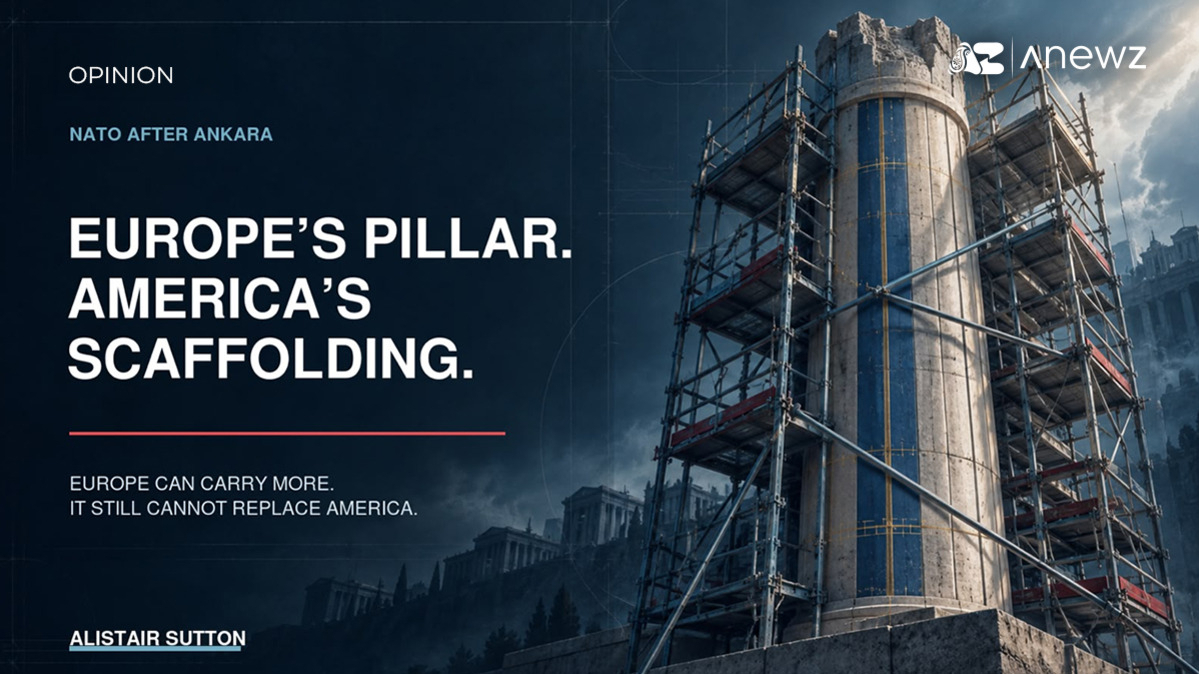
Ankara marked a genuine transfer of conventional responsibility from Washington to its allies. But budgets are rising faster than command, integration and strategic enablers. Europe can carry more of NATO. It still cannot replace America.
For decades, NATO’s burden-sharing argument was conducted with a calculator. Who paid two per cent? Who fell short? Who could still shelter behind the United States? The Ankara summit changed the question. Europe’s problem is no longer simply whether it will spend. It is whether that money can be converted, quickly enough, into a force able to plan, move, see, strike and sustain without Washington doing the hardest work.
Ankara did not announce European strategic autonomy. Its declaration chose a more careful formula: ‘a stronger Europe in a stronger NATO’. That is a transfer of conventional responsibility inside the alliance, not a transfer of ultimate authority away from it. The distinction is the whole story.
The money has moved
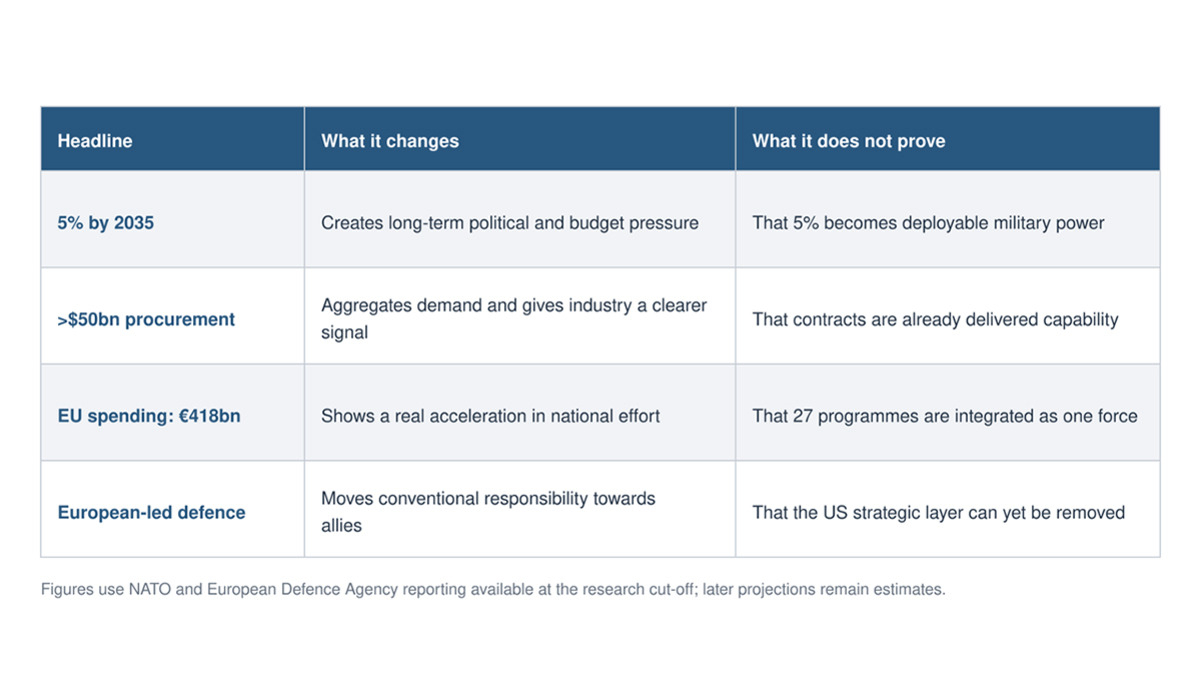
The old accusation — that Europe simply refuses to pay — is becoming obsolete. NATO says European allies and Canada spent more than $571 billion on defence in 2025 in constant 2021 prices, equal to 2.3 per cent of their combined GDP. The annual increase was more than $90 billion in those constant prices, or close to $139 billion in nominal terms. Those are different measures; they should not be merged into one dramatic number. Either way, the acceleration is real.
The alliance’s five-per-cent commitment now points to 2035. At least 3.5 per cent of GDP is intended for core defence requirements, with up to 1.5 per cent for wider security, infrastructure and resilience. That split matters. A hardened railway, protected data network or resilient port may be essential to war-fighting. It is not the same thing as an air-defence battery, a stocked magazine or a deployable brigade. Five per cent is a political forcing mechanism. It is not a military unit.
Ankara added industrial weight to the budget pledge. The summit declaration announced more than $50 billion in new multinational procurements. NATO’s secretary general also advertised a $40 billion counter-drone programme over five years, €27 billion for fuel storage, distribution and pipelines, and €70 billion in allied equipment, assistance and training for Ukraine in 2026, with at least an equivalent level envisaged for 2027. The alliance is trying to move from targets to orders. That is progress.
Cash is not capability
But procurement announcements are promises about the future. Deterrence exists in the present. Between the two lie factory capacity, skilled workers, certification, munitions stocks, maintenance crews, secure communications, training hours and political permission to use the force. Europe has opened its wallet faster than it has repaired that chain.
The Ankara industry forum offered a useful snapshot. Allies marked delivery of a tenth Airbus A330 tanker to a multinational fleet, agreed to buy Northrop Grumman Triton aircraft for maritime surveillance, and advanced a joint purchase of Saab GlobalEye aircraft for airborne early warning and command. These are not parade-ground ornaments. They are precisely the enabling systems that let separate national forces behave like one alliance. They also reveal the emerging model: European platforms, American platforms and joint NATO structures woven together.
That model is sensible. It is not sovereign independence. A European pillar can become stronger while remaining transatlantic in its nervous system. The danger begins only when governments sell the first achievement as the second.
Europe is buying faster than it is integrating
The freshest European Defence Agency figures are stronger than the projections often repeated before Ankara. The agency recorded €418 billion of defence spending by the EU’s 27 members in 2025, up 20 per cent from 2024, and projected €454 billion for 2026. Defence investment reached €134 billion in 2025; equipment procurement accounted for €115 billion. This is no statistical twitch. Europe is rearming.
Yet the same data expose the weakness beneath the rise. Collaborative expenditure involving EU partners or third countries represented 24 per cent of equipment procurement in 2025. On the narrower European measure, reporting by 19 member states amounted to only 11 per cent in aggregate — far below the old 35 per cent collective benchmark and the current 40 per cent EU objective. Defence research and development reached €17 billion, but remained a small share of the total. National orders are rising more quickly than a common architecture.
Europe’s defence problem is therefore not only scarcity. It is multiplication: many national requirements, many contracting calendars, many maintenance chains and many political vetoes. Twenty-seven larger budgets can still produce less usable power than a smaller number of connected systems. The European Court of Auditors warned in its September 2026 review that planning remains predominantly national, gaps and duplication persist, and spending targets say little about performance. A euro counted is not automatically a capability created.
The dependence is also industrial. The auditors found that 78 per cent of acquisitions made by EU states between Russia’s full-scale invasion and June 2023 came from outside the EU, with the United States alone accounting for 63 per cent. That is a historical snapshot, not a current procurement ratio. Still, it captures the starting point: Europe is attempting to build autonomy by buying urgently from the ecosystem on which it already depends.
Ankara’s promise — and its limit
The €800 billion headline is not a cheque
Brussels’ Readiness 2030 plan is routinely compressed into the phrase ‘€800 billion for defence’. The real mechanism is less theatrical. It could enable up to €650 billion in additional national fiscal space and offers up to €150 billion in EU-backed loans through SAFE for common procurement. The total depends on governments choosing and being able to borrow and spend. It is an envelope of possibility, not a central war chest.
That does not make it trivial. The Readiness 2030 framework can lower financing costs, reward joint buying and give factories a longer demand signal. But debt capacity differs, orders take time, and supply chains still face bottlenecks in components, materials and labour. A large headline may change expectations. Only deliveries change readiness.
America still supplies the hardest layer
A credible European conventional force needs far more than battalions and shells. It needs intelligence, surveillance and reconnaissance; space services; strategic lift; air-to-air refuelling; integrated command; deep strike; air and missile defence; cyber support; logistics at continental scale; and a nuclear guarantee. Europe contributes to every one of these functions. It does not yet replace the United States across them.
The nuclear fact is stated without euphemism in NATO’s own policy: the independent British and French forces contribute significantly to allied security, while the strategic nuclear forces of the United States are the supreme guarantee of the alliance. NATO’s sharing arrangements also rely on US weapons, allied aircraft and allied infrastructure. A more European conventional posture can change the bargain. It does not abolish the American backstop.
This is why the Pentagon’s force-posture review must be read with discipline. Reuters reported in August that officials were preparing options for Defense Secretary Pete Hegseth by 6 November, against a backdrop of roughly 80,000 US troops in Europe. The reported criteria range beyond troop numbers to bases, cyber, intelligence and space infrastructure. No public decision on a withdrawal was available at the research cut-off. Treating a review as an exit order would be premature.
The important signal is strategic, not numerical. Pentagon policy chief Elbridge Colby told allies that Washington wanted a durable, powerful European-led conventional defence. That suggests a narrower American role, not necessarily an absent one: allies lead the conventional defence of the continent while the United States preserves critical high-end support and shifts attention elsewhere. Europe’s task is to make that division of labour stable before American priorities make it compulsory.
The pillar will be built by capitals, not slogans
There will be no single European army waiting at the end of this process. The likely pillar is a federation of functions. France and Britain bring nuclear forces and expeditionary experience. Germany is central to industry, logistics and the movement of forces. Poland and the Nordic allies add mass, geography and urgency on the north-eastern flank. Türkiye brings one of the alliance’s largest militaries, a fast-growing defence industry and control of the gateway between the Black Sea and the Mediterranean. NATO, not the European Union alone, is the frame capable of joining those assets.
That is why Ankara was more than a venue. Before the summit, Mark Rutte said Türkiye’s defence sector had grown to about 3,000 companies and stressed its importance to allied capability. As Europe takes more conventional responsibility, Turkish production, geography and command weight become more central. The alliance’s Europeanisation therefore cannot be reduced to the EU. One of its indispensable European powers sits outside the Union.
What Ankara means beyond NATO’s borders
For the South Caucasus, the immediate effect is indirect. The Ankara declaration created no new NATO role for the region and offered no new accession path. It should not be read as a security guarantee for Azerbaijan, Georgia or Armenia. But an alliance that depends more heavily on Türkiye will inevitably pay closer attention to the routes, partnerships and security conditions around Türkiye’s eastern approaches.
For Baku, that raises opportunity and risk. Azerbaijan’s relationship with Türkiye, its transport geography and its capacity to work with allied standards can increase its strategic relevance. Yet relevance is not membership, and bilateral closeness to Ankara is not Article 5. The South Caucasus may become more important to NATO’s European pillar without becoming part of NATO’s defended territory. Precision on that point is essential.
The real test begins after the summit
The success of Ankara should not be measured by the elegance of the declaration or even by next year’s spending curve. Four harder tests matter. Are allies buying together rather than merely buying more? Are they closing the enabling gaps that make US support indispensable? Can European stockpiles, industry and logistics sustain a long war? And can political leaders authorise action at the speed the plans assume?
If the answer becomes yes, Europe will have built a genuine pillar: not an alternative to NATO, but a partner strong enough to keep the alliance balanced when Washington is distracted, delayed or less generous. If the answer remains no, the continent will have purchased expensive fragments of strength while continuing to outsource the system that makes them coherent.
Ankara was therefore neither the birth of European independence nor another empty summit. It was a serious renegotiation of responsibility. Europe is no longer asking whether it must do more. It is being asked whether it can do the difficult things America has long done on its behalf.
Strategic adulthood is not measured by expenditure alone. It is measured by whether Europe can decide, deploy, see, strike and sustain when the United States is late, occupied or unwilling. Ankara opened that test. It did not pass it. The cheque has been signed. The chain of command has not.











What is your opinion on this topic?
Leave the first comment