Saudi Arabia is opening up to more international travellers as tourism expands beyond religious travel. In Riyadh, historic landmarks stand alongside new developments and a rapidly changing skyline, while AlUla and Diriyah offer a glimpse into the kingdom’s heritage.
In 2019, the kingdom began issuing tourist visas to international visitors travelling for non-religious purposes for the first time, as part of efforts to diversify the economy under Vision 2030. Tourism has since become an increasingly important part of that strategy.
New research from Tourism Economics presented at the WTM Spotlight Riyadh event held in September, highlighted the growth of Saudi Arabia’s leisure market.
Europe was the fastest-growing long-haul region for Saudi leisure travellers between 2019 and 2025, accounting for 10 per cent of leisure trips in 2025, while the Middle East remained dominant with an 82 per cent share.
I travelled to Riyadh for the event, where the transformation is visible across the capital, from historic sites and new towers to construction projects and emerging districts.
Riyadh: Where old meets new
Riyadh provides perhaps the clearest example of this contrast.
Al Masmak Palace, a historic fortress in the heart of the city, offers a window into the country’s past. Originally built to defend the city, it later served as an arms depot before being converted to a museum in 1995.
The Saudi National Museum nearby takes visitors further back in time, tracing the country’s history through thousands of archaeological and historical artefacts.
Then the skyline changes.
The King Abdullah Financial District, known as KAFD, is one of Riyadh’s most striking modern developments. Spanning 1.6 million square metres, it comprises 95 buildings and brings together offices, residences, retail, hospitality and entertainment facilities.
The mixed-use district is part of Saudi Arabia’s efforts to diversify its economy under Vision 2030.
Diriyah: Bringing history into a new setting
Just outside central Riyadh, Diriyah offers a different way of experiencing Saudi Arabia’s past.
The UNESCO-listed At-Turaif district is the birthplace of the first Saudi state and is known for its traditional Najdi mud-brick architecture.
Today, the historic area is at the centre of a much larger development featuring hospitality, dining and cultural experiences.
Further north, AlUla offers a different combination of archaeology, landscape and contemporary tourism.
Once a crossroads for ancient civilisations, the region is home to Hegra, Saudi Arabia’s first UNESCO World Heritage Site.
Its archaeological sites, sandstone formations and desert landscapes have made it an increasingly prominent destination for leisure travel.
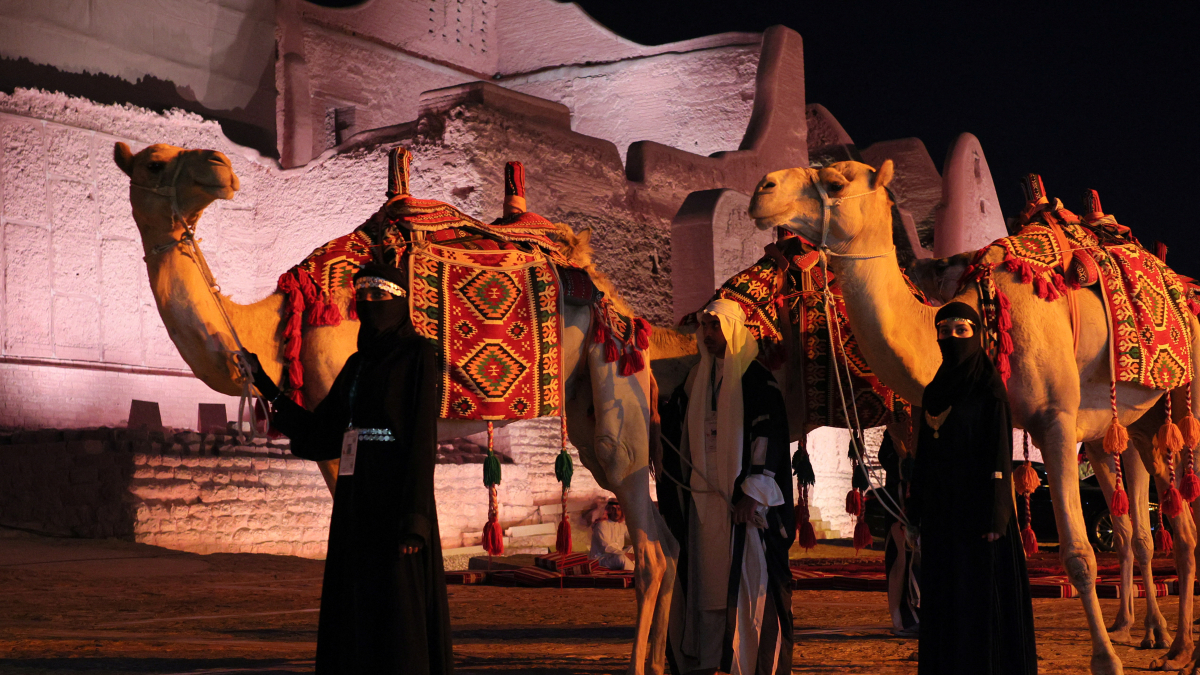
Visitors can explore AlUla Old Town, see Elephant Rock or attend events at Maraya, the mirrored concert and events venue built into the surrounding landscape.
The destination is also attracting significant visitor numbers. AlUla recorded around nine million visitor nights in 2025, with visitor nights forecast to grow by an average of 11 per cent a year through 2030.
 Visitors walk outside the tombs at the Madain Saleh antiquities site, al-Ula, Saudi Arabia, 10 February 2019.
Beyond heritage
Saudi Arabia’s tourism development also extends beyond historical and cultural sites.
Qiddiya City, being developed southwest of Riyadh, is planned as a major destination for entertainment, sport and outdoor activities. Its projects include theme parks, performance venues, sporting facilities and adventure attractions.
The Red Sea is another major part of the country’s tourism development, while major international events are adding to the country’s growing tourism calendar, including Expo 2030 and the 2034 FIFA World Cup.
The wider tourism figures point to a changing market. International visitor nights increased by 177 per cent between 2019 and 2025, while international leisure arrivals reached 7.6 million in 2025.

For decades, Saudi Arabia’s international tourism profile was closely linked to Makkah and Madinah, which remain the country’s largest destinations.
But Riyadh, Jeddah and AlUla are attracting an increasing number of visitors, while new projects and expanded visa access are widening the country’s leisure and international tourism offer.











What is your opinion on this topic?
Leave the first comment