The AnewZ Opinion section provides a platform for independent voices to share expert perspectives on global and regional issues. The views expressed are solely those of the authors and do not represent the official position of AnewZ
Poland has built much of its wartime image on one claim: it is Ukraine’s closest friend in Europe. There is truth in that claim.
Warsaw opened its borders. Polish society received millions of Ukrainians. The Polish state became one of Kyiv’s loudest advocates after Russia’s full-scale invasion. Poland has supported Ukraine’s EU and NATO ambitions, supplied military assistance and pushed Europe to take Moscow seriously.
That record matters.
But friendship in politics is not a sacred word. It is a field of interests.
And Ukraine should know this better than most.
Behind Poland’s language of solidarity sits a harder reality. Warsaw is not only helping Ukraine resist Russia. It is also trying to shape the terms of Ukraine’s future — economically, politically and historically.
That is where the problem begins.
Support can protect sovereignty.
It can also limit it.
The ally with conditions
Poland’s policy towards Ukraine now carries a visible contradiction.
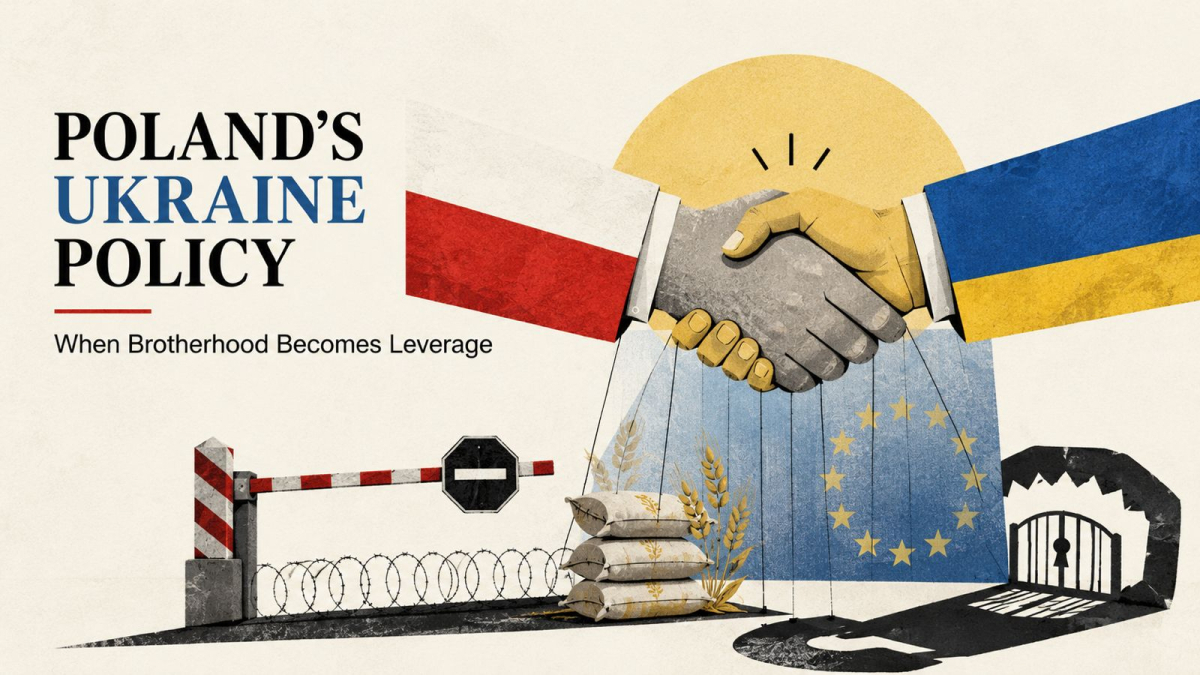
Publicly, Warsaw speaks of brotherhood, shared sacrifice and common resistance against Moscow. Practically, it has repeatedly used borders, trade, historical memory and EU politics to pressure Kyiv.
This does not make Poland Russia.
Russia is the aggressor. Russia occupies Ukrainian land. Russia kills to deny Ukraine’s independence. Poland does not do this.
But the fact that Poland is not Russia does not make every Polish move noble.
Warsaw’s methods are different. The logic is sometimes uncomfortably familiar: Ukraine is treated less as a fully equal partner and more as a smaller neighbour whose choices must be managed.
That is not solidarity.
That is leverage.
The border told the real story
The grain dispute exposed the limits of Polish brotherhood.
For Ukraine, agriculture is not just business. In wartime, it is one of the country’s economic lifelines. Every blocked crossing, every disrupted route and every restriction on agricultural products cuts into Ukraine’s ability to endure.
Yet in April 2023, Poland joined Hungary in banning imports of Ukrainian grain and other food products, arguing that cheap Ukrainian supply was hurting local farmers. The European Commission warned at the time that unilateral trade measures were unacceptable.
That was the first warning.
The second came in September 2023. When the EU decided not to extend temporary restrictions on Ukrainian grain, Poland, Hungary and Slovakia moved to keep their own national limits.
Then came the blockades.
In November 2023, Polish truckers began blocking border crossings with Ukraine. Their demand was clear: they wanted the EU to restore permit requirements for Ukrainian hauliers, whose access had been liberalised after Russia’s full-scale invasion. Farmers later joined the protests.
By February 2024, Polish farmers were enforcing a near-total blockade of parts of the Ukrainian border. Reuters reported that protesters opened railway carriages and allowed Ukrainian grain to pour onto the tracks — a gesture Kyiv condemned as political provocation.
This was not a symbolic dispute.
It hit Ukraine’s trade routes during war.
Poland’s domestic concerns were real. Its farmers faced pressure. Prices were affected. Anger moved from villages to highways, and then to the border.
But this is exactly the point.
Solidarity is easy when it costs nothing.
The test comes when another country’s survival collides with your own voters’ discomfort.
At that moment, Poland chose the border.
It chose protection.
It chose domestic politics.
For Kyiv, the lesson was clear: even its closest friends may stand with Ukraine only until Ukrainian interests begin to hurt their own.
Refugees are not a labour reserve
Poland often reminds Europe how many Ukrainians it has taken in.
It should be recognised for that.
But recognition should not silence criticism.
The treatment of Ukrainian refugees has gradually shifted from moral duty to economic calculation. That shift became visible in August 2025, when President Karol Nawrocki vetoed legislation extending benefits for Ukrainian refugees. His central argument was that Poland’s 800+ child benefit should be available only to Ukrainians who work in Poland.
To Polish voters, this may sound like fairness.
To Ukrainians, it sounds different.
It says: you are welcome if you work, useful if you fill gaps, tolerated if you do not cost too much.
That is not the language of brotherhood.
It is the language of labour management.
A refugee fleeing war should not have to prove economic value before being treated with dignity. Yet across parts of Polish politics, Ukrainians are increasingly discussed through the vocabulary of cost, pressure and usefulness.
First they were symbols of European solidarity.
Now they are becoming objects of domestic resentment.
That transformation matters.
Because it reveals how quickly compassion can become conditional once the cameras move elsewhere.
History as a political instrument
Then comes Volhynia.
The massacres of the 1940s remain a deep wound in Polish memory. Poland has every right to remember its victims. It has every right to demand historical honesty from Ukraine.
But there is a difference between historical justice and political pressure.
When Volhynia is tied to Ukraine’s European future, it stops being only a matter of memory. It becomes a tool.
This is not theoretical. Polish officials have repeatedly connected the issue of Volhynia, especially exhumations and remembrance, with Ukraine’s path towards the European Union. In 2024, Polish Defence Minister Władysław Kosiniak-Kamysz warned that Ukraine could not join the EU unless the Volhynia issue was resolved.
Ukraine later moved on the matter. Exhumation work began in the village of Puzhnyky in 2025, after years of dispute over the search for Polish victims.
That step matters.
But it does not erase the political pattern.
Ukraine’s path to the European Union should be judged by reforms, institutions and democratic standards — not by whether Kyiv satisfies the historical expectations of one member state.
Yet Poland has shown that historical memory can be brought into the political bargain. The result is clear: Ukraine’s EU path becomes vulnerable not only to legal conditions, but to national grievance.
That is not European principle.
It is national leverage dressed in moral language.
The old map still whispers
Poland does not officially claim Ukrainian territory.
That must be said clearly.
But official policy is not the whole story. Politics is also shaped by memory, nostalgia and old maps that never fully disappear.
In some Polish circles, Galicia and Volhynia are still discussed through the lens of historical Polish lands. The old Polish-Lithuanian Commonwealth remains part of a wider political imagination — one in which Poland sees itself as the natural leader of Eastern Europe.
This does not mean Warsaw is planning territorial revision.
There is no serious evidence that the Polish state is pursuing a territorial claim against Ukraine.
But influence does not always require annexation.
A neighbour can respect your borders on paper while still seeking power over your choices. It can defend your sovereignty against one threat while narrowing it from another direction.
Poland wants Ukraine safe from Russia.
But Poland also wants Ukraine inside a regional order where Warsaw has the strongest voice.
Those two aims can exist together.
And that is precisely why they deserve scrutiny.
The uncomfortable comparison
There is one comparison Poland will reject immediately: Russia.
And yes, the difference is enormous.
Russia attacks Ukraine with missiles, occupation and annexation. Poland uses markets, borders, welfare rules, historical pressure and EU politics. These are not the same tools. They do not carry the same moral weight.
But politics should not examine only tools.
It should examine assumptions.
Russia calls Ukraine a brotherly nation while denying its independence.
Poland calls Ukraine a brotherly nation while placing conditions around its economy, refugees and European future.
Russia speaks the language of history to justify domination.
Some Polish voices speak the language of history to demand concessions.
Russia wants Ukraine subordinated by force.
Poland does not seek that. But parts of its policy suggest another ambition: Ukraine as a dependent partner — grateful, weakened and responsive to Warsaw’s demands.
That is a softer form of control.
But it is still control.
Ukraine needs allies, not guardians
Ukraine cannot survive alone. It needs Poland. It needs Europe. It needs military, economic and diplomatic support.
But need should not be confused with silence.
Kyiv has the right to question the motives of its allies. It has the right to ask whether support is being turned into influence, and whether friendship is becoming hierarchy.
Poland has helped Ukraine.
It has also used Ukraine’s weakness to defend its own interests.
Both things can be true.
That is the reality of international politics. There are no pure friendships between states. There are interests, pressures, memories and calculations.
But if Poland wants to be seen as Ukraine’s friend, it must treat Ukraine as an equal state — not as a wounded neighbour to be managed.
A real ally does not use another country’s hour of need to tighten its grip.
It helps that country stand on its own feet.
Poland says it stands beside Ukraine.
The question is whether it stands beside Kyiv as a partner — or above it as a guardian.
For Ukraine, that distinction is not rhetorical.
It is sovereignty.













What is your opinion on this topic?
Leave the first comment