The AnewZ Opinion section provides a platform for independent voices to share expert perspectives on global and regional issues. The views expressed are solely those of the authors and do not represent the official position of AnewZ
Azerbaijan's entry into the regional consultative format gives Central Asia reach across the Caspian. But turning geography into power will require more than summits and corridors.
Maps have a habit of becoming political arguments.
For decades, the Caspian Sea appeared on most of them as Central Asia's western boundary: a body of water separating the region from the South Caucasus and Europe. The informal summit held in Cholpon-Ata on 31 July suggested a different reading. The Caspian is no longer merely an edge. It is becoming a hinge.
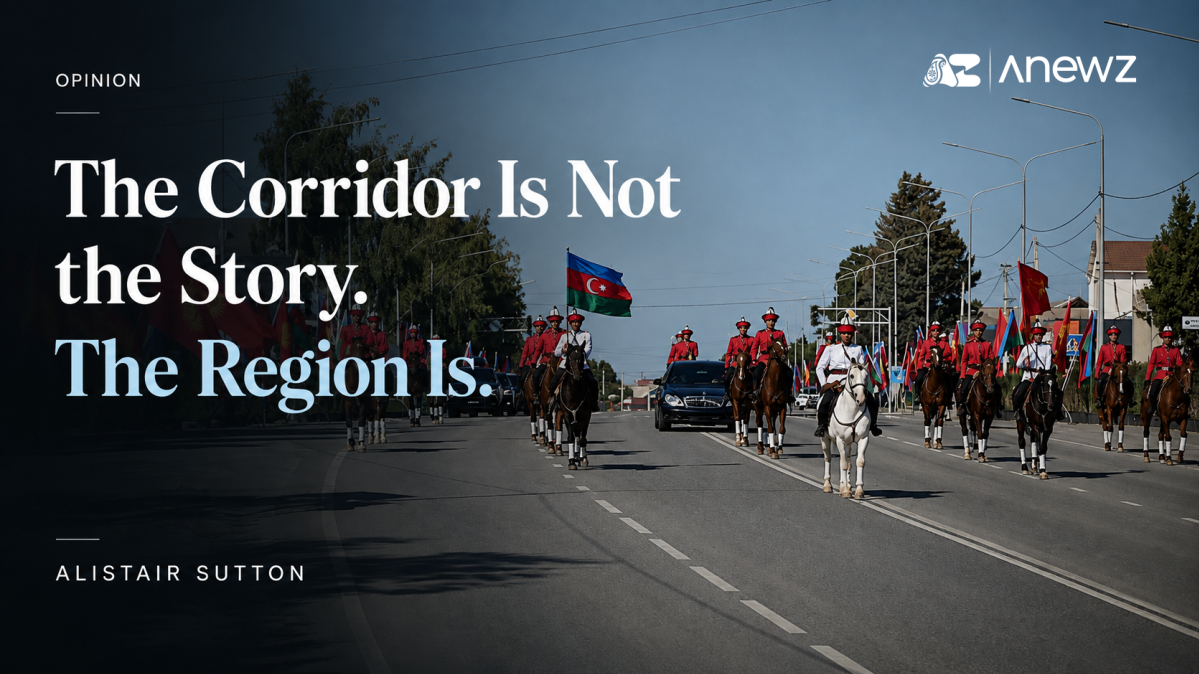
The presidents of Kazakhstan, Kyrgyzstan, Tajikistan, Turkmenistan and Uzbekistan met with Azerbaijan's President Ilham Aliyev under a format now formally described as the Consultative Meeting of the Heads of State of Central Asia and Azerbaijan. Aliyev had attended before as a guest. This time, following Azerbaijan's admission in Tashkent in 2025, he sat at the table as a full participant.
That distinction matters. Diplomatic labels are often dismissed as ceremony. Yet membership defines who belongs inside a political conversation and who remains outside it. Azerbaijan's inclusion does not simply add a sixth flag. It changes the geography of the format.
Central Asia gains a direct political link across the Caspian to the South Caucasus, Türkiye and European markets. Azerbaijan gains a deeper role in a region increasingly central to Eurasian transport, energy and strategic competition. Each side gives the other something it cannot easily create alone: Central Asia offers scale; Azerbaijan offers reach.
This is the larger story behind Cholpon-Ata in Kyrgyzstan. But it is not yet a finished one.
From trust to delivery
The Central Asian consultative process began in 2018 with a relatively modest purpose: to restore regular dialogue among neighbours whose relations had too often been constrained by border tensions, water disputes and competing national priorities. Its early achievement was not a railway or a trade agreement. It was trust.
That foundation is now being tested. The format has accumulated road maps, ministerial coordination and a Council of National Coordinators. A regional friendship treaty, first signed in 2022 by Kazakhstan, Kyrgyzstan and Uzbekistan, has since been joined by Tajikistan and Turkmenistan. In Cholpon-Ata, Kazakhstan's President Kassym-Jomart Tokayev called for an action plan with clear benchmarks to implement it.
The proposal exposed the central challenge. Regional cooperation can no longer be judged by the warmth of the summit photograph. It must be judged by what happens after the motorcades leave.
This shift from reconciliation to execution explains why Azerbaijan's participation arrives at an important moment. The format has largely succeeded in rebuilding political dialogue. It now needs projects that give that dialogue material weight. Azerbaijan brings experience, infrastructure and relationships that can help turn regional coordination outward.
President Aliyev gave a striking measure of the political intensity behind this process. Since the beginning of 2023, he said, he had visited Central Asian countries 16 times, while their leaders had visited Azerbaijan 26 times. Numbers alone do not prove integration. But this density of contact is difficult to dismiss as occasional diplomacy.
The question is what those meetings are building.
What Azerbaijan changes
Azerbaijan's value to the format begins with geography, but geography by itself is passive. A coastline is not a corridor. A port is not a strategy. Influence appears only when location is converted into systems.
Baku has spent years doing precisely that. The port of Alat, rail connections through Georgia and Türkiye, energy infrastructure to European markets and emerging digital links across the Caspian give Azerbaijan a role beyond that of a transit country. It is becoming an organiser of connections between regions that were long discussed separately.
This is why the Middle Corridor dominates so much of the conversation. The Trans-Caspian route links China and Central Asia to Europe through the Caspian Sea, Azerbaijan, Georgia and Türkiye. Its strategic appeal has grown as war, sanctions, insecurity in the Red Sea and supply-chain disruption have made dependence on any single route more dangerous.
The numbers show momentum. The Trans-Caspian International Transport Route Association reported that freight moved through the seaports of Kazakhstan and Azerbaijan reached 3.3 million tonnes in 2024, while container traffic rose sharply to 56,500 twenty-foot equivalent units. The number of container trains dispatched from China rose 33-fold over the previous year. Meanwhile, Kazakhstan and Azerbaijan are advancing a fibre-optic link across the Caspian, alongside discussions on a deep-sea electricity cable.
Steel, fibre and power are beginning to follow the same map.
Yet Azerbaijan changes more than logistics. Its participation gives Central Asia a partner that understands the politics of being located between larger powers. Baku has long balanced relations with Russia, Türkiye, Europe, China, Iran and the United States without surrendering its freedom of manoeuvre to any single centre. Central Asian states pursue different versions of the same strategy.
This creates a natural political language: not alignment, but options.
Kyrgyz test case
Aliyev's state visit to Kyrgyzstan, held alongside the regional meeting, showed how that language is becoming institutional.
Azerbaijan and Kyrgyzstan signed a Treaty on Allied Relations, elevating bilateral ties to their highest formal level. They also doubled the capital of their joint development fund from $100 million to $200 million. The wider package covered road transport, freight, shipping, shipbuilding, petroleum products, energy cooperation, cybersecurity, statistics, financial regulation and links between cities.
This matters because it moves the relationship beyond the familiar vocabulary of shared history and cultural kinship. Symbolism remains important. But symbols do not move goods, finance projects or protect digital infrastructure. Institutions do.
The fund is particularly revealing. Its value is not simply the amount committed. Its purpose is to create joint ventures, jobs and economic interests that survive changes in political mood. Kyrgyz President Sadyr Japarov said three projects had been inaugurated and eight more launched under the mechanism. The fund therefore offers a small but concrete model for the wider region: political closeness converted into shared assets.
The bilateral track also reveals a broader pattern. Azerbaijan is not entering Central Asia through one grand project. It is building a web of relationships - country by country, sector by sector, institution by institution. This is slower than a declaration. It may also prove more durable.
Corridor trap
There is, however, a danger in allowing the Middle Corridor to become a slogan that explains everything.
Corridors are seductive. They compress complicated politics into a clean line on a map. Yet cargo does not travel through lines. It travels through ports, rail gauges, customs systems, tariffs, schedules, weather conditions and bureaucracies. Every border adds friction. Every uncoordinated agency adds time.
The World Bank has estimated that the Middle Corridor could triple trade flows and halve travel times by 2030. But the important words are not "triple" and "halve". They are "could" and "if". The projection depends on investment, digitalisation, better coordination and the removal of operational bottlenecks.
This is where political ambition meets administrative reality.
A corridor can be strategically important and commercially frustrating at the same time. It can attract speeches faster than cargo. Governments may build terminals while neglecting common documentation. They may announce routes without ensuring predictable timetables. They may celebrate rising volumes while businesses still face uncertainty over costs and delays.
The enlarged consultative format will therefore be judged less by its ability to promote the Middle Corridor than by its ability to make the corridor boring: reliable, standardised and predictable. Successful infrastructure eventually disappears from political conversation because it simply works.
That is the real benchmark.
Not a bloc, but a bargaining position
Another mistake would be to interpret closer cooperation as the construction of an anti-Russian, anti-Chinese or anti-Western alliance.
The region's leaders have shown little interest in replacing one dependency with another. Russia remains deeply embedded in Central Asia through trade, labour, language and security ties. China is a major investor and market, as well as the eastern anchor of many transport projects. Europe offers capital, technology and demand. Türkiye provides political and cultural proximity. None can simply be excluded.
The emerging model is therefore not separation. It is diversification.
For much of the post-Soviet period, Central Asian states often negotiated with external powers individually. That gave larger partners a structural advantage. Better regional coordination does not eliminate the imbalance, but it can narrow it. A group that understands its shared interests can approach Moscow, Beijing, Brussels, Ankara or Washington with greater clarity and leverage.
Azerbaijan strengthens that position because it widens the available routes and partnerships. It does not liberate Central Asia from geography. No country can. It makes geography less restrictive.
This distinction is important. Strategic autonomy is not isolation. It is the ability to say yes without losing the ability to say no.
The Organisation of Turkic States also forms part of this architecture, but it should not be confused with the Central Asian consultative format. The Turkic organisation supplies identity, political affinity and a broader institutional network. The consultative process, by contrast, is rooted in regional ownership and includes Tajikistan, a Persian-speaking state, as a central participant. Their overlap can be useful, provided cultural language does not narrow an agenda that is fundamentally geographic and economic.
The strength of the Cholpon-Ata format lies precisely in its pragmatism. It is not built around ideology. It is built around proximity, shared vulnerabilities and the need to connect.
Institutional test
Its flexibility is also its weakness.
The consultative meetings do not require a large supranational bureaucracy or the transfer of sovereignty. This allows leaders to discuss sensitive issues without creating another rigid organisation. For a region protective of national independence, that is an advantage.
But informality can become an excuse for weak implementation. Agreements may depend too heavily on presidential momentum. Ministries may work at different speeds. National interests may diverge once costs have to be paid. Without transparent benchmarks, success can be declared without being measured.
Tokayev's call for a practical action plan is therefore more consequential than it appears. The region does not necessarily need another institution with a headquarters and flag. It does need deadlines, responsible agencies, interoperable regulations and public evidence of delivery.
The same applies to Azerbaijan's role. Baku should resist the temptation to define success through the number of visits or documents signed. Its value will be measured by whether it helps reduce transport time, expand trade, finance productive businesses, secure energy links and build digital infrastructure that countries actually use.
There is also a political risk. As Central Asia and Azerbaijan acquire greater geopolitical weight, outside powers will attach their own narratives to the process. Europe will describe it as connectivity. China may see an extension of Eurasian trade. Türkiye will emphasise Turkic solidarity. Russia may watch for signs of strategic displacement. The United States may frame it as diversification away from Moscow and Beijing.
The region should listen to all of them and belong to none of their stories completely.
A hinge, not a frontier
Cholpon-Ata did not create a new geopolitical region in a single day. Nor did Azerbaijan's membership erase the differences among six sovereign states. Their economies, alliances, political systems and external relationships remain distinct.
But something has changed.
Central Asia is increasingly attempting to define itself through coordination rather than through the ambitions of surrounding powers. Azerbaijan's inclusion gives that project an outlet across the Caspian and a stronger connection to the wider world. The bilateral alliance with Kyrgyzstan, the expanded development fund, the Cholpon-Ata Declaration and the push for practical implementation are separate events. Together, they point in the same direction.
The Caspian is becoming less of a divide and more of an organising space.
Whether this produces genuine geopolitical weight will depend on discipline. The region must avoid mistaking access for influence, announcements for institutions and construction for connectivity. A route is only as strong as its slowest border. A political format is only as credible as its least implemented decision.
Still, the strategic logic is difficult to ignore. Central Asia offers resources, markets and growing political coordination. Azerbaijan offers infrastructure, westward access and diplomatic reach. Their interests do not perfectly align. They do not need to. Durable cooperation is rarely built on perfect alignment. It is built on sufficient common purpose.
The old map placed the Caspian at the edge of Central Asia.
The emerging map places it at the centre of a wider trans-Caspian space.
A corridor can move cargo. Only institutions can move a region.
Read more:











What is your opinion on this topic?
Leave the first comment