The AnewZ Opinion section provides a platform for independent voices to share expert perspectives on global and regional issues. The views expressed are solely those of the authors and do not represent the official position of AnewZ
A storm in a teacup. Despite Ukrainian threats to attack the Victory Day parade in Moscow on 9 May, and Russia’s warning that it would bomb downtown Kyiv in retaliation, in the end nothing happened. But why?
Harsh rhetoric and saber-rattling rarely lead to serious escalation, but rather to an easing of tensions. Nowhere was this more obvious than during the active phase of the U.S.-Iran conflict, when U.S. President Donald Trump vowed to send the Islamic Republic “back to the Stone Ages.” But instead of destroying the country’s bridges, power stations, and other critical infrastructure, the United States pressured Iran into signing a ceasefire agreement. The same pattern seems to have unfolded between Ukraine and Russia, with Trump once again playing a major role.
While all eyes were on Moscow, which was preparing to hold what proved to be a very modest parade, Trump posted on his Truth Social account that there would be a three-day ceasefire between Russia and Ukraine from 9 to 11 May. The ceasefire, he stressed, would pause all kinetic activity and include the exchange of 1,000 prisoners from each side.
Simultaneously, Ukrainian President Volodymyr Zelenskyy published a decree supposedly removing Red Square from the list of potential Ukrainian military targets during the 9 May Victory Day celebrations in Moscow. Although the Kremlin’s spokesman Dmitry Peskov reacted immediately saying that “Russia needs no one's permission to hold Victory Parade,” in reality without Zelenskyy’s “goodwill gesture” there would be no safe ceremony in the Russian capital.
Kyiv has repeatedly demonstrated that it can carry out strikes deep inside Russia – often hundreds, if not thousands, of miles from the Ukrainian border – causing severe damage to the Russian military and to the country’s critical infrastructure facilities.
The fact that the European Union refused to evacuate its mission from the Ukrainian capital following threats by Russian Foreign Ministry spokesperson Maria Zakharova that Russia would strike “central Kyiv” if it attacked the parade in Moscow clearly suggests that no Western policymaker takes the Kremlin’s rhetoric seriously anymore.
Ukraine could have, therefore, indeed spoiled the event in Moscow, humiliating Russia as never before. But it didn’t. At the very last moment, it was Donald Trump who effectively helped Russian President Vladimir Putin hold the Victory Day parade- celebrating a victory with which he and his elite have nothing in common.
Trump is now expected to insist on an extension of the ceasefire, which is unlikely to happen. Although it is Russia that desperately seeks to freeze the conflict in a way that would allow Putin to save face, reaching a lasting ceasefire without seizing parts of the Donbas that are still under Ukrainian control would be seen as giving up on all the goals of his so-called “special military operation.”
A long ceasefire does not seem to benefit Ukraine either. Kyiv now has the initiative, at least when it comes to missile and drone strikes. Halting a campaign against the Russian military-industrial complex and energy infrastructure would only allow Moscow to strengthen its air defenses. Thus, under the current circumstances, for Trump to mediate a ceasefire similar to the one he reached with Iran would be easier said than done.
But from the Kremlin’s perspective, his ceasefire initiative was more than beneficial, as it allowed Putin to once again demonstrate that Russia is “not isolated,” as a handful of foreign leaders attended his parade in Moscow. In comparison, in 2005, more than 50 heads of state and leaders from 56 countries, including the then U.S. President George W. Bush, were among the guests at Putin’s Victory Day celebrations.
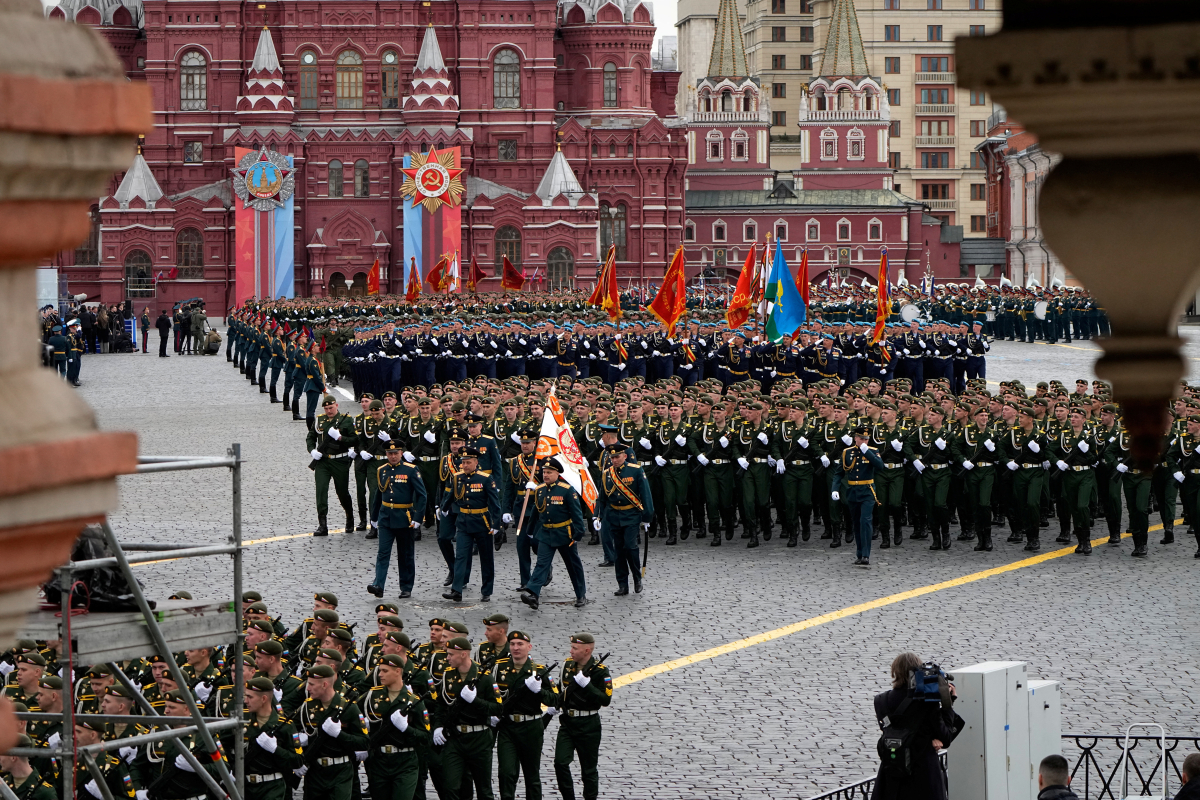
This year, the parade lasted only around 40 minutes, with no military hardware on display. Even for that low-key event, Putin needed de facto security guarantees from Ukraine and the United States. Significant parts of Russian society will undoubtedly see this as a humiliation.
The 9th of May is possibly the most significant secular holiday in Russia, celebrating the Soviet Union's victory over Nazi Germany in 1945. As a result of Putin’s actions in Ukraine, the Russian people do not feel as safe celebrating it as they did in the past.
According to reports, many members of the Russian elite also see that Putin’s war in Ukraine is going nowhere, and that Moscow, after more than four years, has not achieved any of its strategic goals in the Eastern European country.
But what the Kremlin seems to fear more are the so-called hardliners, who expect Russia to fundamentally change its approach to the war. Could it be that the ongoing tightening grip on the internet all over Russia is aimed at preventing potential unrest that might come from the pro-war faction?
One thing is certain- Putin’s policy has made the celebration of Victory Day meaningless. As a result of his invasion of Ukraine, Russia is no longer in a position to hold a ceremonial event in downtown Moscow without help from the United States.
Since in politics there is no such thing as a free lunch, it remains to be seen what the Kremlin will have to give its American partners in exchange.














What is your opinion on this topic?
Leave the first comment