The AnewZ Opinion section provides a platform for independent voices to share expert perspectives on global and regional issues. The views expressed are solely those of the authors and do not represent the official position of AnewZ
The deadly fire at Utumishi Girls Academy has exposed a hard truth: despite decades of warnings, many African boarding schools still leave children vulnerable to preventable disasters.
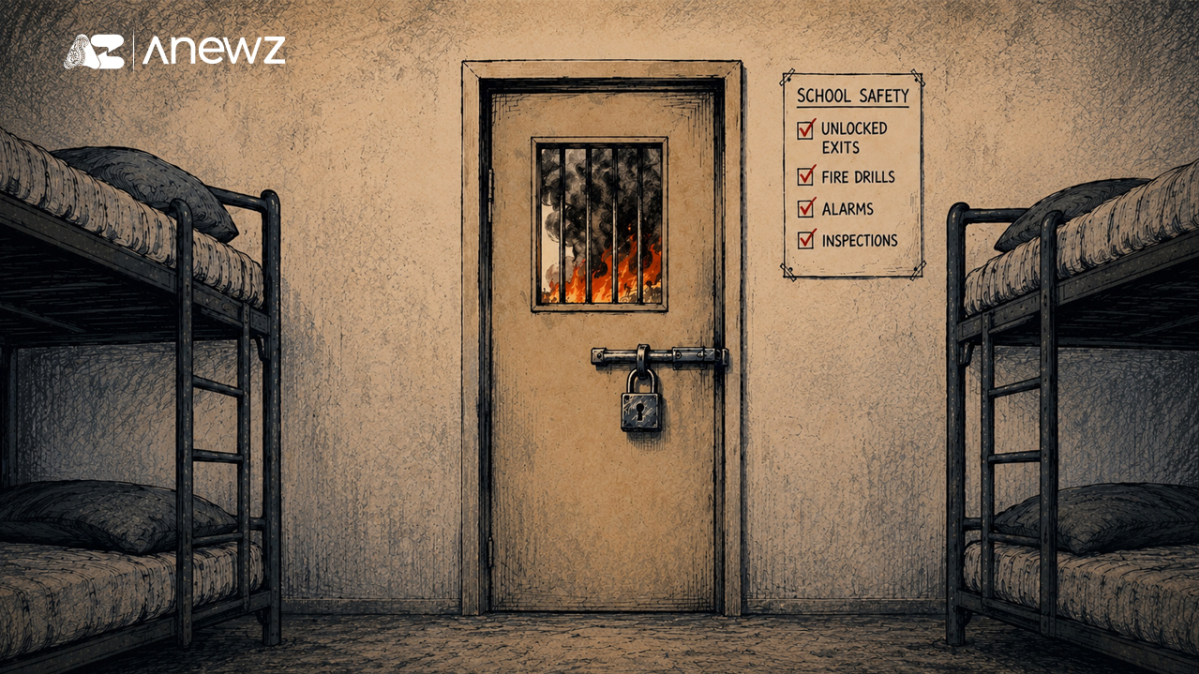
I was in primary school when the dormitory at Kyanguli Secondary School in Machakos, eastern Kenya, caught fire in the early hours of a March night in 2001. Fifty-seven boys died, many trapped as smoke filled the building and flames spread faster than anyone could respond. Investigators later found the doors had been padlocked and the windows fitted with metal grilles.
For weeks, the tragedy weighed heavily on the country. Parents with children in boarding schools called simply to hear their voices. Politicians promised action, and committees were formed with the kind of urgency that suggested things would be different in future. There was a shared sense that something like this could never be allowed to happen again. More than two decades later, that confidence looks badly misplaced.
The fire at Utumishi Girls Academy in Gilgil, in Kenya's Rift Valley, has killed 16 students and reopened questions that Kenya has never honestly answered. Details are still emerging, but the broad picture is familiar. Children who should have been safe in their dormitory were not.
Seven girls died at Moi Girls High School in Nairobi in 2017. Twenty-one boys were killed at Hillside Endarasha Academy in Nyeri in 2024. Each tragedy brought public grief, investigations and official promises. What has been far harder to find is any lasting change.
A policy choice, not a resource problem
Boarding schools sit at the centre of education across much of Africa, and for good reason. For many families, they represent the clearest path to better academic outcomes, offering structured environments, consistent supervision and access to facilities that many day schools cannot match. Parents make significant financial sacrifices to secure a place, trusting that, alongside education, their children will be kept safe.
That trust has been broken too many times.
In many Kenyan boarding schools, practices carrying obvious safety risks have existed for years without serious challenge. Dormitory doors are locked from the outside at night, sometimes for security reasons and sometimes to enforce lights-out. Windows are barred to prevent theft or unauthorised movement.
Each measure has a rationale. In a fire or any sudden emergency, however, that rationale can become deadly, leaving students with no way out and no time to find one. The deeper problem is not simply that these practices exist, but that they are tolerated until something goes wrong. Even then, the response rarely addresses the conditions that made the deaths possible in the first place.
In the aftermath of Kyanguli, attention focused largely on who started the fire. A decade later, when eight girls died at Asumbi Primary School in Homa Bay County, western Kenya, trapped behind grilled windows and a door they could not open, two officials lost their jobs. The grilles, the locked doors and the culture that produced them remained.
A continent-wide pattern
Kenya is not alone, and that is what makes the pattern particularly troubling.
Across sub-Saharan Africa, fatal dormitory fires have occurred with a regularity that should long ago have forced a continent-wide conversation. Uganda, Tanzania and Nigeria have all experienced incidents marked by the same features: overcrowded rooms, blocked or inadequate exits, little or no fire preparedness, and emergency services arriving after the worst had already happened.
In nearly every case, official inquiries followed. Findings were published and recommendations made. Yet when the next fire came, it often found the same doors locked and the same windows barred.
The will, not the wallet
The resource argument surfaces after almost every tragedy, and there is some truth to it. African governments face genuine constraints, and holding them to the same standards as wealthier countries without acknowledging that gap is not a serious position.
But the argument is often asked to carry more weight than it can bear.
Fire drills do not require major spending. A rule prohibiting dormitory doors from being locked from the outside is exactly that: a rule. Accessible emergency exits are not a technological challenge. These are matters of enforcement and political priority, and on both counts the record across much of the continent remains poor.
Some countries have performed better. South Africa has mandatory safety compliance requirements for school facilities, including fire safety provisions. Rwanda has invested heavily in educational infrastructure as part of broader reforms and treats school safety as a policy commitment rather than an afterthought.
Neither system is perfect. Both demonstrate that progress is possible when governments decide it matters.
Kenya has regulations on paper. The gap between those regulations and what happens inside school compounds at night remains substantial. Inspections are inconsistent, enforcement tends to come in bursts - usually after a tragedy attracts public attention - and then fades once the headlines disappear.
The cycle must end
At this point, it is difficult to describe the problem simply as a failure of response. The risks are well known and they keep resurfacing.
Parents sending children to boarding schools are not asking for guarantees. They understand that institutions carry risks. At the most basic level, they expect that a dormitory door can be opened from the inside and that somebody responsible has ensured that it can.
The students who died at Utumishi deserved that. So did the boys at Kyanguli, the girls at Moi, the children at Endarasha and the many others whose names never reached national headlines.
After every school fire, the conversation focuses on what happened. The more important question is why the same conditions continue to produce the same deaths years apart - and why the answers offered after each tragedy never seem to reach the dormitory door.


























What is your opinion on this topic?
Leave the first comment