The AnewZ Opinion section provides a platform for independent voices to share expert perspectives on global and regional issues. The views expressed are solely those of the authors and do not represent the official position of AnewZ
For much of the post-Soviet era, Russia and Kazakhstan have maintained one of Eurasia’s most stable bilateral relationships. Deep economic ties, shared history and strategic geography continue to bind the two neighbours together, but Astana is increasingly pursuing a more independent path.
They share the world’s second-longest continuous land border. They are linked by extensive economic ties, energy networks, transport routes and decades of Soviet history. These connections are not easily undone.
But stability should not be mistaken for subordination.
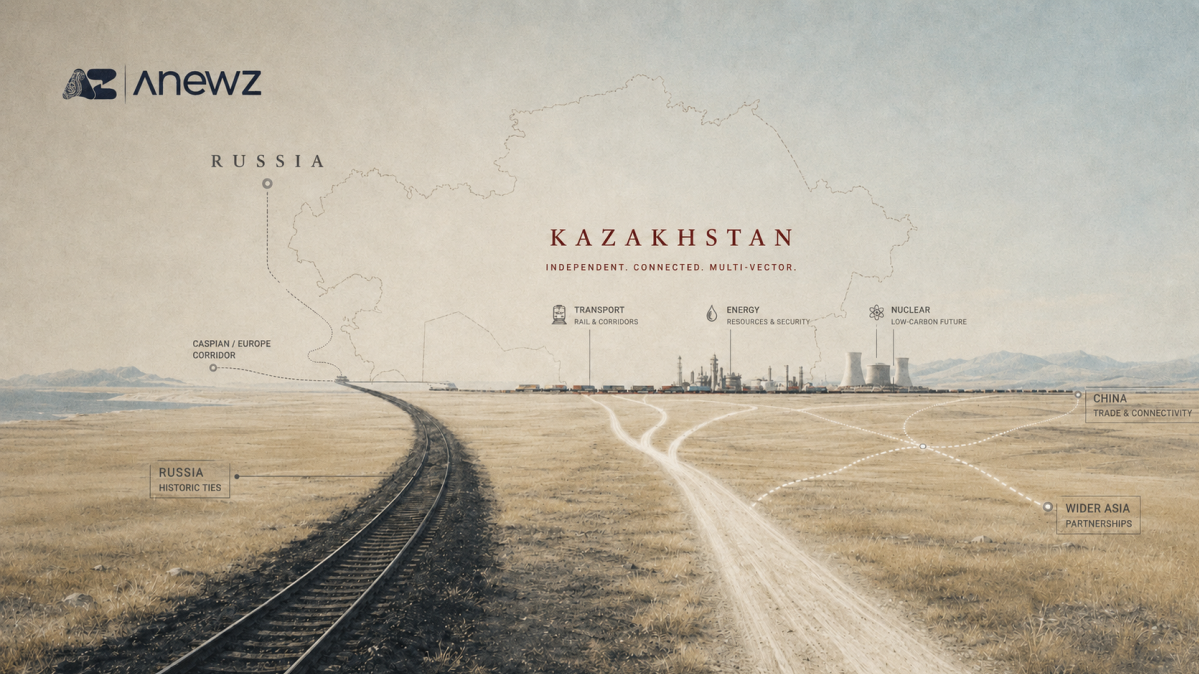
Under President Kassym-Jomart Tokayev, Kazakhstan has pursued a more independent and diversified foreign policy. Astana continues to value its relationship with Moscow. At the same time, it has expanded cooperation with China, Türkiye, the Gulf states, Europe and other regional and global actors. Kazakhstan remains one of Russia’s most important partners, but it is no longer willing to act as a passive participant in a purely Russian-centred regional order.
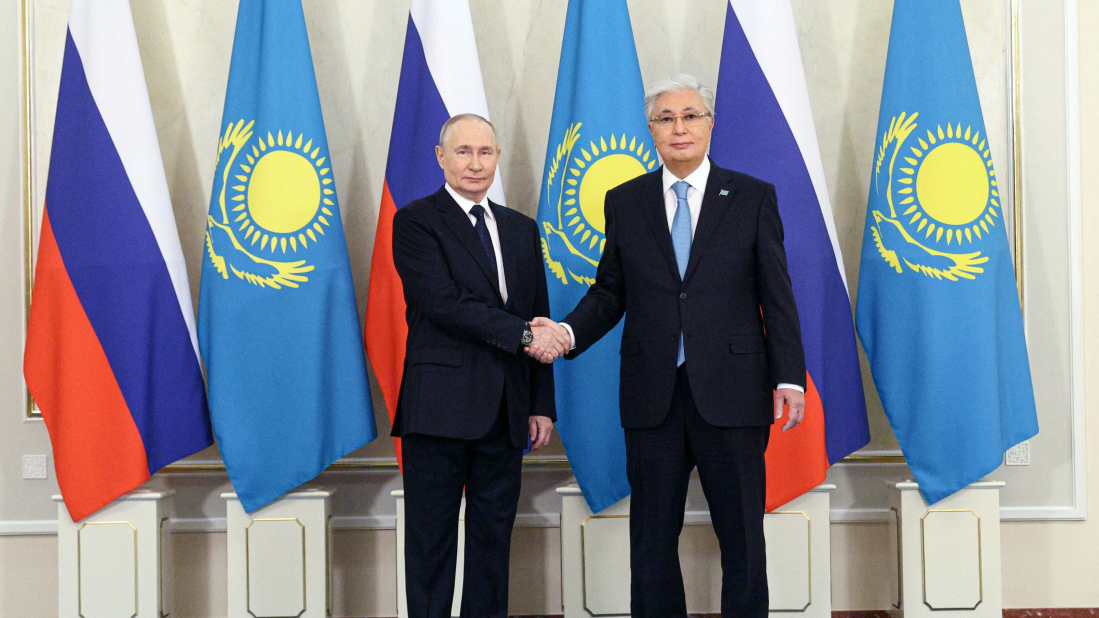
The latest meeting between Russian President Vladimir Putin and President Tokayev in Astana demonstrated that both sides still attach significant value to the relationship. On 28 May, the two leaders adopted a declaration outlining seven principles of friendship and good-neighbourliness. The symbolism was clear. Moscow and Astana wanted to project continuity at a time when Russia remains under pressure from much of the West.
For Russia, Kazakhstan offers economic opportunity, logistical access to Asian markets and a stable regional partner. For Kazakhstan, Russia remains a neighbour that cannot be ignored, a security actor that cannot be dismissed and an economic partner that still matters.
Yet beneath the diplomatic ceremony lies a more complicated reality. Russia continues to behave like a traditional great power seeking to preserve influence. Kazakhstan increasingly acts like a fast-developing middle power seeking to preserve autonomy.
History and sovereignty
To understand contemporary Kazakh foreign policy, one must look beyond current diplomacy. History still speaks in Astana.
The Kazakh famine of 1930–1933 remains one of the deepest wounds in the national memory. During Stalin’s collectivisation campaign, millions of Kazakhs faced displacement, imprisonment, starvation and death. Historians estimate that roughly one-third of the Kazakh population perished. The catastrophe transformed Kazakhstan’s demographic and social structure and remains central to the country’s understanding of sovereignty.
Another Soviet legacy is nuclear testing at Semey, formerly known as Semipalatinsk. Between 1949 and 1989, hundreds of nuclear tests were conducted on Kazakh territory. Communities were exposed to radiation, and the health and environmental consequences continue to shape public memory.
These experiences matter. For Kazakhstan, sovereignty is not merely a legal concept. It is linked to survival, historical memory and a determination to avoid a return to external control.
This helps explain why Tokayev repeatedly emphasises sovereignty while maintaining close ties with Russia. It also explains why many Kazakhs view foreign policy independence as a national interest rather than a temporary political preference.
Moscow appears to recognise these sensitivities. Recent Russian-Kazakh agreements have emphasised equality, mutual respect and good-neighbourly relations. Excessive pressure on Kazakhstan could generate resistance rather than loyalty.
A partnership built on necessity
Despite frequent predictions of a widening rift, the foundations of Russian-Kazakh relations remain strong. Trade continues to grow. Joint enterprises operate across both economies. Transport corridors linking Europe, Russia, Central Asia and China make cooperation a practical necessity.
For Moscow, Kazakhstan occupies a unique strategic position. It is Russia’s most important partner in Central Asia, a major transit route to China and a member of both the Eurasian Economic Union (EAEU) and the Collective Security Treaty Organization (CSTO).
The latest talks in Astana underlined this importance. The two sides signed agreements covering transport, energy, education, finance, industrial cooperation and cross-border development. Both governments continue to describe the relationship as a strategic partnership.
The strongest evidence of continued cooperation may be found in the energy sector. Russia’s state nuclear corporation, Rosatom, secured a major role in Kazakhstan’s first nuclear power plant near Lake Balkhash. Worth billions of dollars, the project will connect Russian technology, financing, fuel supply and maintenance services to Kazakhstan’s energy sector for decades.
From Moscow’s perspective, this represents a strategic success. Russia gains long-term influence in one of the most sensitive sectors of Kazakhstan’s economy. Yet Astana also demonstrated its familiar balancing strategy by keeping nuclear cooperation with China on the table. Rather than choosing one Eurasian giant over another, Kazakhstan continues to seek room to work with both.
Lessons from 2022
The legacy of the January 2022 unrest also remains relevant. During those turbulent weeks, Tokayev requested assistance from the CSTO. Troops from Russia and other member states were rapidly deployed. Many observers interpreted the intervention as evidence that Kazakhstan would become increasingly dependent on Moscow.
The years that followed told a more complex story.
Tokayev did not recognise Russian-backed entities in eastern Ukraine. He maintained dialogue with Western partners, strengthened ties with the Turkic world and continued to promote Kazakhstan’s multi-vector diplomacy. Russian influence remains significant, particularly in security, intelligence and military affairs. However, cooperation with Russia has not automatically translated into political dependence.
One of the most important questions now concerns the future of Eurasian integration.
For Putin, the Eurasian Economic Union is more than a trade arrangement. Established in 2015, it was designed to deepen integration among former Soviet republics and reinforce Russia’s role as a leading Eurasian power.
Kazakhstan remains an active participant in the EAEU. However, Astana views the organisation through a pragmatic lens. It is useful for trade, transport, investment and labour mobility, but it does not define Kazakhstan’s broader foreign policy identity.
This is where Astana’s approach diverges from Moscow’s. Russia often favours integration centred on Moscow-led institutions. Kazakhstan seeks to remain within those institutions while simultaneously developing alternatives.
Balancing Moscow, Beijing and beyond
The Middle Corridor is central to this strategy. The route links China to Europe through Kazakhstan, the Caspian Sea, Azerbaijan, Georgia and Türkiye. It reduces dependence on Russian-controlled transport networks and gives Astana greater strategic flexibility.
Kazakhstan has also strengthened cooperation with the Organisation of Turkic States, expanded ties with Gulf countries and deepened economic engagement with Europe. Its diplomacy reflects a pragmatic logic: it seeks flexible partnerships rather than exclusive alignments.
For Moscow, this diversification is not entirely comfortable. Russia would prefer Kazakhstan to remain firmly anchored within Moscow-led structures. Kazakhstan wants access to those structures, but not confinement within them.
If Kazakhstan’s twentieth-century challenge was managing its relationship with Moscow, its twenty-first-century challenge may be balancing Moscow and Beijing simultaneously.
China’s economic presence continues to reshape Central Asia. Kazakhstan occupies a central position in the Belt and Road Initiative. Chinese investment, infrastructure projects, transport corridors and energy cooperation have expanded significantly over the past decade.
Yet Kazakhstan has also avoided becoming dependent on China. Tokayev’s strategy can best be described as balanced diversification. Russia remains essential because of geography and security considerations. China provides investment and market access. Europe offers technology and capital. Türkiye provides cultural and political partnership, while Gulf states contribute financing and growing economic engagement.
Kazakhstan is not choosing a single camp. It is seeking to benefit from several. In that sense, it has become one of the clearest examples of how medium-sized states navigate an increasingly multipolar world.
An evolving relationship
The future of Russian-Kazakh relations will depend on adaptation. Putin’s visit demonstrated once again that Russia remains indispensable to Kazakhstan in many areas. It also showed that Kazakhstan remains indispensable to Russia’s Eurasian ambitions. Neither side can afford a serious rupture.
For Moscow, the challenge is evolving. It is no longer simply about preserving a sphere of influence. It is about learning how to work with a partner that values friendship while insisting on sovereignty.
Kazakhstan is not leaving Russia behind. But it is no longer walking solely in Russia’s shadow.











What is your opinion on this topic?
Leave the first comment