The AnewZ Opinion section provides a platform for independent voices to share expert perspectives on global and regional issues. The views expressed are solely those of the authors and do not represent the official position of AnewZ
Against a backdrop of mounting environmental pressure across Central Asia, the Kazakh Ministry of Ecology and Natural Resources has announced that the Regional Ecological Summit (RES) 2026 will take place from 22–24 April in Astana.
The summit is expected to bring together more than 1,500 participants from governments across the region, international organisations, development institutions, business, civil society and the expert community, creating a high-level international platform to coordinate regional solutions to shared climate and environmental challenges.
While Central Asia faces a range of ecological challenges, including shrinking water resources and the degradation of dryland ecosystems, the region’s states increasingly recognise the interconnected nature of climate, technology, and economic pressures. In response, Kazakhstan, together with neighbouring countries, has taken the lead in advocating greater collaboration and regional integration to confront these shared threats.
Central Asian countries increasingly push environmentally oriented projects and initiatives through various cooperation formats, notably the Organization of Turkic States (OTS). For example, during the OTS leaders’ summit in Gabala in 2025, all member countries stressed the importance of cooperation in the field of artificial intelligence (AI) and promoted the integration of AI, green and digital technologies, and smart manufacturing systems into industrial strategies of member states.
The OTS’s shift to ecological challenges and alternative energy resources marks a significant evolution for an organisation that primarily focused on cultural-linguistic and economic dimensions. Moreover, these important efforts are a response to practical challenges facing landlocked Central Asian states.
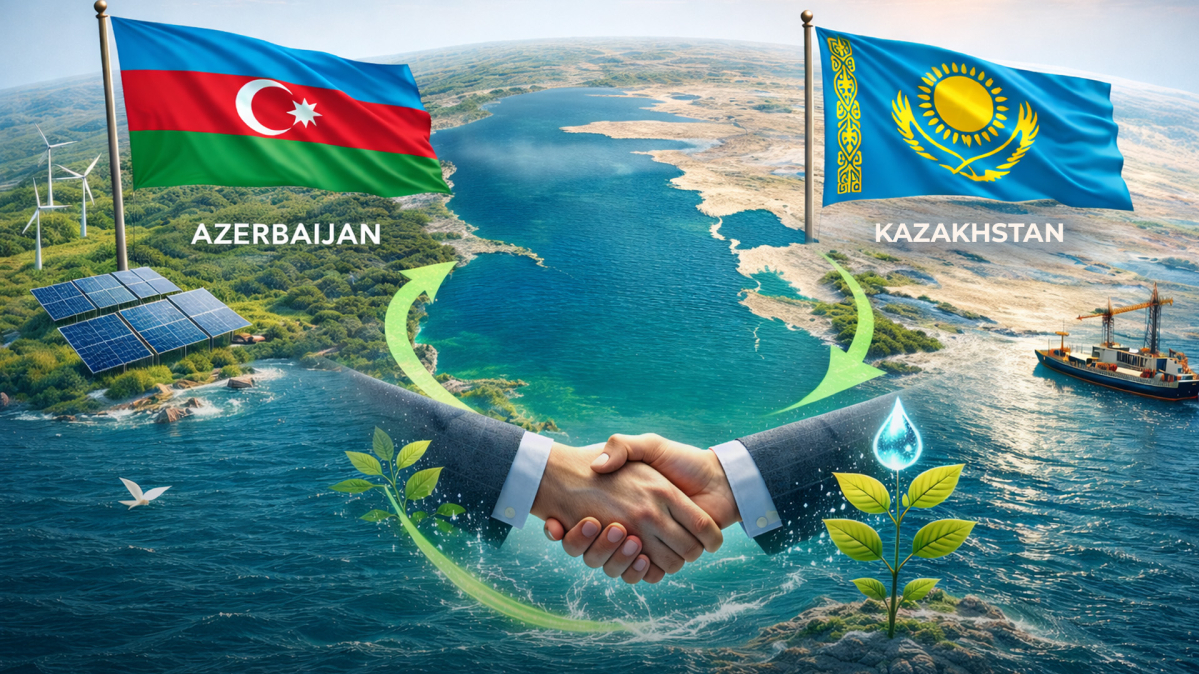
Given the complexity of environmental issues, Central Asian states, namely Kazakhstan, sought to diversify their partnerships with countries in the wider region for long-term results. In this vein, Azerbaijan appeared to be a viable partner for Astana in addressing the existing environmental problems, such as decreasing water levels in the Caspian Sea.
Recently, the Azerbaijani government highlighted these growing environmental risks during the United Nations discussions in Geneva, as new international rules governing large infrastructure projects around the region come into force. Indeed, the Caspian’s water level instability poses a significant threat to both the environment and the future economic development of all littoral states.
Moreover, the Caspian Sea lies at the heart of key Europe-Asia energy and transport corridors, such as the Middle Corridor, making its environmental integrity a matter of global concern. Stronger oversight is therefore essential to safeguard against habitat loss, pollution, and water-level fluctuations that threaten both fragile ecosystems and the region’s economic connectivity.
Azerbaijan and Kazakhstan serve as pivotal connectors between Central Asia, the Caucasus, and Europe, underscoring the strategic importance of maritime infrastructure development. Both Baku and Astana recognise that trade and the environment are deeply intertwined, shaping their approaches to regional cooperation and sustainable growth.
The Caspian Sea, along with its port infrastructure, is a vital asset for all littoral states, serving as a cornerstone of sustaining international trade flows. Thus, to ensure that both countries’ investments in infrastructure construction and upgrade are fruitful, Baku and Astana are engaged in a critical partnership over the Caspian Sea’s environment.
As such, it's reported that Kazakhstan’s Minister of Ecology and Natural Resources, Yerlan Nyssanbayev stated that Kazakhstan and Azerbaijan are exploring environmental cooperation in a number of areas, including the development of satellite monitoring systems for oil spill prevention and response, the application of digital and innovative environmental technologies, water resource management, and the exchange of experience in biodiversity protection.
In this context, the Kazakh Research Institute of the Caspian Sea is set to expand scientific collaboration among the Caspian littoral states, including Kazakhstan and Azerbaijan.
Although the Caspian Sea’s natural resources make it a strategically important asset for all littoral states, a loss of water could severely affect the regional climate, leading to reduced rainfall and drier conditions across Central Asia, with dire impacts on agriculture.
Hence, the current negative climate tendencies around the Caspian basin emboldened Azerbaijan and Kazakhstan to diversify their partnership with relevant international institutions in this field. For that purpose, the World Bank introduced the Environmental and Social Management Framework (ESMF) as part of the ‘Blueing the Caspian Sea’ Project in 2025. The project aims to provide technical assistance to establish national-level consultative and collaborative mechanisms for the private and public sectors in the oil and gas industry, as well as other sectors, notably those active in the Caspian Sea, regarding environment and marine resources.
Kazakhstan’s active efforts to preserve the Caspian Sea habitat, linking infrastructure governance with environmental responsibility in partnership with other countries, and its preparations for the upcoming Regional Ecological Summit in Astana position the country as a reliable, forward-looking partner in safeguarding one of the world’s most unique inland seas.

















What is your opinion on this topic?
Leave the first comment