Kazakhstan has significantly expanded its international air connectivity last year, reopening and launching flights to 30 countries according to data released by the country’s transport authorities. By the end of 2025, Kazakhstan was operating 135 international routes.
The latest report also shows there were a total of 626 flights per week. The international network now covers the Commonwealth of Independent States (CIS), Europe, the Middle East, Asia and Southeast Asia.
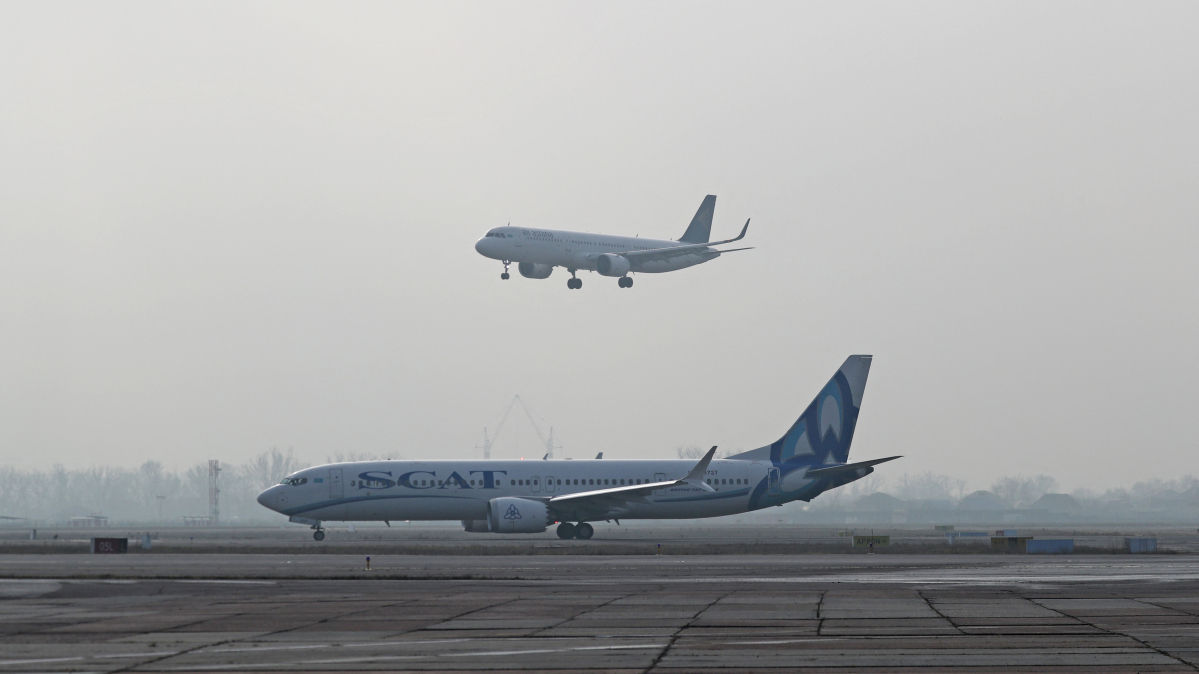
The growth of international routes has been supported by an expansion of the national airline fleet. Official figures show that in 2025 the combined fleet of Kazakh airlines reached 109 aircraft, including eight new Airbus A320s and four Boeing 737 MAX 8 jets.
Several new low-cost carriers also entered the market, contributing to increased competition and improved connectivity. Over the year, more than 35 new international routes were launched, including flights to Budapest, Shanghai, Seoul, Guangzhou and Munich.
At the same time, authorities advanced a number of major airport infrastructure projects. Government presentations confirmed the resumption of restoration work at Arkalyk Airport, while a new master plan for the development of Almaty International Airport was unveiled alongside an investment programme by TAV Airport Holding valued at $362 million.
In parallel, an investment agreement was signed for the construction of a combined cargo and passenger airport within the Khorgos-Eastern Gate special economic zone, with total investments estimated at approximately $550 million.
Regulatory and safety performance also improved. According to the results of an audit conducted by the International Civil Aviation Organization, Kazakhstan achieved a compliance rate of 95.7% with international standards for aviation safety and facilitation.
These developments form part of a broader transport strategy aimed at reinforcing Kazakhstan’s position as a key link between Europe and Asia. The authorities continue to position the country as a land bridge across Eurasia by developing international transport corridors running East–West, North–South and along the Trans-Caspian International Transport Route.
Infrastructure upgrades, fleet modernisation and the introduction of digital solutions in transport monitoring have contributed to the expansion of transit capacity.
According to the official transport statistics, by the end of 2025 total transit cargo volumes through the country reached 36.9 million tonnes, which is an increase of 6.6% compared with 34.6 million tonnes in 2024.
Progress was also recorded in international road transport. Government data show that Kazakhstan expanded the geography of cross-border road haulage by concluding intergovernmental agreements with 42 countries, enabling annual exchanges of transport permits.
A permit-free system was introduced with Turkmenistan, while bilateral and transit arrangements were agreed with Iran.
An agreement was also reached with Türkiye, and Kazakhstan became the first country authorised to carry out transit road transport deep into Chinese territory.
Today, 11 major international transport corridors pass through Kazakhstan, including five rail and six road routes. These include the Northern Corridor, the Eurasian Route, the North-South corridor and the Trans-Caspian route.
According to sector estimates, around 80% of overland freight traffic between Asia and Europe transits through Kazakhstan, reinforcing its position as one of the key overland transit hubs on the Eurasian continent.


















What is your opinion on this topic?
Leave the first comment