The AnewZ Opinion section provides a platform for independent voices to share expert perspectives on global and regional issues. The views expressed are solely those of the authors and do not represent the official position of AnewZ
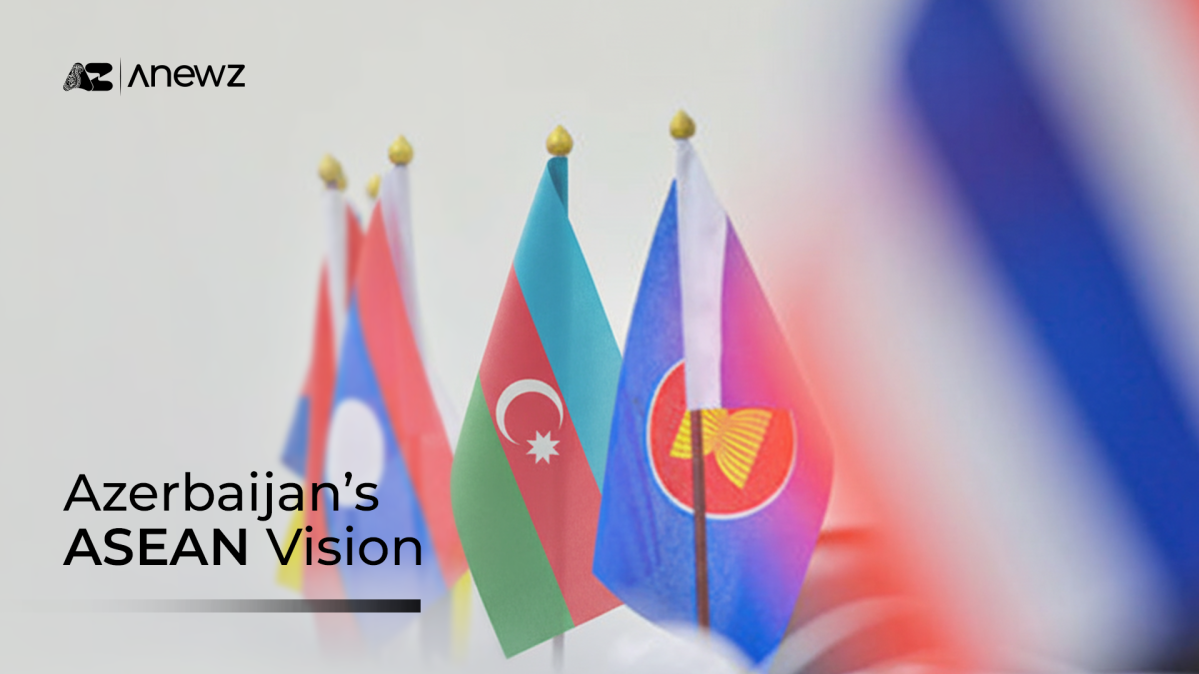
In an era of accelerating geopolitical realignments and shifts in the global economy, Azerbaijan is expanding its foreign policy beyond traditional regional confines. Southeast Asia has emerged as a key frontier in this evolving multi-vector strategy.
The Association of Southeast Asian Nations (ASEAN), comprising ten member states spanning from the resource-rich archipelagos of Indonesia and the Philippines to the manufacturing powerhouses of Vietnam and Thailand, represents a collective entity with a combined population exceeding 670 million and a nominal GDP surpassing four trillion U.S. dollars.
This demographic and economic weight positions ASEAN not merely as a substantial market opportunity but as a key actor in shaping multilateral norms and regional governance structures across the broader Asia-Pacific region. For Azerbaijan - a nation situated at the crossroads of Europe and Asia with long-standing ambitions of serving as a bridge between civilisations - engagement with ASEAN offers multifaceted opportunities. These include access to dynamic emerging markets, diversification of economic partnerships beyond hydrocarbon dependence, and potential integration within a rules-based, cooperative regional framework through accession to the Treaty of Amity and Cooperation in Southeast Asia (TAC).
This strategic recalibration, which has deepened from initial overtures in 2022 to evolving parliamentary diplomacy and bilateral engagement in early 2026, reflects Azerbaijan’s broader ambition. Baku aims to transcend geographic constraints and diversify its partnerships, positioning itself as a genuinely transcontinental player in an increasingly multipolar international system.
After gaining independence from the Soviet Union in 1991, Azerbaijan methodically constructed an extensive network of diplomatic relations with 177 countries. Despite regional security challenges and geographic limitations, Baku has positioned itself as an active and increasingly influential participant in international affairs. This approach has proved valuable in developing robust bilateral relationships with several ASEAN member states, laying the groundwork for more ambitious multilateral cooperation frameworks.
Toward deeper ASEAN engagement
The Azerbaijan–Singapore partnership agreement, signed on 29 October 2024, stands as a notable example of this diplomatic engagement. It encompasses comprehensive cooperation across digital governance modernisation, small and medium-sized enterprise digitalisation programmes, tax administration reform, and sustained parliamentary exchanges that build institutional linkages beyond the executive branches.
A particularly significant milestone was the memorandum of understanding signed between Azerbaijan’s Agency for Innovation and Digital Development and Singapore’s Cooperation Enterprise. The agreement operationalises knowledge exchange in advanced regulatory technology applications and digital public service delivery. Singapore’s technical expertise in these domains could accelerate Azerbaijan’s ongoing institutional reform agenda and broader digital transformation across the public sector.
Relations with Brunei Darussalam, formally established through diplomatic recognition in 1995, have evolved beyond ceremonial ties into a more substantive partnership. Both nations are participants in the OPEC+ framework, reflecting shared interests in energy market stability and strategic alignment in hydrocarbon sector management.
Meanwhile, ties with Indonesia - formalised through the establishment of diplomatic relations in 1992 - have been notably strengthened by Jakarta’s consistent and vocal support for Azerbaijan’s position on territorial integrity in relation to the protracted Garabakh conflict. This backing has helped build bilateral trust and political goodwill, reaffirmed during a meeting between President Ilham Aliyev and Indonesian House Speaker Puan Maharani, which underscored a mutual commitment to expanding cooperation in defence, education and cultural exchange.
Establishing a roadmap
A critical milestone came in December 2022, when Azerbaijan’s Deputy Foreign Minister, Elnur Mammadov, met ASEAN Secretary-General Dato Lim Jock Hoi in Jakarta. The meeting marked the first formal articulation of Azerbaijan’s intention to institutionalise its relationship with ASEAN. It established a roadmap grounded in mutual respect for sovereignty and territorial integrity, a commitment to peaceful dispute resolution, recognition of economic interdependence and appreciation for cultural diversity. The timing - ahead of Indonesia’s assumption of the 2023 ASEAN chairmanship - positioned Baku as a credible and forward-looking partner.
Following this breakthrough, Azerbaijan obtained observer status in the ASEAN Inter-Parliamentary Assembly, representing a qualitative shift from primarily bilateral diplomacy to structured multilateral participation.
Azerbaijan’s diplomatic trajectory in late 2025 and early 2026 also saw deeper integration with Central Asia, indirectly reinforcing its ASEAN ambitions. On 16 November 2025, at the Tashkent Summit, Azerbaijan secured full membership in the Central Asian Consultative Meetings format alongside Kazakhstan, Kyrgyzstan, Tajikistan, Turkmenistan and Uzbekistan. This strengthened its role as a pivotal node in the Trans-Caspian International Transport Route, streamlining logistics for ASEAN exporters seeking access to European and Central Asian markets.
While a formal application for TAC accession has yet to materialise, economic indicators remain robust. Foreign direct investment inflows reached 4.736 billion U.S. dollars from January to September 2025, up 4.7 per cent year on year. Outward investment has increasingly targeted Asian markets, including Southeast Asia. The United Nations has projected GDP growth of 2.7 per cent for 2026, signalling economic stability that may appeal to ASEAN partners seeking energy security and supply chain diversification.
The logic of TAC accession
This deepening Central Asian engagement provides a complementary foundation for closer ASEAN cooperation under the TAC framework. Adopted on 24 February 1976 during the first ASEAN Summit in Bali, the TAC has evolved from a regional code of conduct into a cornerstone of ASEAN’s diplomatic architecture. Originally designed to formalise principles of peaceful coexistence, non-interference and mutual respect among member states, it later became the foundation for engagement with external partners.
The accession mechanism - opened to non-ASEAN states and joined by dozens of countries - has transformed the treaty into a diplomatic bridge between Southeast Asia and the wider Asia-Pacific. The incorporation of TAC principles into the ASEAN Charter in 2007 further strengthened its legal and institutional significance.
In practical terms, the TAC framework enables non-ASEAN states to participate in ASEAN-centred political and economic processes without full membership. Accession signals adherence to ASEAN’s guiding principles, facilitating dialogue partnerships and expanding access to trade, connectivity and development initiatives. For external partners, the TAC is not merely symbolic; it serves as a gateway into Southeast Asia’s institutional ecosystem.
Within this context, Azerbaijan’s engagement takes on strategic significance. ASEAN’s large and increasingly affluent population represents substantial untapped market potential. TAC accession would facilitate engagement with the bloc as a whole, reduce bureaucratic friction and align with Azerbaijan’s broader strategy of reducing reliance on hydrocarbons.
ASEAN’s strengths in advanced manufacturing, digital infrastructure, financial technologies and sustainable agriculture present valuable opportunities for collaboration. Knowledge transfer in these sectors could accelerate Azerbaijan’s transition towards a more competitive, diversified non-oil economy.
Support for energy objectives
Moreover, by aligning its Eurasian connectivity agenda - particularly the Middle Corridor and Digital Silk Way - with ASEAN’s principles of cooperative regionalism, Azerbaijan can position itself as a complementary transit and energy partner. Offering alternatives to maritime chokepoints such as the Strait of Malacca, Azerbaijan provides ASEAN economies with greater diversification of trade routes, potentially shorter transit times to Europe and reduced exposure to geopolitical disruption.
In the energy sector, Azerbaijan’s experience in both fossil fuels and renewables could support ASEAN’s energy security and green transition objectives. Joint ventures and infrastructure partnerships may bolster resilience amid volatile global energy markets.
The Digital Silk Way also creates platforms for cooperation in information technology, cybersecurity, smart logistics and digital governance - all sectors critical to ASEAN’s continued development. Crucially, Azerbaijan offers ASEAN strategic access to the South Caucasus and Central Asia. Enhanced transport and digital connectivity could allow ASEAN exporters to diversify trade routes, mitigate maritime chokepoint risks and expand into emerging Eurasian markets.
Looking ahead, the formalisation of Azerbaijan’s relationship with ASEAN through potential TAC accession would represent a watershed moment - not only for Azerbaijani foreign policy, but for the broader architecture of Eurasian–Southeast Asian cooperation. Such a development would reinforce ASEAN’s relevance as a platform capable of attracting diverse partners into its rules-based framework. At the same time, it would demonstrate Azerbaijan’s successful execution of a multi-vector strategy that broadens partnerships without compromising sovereignty or core national interests.
The path forward will require sustained diplomatic effort, institutional capacity-building and tangible deliverables in trade, infrastructure and technology cooperation. Yet as both sides increasingly recognise the mutual benefits of structured engagement, the prospect of deeper institutional ties appears not only viable, but strategically compelling.
















What is your opinion on this topic?
Leave the first comment