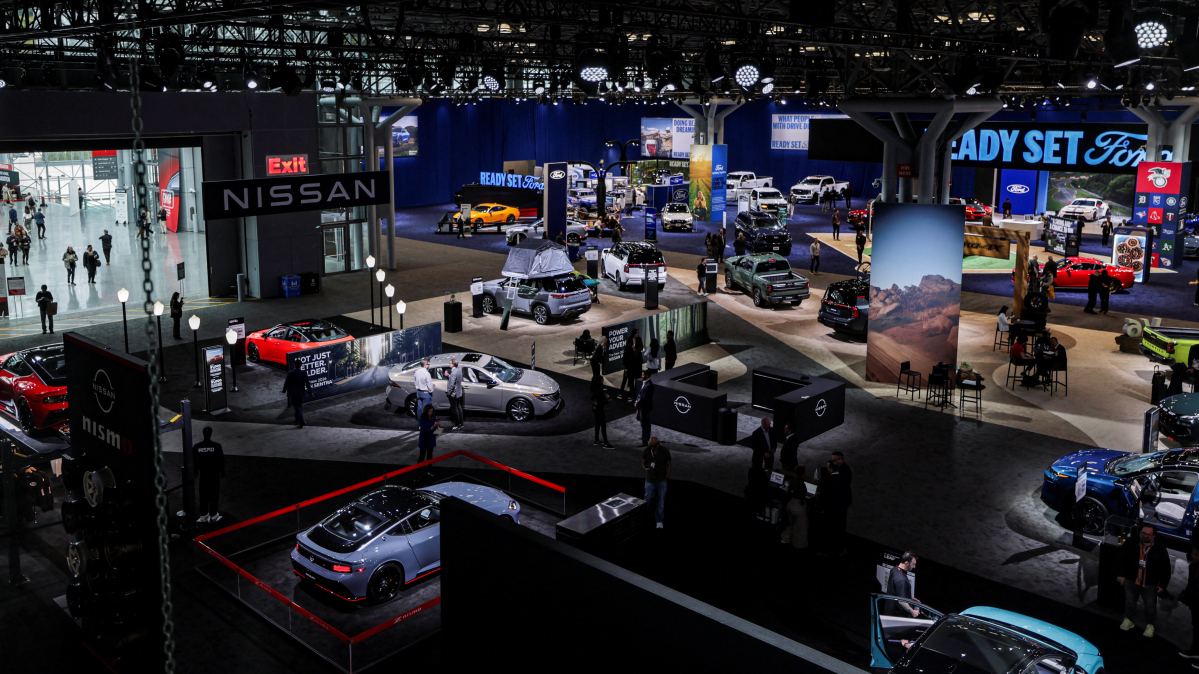
Major automakers showcased new electric vehicles at the New York Auto Show this week, under the slogan “electrification is the future." However, weakening demand in the United States and intense competition with China are raising questions for markets across the globe, including the South Caucasus.
Despite the optimistic messaging, the U.S. electric vehicle (EV) market has faced a notable downturn in recent months, following Washington’s decision to eliminate a $7,500 tax credit for EV purchases.
EVs accounted for 9.6% of total U.S. vehicle sales in 2025 but dropped to 6.5% in the last three months, making it the lowest level since early 2022.
Automakers are nevertheless pressing ahead with new launches.
Kia plans to introduce its lower-cost EV3 model later this year, while Subaru unveiled a new seven-seat electric SUV, the “Getaway”. Other manufacturers, including General Motors, Nissan, Hyundai and Toyota, are also adjusting their EV strategies, with some shifting towards hybrid production as market conditions evolve.
Slower transition than expected
Eyyub Aliyev, chairman of the Azerbaijan Automobile Dealers Association, said the global push towards electrification may have outpaced real-world readiness across the region.
“People were not fully prepared for the transition to electric vehicles, even though the process was promoted very rapidly worldwide,” he said.
He pointed to infrastructure gaps as a key factor, particularly outside major cities across the South Caucasus. While charging networks have expanded beyond capitals in recent years, consumer hesitation persists.
“This shows that electrification will not happen as quickly as expected,” he added.
According to Aliyev, the growth of trust in hybrid and plug-in hybrid vehicles has also led to a slowdown in the sales dynamics of fully electric cars.
U.S.-China rivalry shapes regional markets
The intensifying competition between American and Chinese automakers is also influencing consumer behaviour in the South Caucasus.
“The U.S. and Chinese brands are engaged in fierce competition for global market share,” Aliyev said, noting that negative publicity campaigns between rivals can undermine consumer confidence.
“These factors ultimately reduce overall interest in electric vehicles and create a sense of uncertainty among buyers.”
China’s growing dominance
While U.S. brands retain a degree of appeal among consumers in the region, Chinese manufacturers are rapidly gaining ground due to competitive pricing and design advantages.
“Chinese brands, with their interior, exterior and price advantages, are reaching a higher level in our market, which directly affects sales,” Aliyev said.
“In the coming years, Chinese dominance in our market is inevitable.”
Across the wider South Caucasus, trends vary. In Georgia, American brands (particularly Tesla) remain popular and are widely perceived as reliable, while in Russia the shift towards Chinese vehicles has accelerated.
Policy shifts and uncertain trajectory
In the United States, policy changes under President Donald Trump have also reshaped the EV landscape, with measures aimed at discouraging EV adoption and supporting petrol-powered vehicles.
Analysts say these global trends, such as policy shifts, market competition and evolving consumer preferences, suggest that while electrification remains the long-term direction of the auto industry.
However, the transition may be slower and more uneven than previously expected, particularly in emerging regions such as the South Caucasus.



















What is your opinion on this topic?
Leave the first comment