A high-speed train involved in Wednesday's deadly collision in Spain was travelling at between 160 and 200 kilometres per hour, far above the 40 km/h safety limit, according to a preliminary investigation published on Friday.
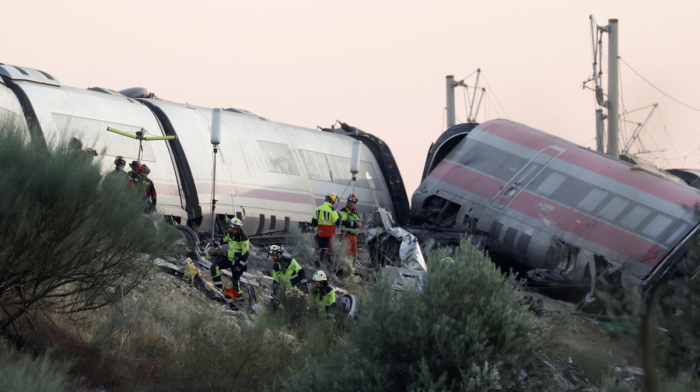
The Renfe-operated train struck a stationary Iryo train near Urda, in central Spain, killing at least 74 people.
Controller authorised train to resume normal speed
The collision occurred after a failure of the automatic signalling system forced several trains to stop, prompting Madrid's central control centre to take over operations.
According to Spanish Transport Minister Óscar Puente, a controller authorised the Renfe train to resume normal speed, despite a safety protocol restricting trains to 40 km/h under those circumstances.
Audio recordings obtained by Spanish newspaper El País revealed that the controller allowed the Renfe train to proceed, even though the stationary Iryo train ahead should have been given permission to move first.
The Renfe train was carrying 379 passengers and seven crew members, while the Iryo train had 147 passengers and five crew members aboard.
Investigators examine sequence of failures
The Independent Authority for the Technical Investigation of Accidents and Incidents (AITAT) estimated that the Renfe train was travelling at between 160 and 200 km/h when the trains collided.
However, investigators said the exact speed would not be known until data had been recovered from the train's black box.
“The sequence of malfunctions, instructions, and actions eventually led to the collision, in the absence of the necessary mitigating barriers,” the preliminary report stated.
The findings raise questions about why the train was allowed to travel at normal speed despite the signalling failure and safety restrictions.
The crash, Spain's deadliest railway accident since 2013, has renewed concerns over rail safety after a separate fatal collision on the same line in January claimed 46 lives.
The investigation into Wednesday's crash remains ongoing.
Read more:




















What is your opinion on this topic?
Leave the first comment