A small container of lunar soil travelled more than 380,000 kilometres from the far side of the Moon to Earth two years ago. It recently made one more journey - from Beijing to Vienna, where China officially handed it over to the United Nations.
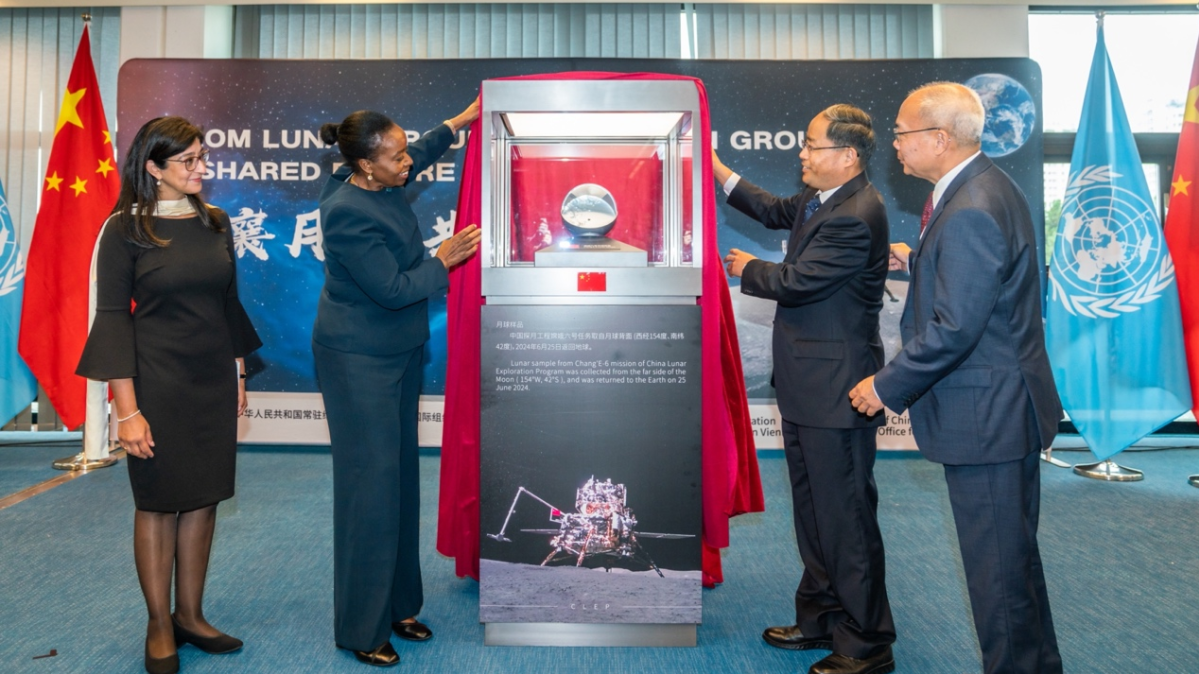
The donation, made at a ceremony at the UN Office in Vienna on 14 September, marks the first time in history that a sample from the far side of the Moon has been presented to the United Nations. The material will go on permanent display there, sitting in the heart of international diplomacy as a reminder of what humanity is capable of when it points itself at something extraordinary.
The sample came from China's Chang'e-6 mission, which in 2024 achieved something nobody had ever done before: landing on the far side of the Moon, scooping up soil and rock from the surface, and bringing it back to Earth. The far side of the Moon (the half that permanently faces away from Earth and cannot be seen from our planet's surface) had never been sampled before.
The mission collected 1,935.3 grams of material from the South Pole-Aitken Basin, one of the largest and oldest impact craters in the entire solar system, and returned it safely to Earth. It was one of the most technically demanding feats in the history of space exploration.
The ceremony in Vienna was themed "From lunar ground to common ground: a shared future for all" - a phrase that captures what China says it wants the donation to represent.
More than 400 guests attended, including diplomats, heads of international organisations, and representatives from countries around the world.
Exploring the universe is a shared dream of humanity
China's National Space Administration chief Shan Zhongde said at the ceremony that exploring the universe is a shared dream of humanity and that Chang'e belongs to all humankind. He described the donation as a concrete expression of China's commitment to multilateralism and to ensuring that the benefits of space exploration are shared broadly rather than kept to a handful of nations.
The UN Office for Outer Space Affairs Director Aarti Holla-Maini welcomed the donation warmly, saying it underscores the significance of outer space as a common domain for all humanity. She expressed hope that the sample would help advance global governance of outer space - an increasingly important issue as more countries and private companies push further into space and questions about who owns what and who sets the rules become harder to avoid.
Sample reveals new insights
The science behind the sample is as interesting as the diplomacy. Research published in the journal Nature Geoscience has already used the Chang'e-6 samples to reveal new insights into how Earth's magnetosphere influences solar wind exposure on the Moon's two hemispheres, findings that help scientists understand the relationship between our planet and its closest neighbour in ways that were simply not possible before. Because the far side of the Moon faces away from Earth, it is shielded from our planet's magnetic field in a different way to the near side, and the samples carry a chemical record of that difference. Future research on the material held in Vienna could yield further discoveries.
Space mission building international partnerships
The Chang'e-6 mission was also notable for its international dimension. It carried scientific instruments from France, Italy, Sweden and Pakistan - a reminder that China's space programme, while state-led and nationally ambitious, has been building genuine international partnerships along the way. Pakistan's ICUBE-Q satellite was deployed into lunar orbit during the mission.
China is now pressing ahead toward an even more ambitious goal: a crewed lunar landing by 2030. The samples sitting in a display case in Vienna are not just a diplomatic gesture - they are a preview of what China intends to do next. Shan put it simply at the ceremony; the Moon is not China's alone. But China got there first, on the far side, and brought back the proof.
Read more about space:

















What is your opinion on this topic?
Leave the first comment