Europe's space industry gathered in Paris this week for a landmark summit. But the event has been overshadowed by reports that Washington leaned on major U.S. firms to stay away.
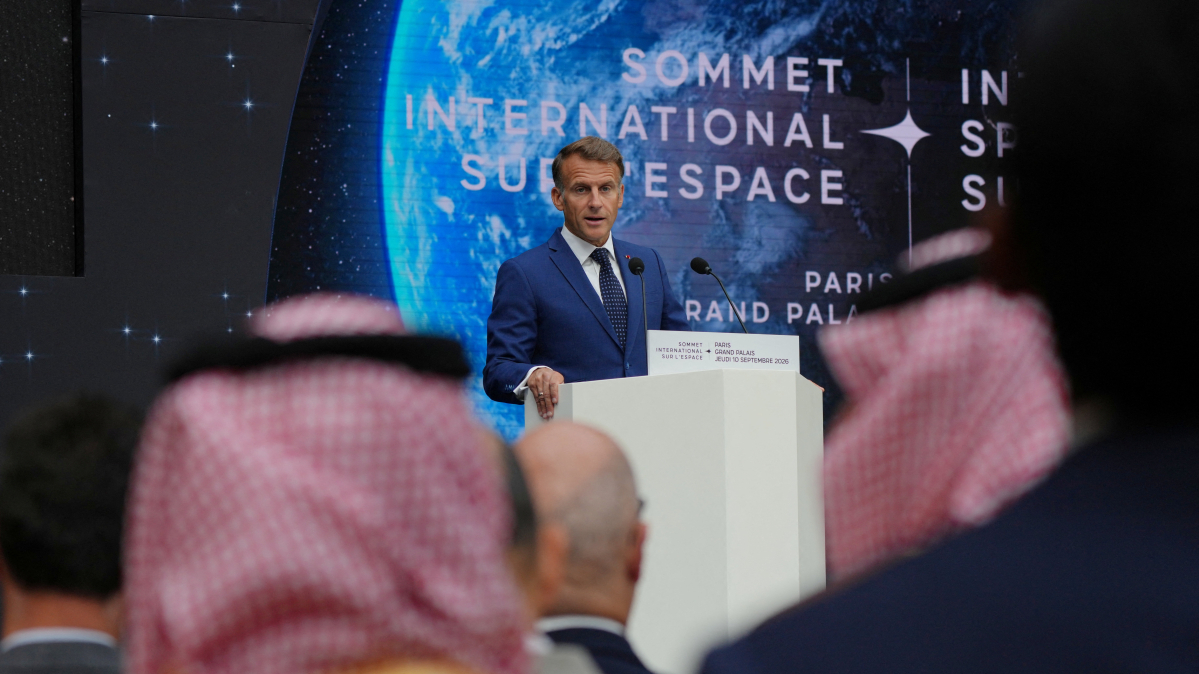
France and Germany co-hosted the international space summit at the Grand Palais in Paris from 9 to 10 September. Astronauts, heads of state and top industry figures from around the world attended.
French President Emmanuel Macron who opened the event on Wednesday announced that more than 50 projects would be signed over the two-day event.
He said Europe needed to “strengthen the European and space research” while also deepening ties with countries beyond the continent.
Macron had first announced the summit back in October 2025. He described it then as a chance to “bring Europeans together around a common ambition” and to build a “shared vision of Europe's place on the map of global space powers by 2035.” According to the Élysée, the event's focus is international cooperation and strengthening space security.
Big deals and a historic mission
Macron, alongside Greek Prime Minister Kyriakos Mitsotakis, welcomed news of the European Space Agency's next private astronaut mission to the International Space Station.
The mission, known as PAM-6, is scheduled for 2027. It will carry Adrianos Golemis, who will become the first Greek astronaut in space.
Macron also announced a major deal between Amazon Leo and Arianespace on social media. “Amazon Leo is renewing its trust in Arianespace with 6 additional launches, 24 in total,” he wrote on X.
Challenging U.S. dominance
The summit lands at a pivotal moment for Europe's space ambitions. For years, Europe has spent far less on space than the U.S. Figures show Europe has historically invested around 0.07 per cent of GDP in space programmes, compared with 0.24 per cent in the U.S.
That gap is starting to close. In November, the European Space Agency approved a record €22.3 billion budget for its 2026–2028 funding cycle. A further €35 billion has been earmarked for space security and defence.
Europe is also looking beyond Earth's orbit. Lunar mining has emerged as a possible route to secure clean energy and critical raw materials, as the continent tries to cut its reliance on China and Russia for such resources.
The summit hasn't been without friction closer to home. German Chancellor Friedrich Merz confirmed he would skip the event due to other commitments. Defence Minister Boris Pistorius and Space Minister Dorothee Bär attended in his place.
France and Germany have clashed repeatedly over joint space and defence projects. The two countries scrapped the Future Combat Air System project in June 2026 after years of disagreement.
Macron has long pushed for Europe to build its own “strategic autonomy” in space, backing home-grown programmes like Ariane 6 over U.S. providers such as Elon Musk's SpaceX. Germany, by contrast, has shown more willingness to work with cheaper US alternatives.
That divide was on display just days before the summit. German start-up Isar Aerospace launched the first commercial rocket to reach orbit from mainland Europe on Saturday. Merz called it “the beginning of a new era.”
U.S. firms pull out amid pressure claims
Despite the celebrations, the summit has been clouded by reports that Washington pressured U.S. companies to stay away. According to Politico, a White House official warned firms that attending could “look like tacit support for EU policy positions.”
A spokesperson for France's Ministry of Higher Education and Research confirmed that SpaceX, Blue Origin, Stoke Space and Starcloud had all withdrawn. Speaking to AFP, the spokesperson said “it's hard not to link it to the rumours of pressure in the press.”
Read more:



















What is your opinion on this topic?
Leave the first comment