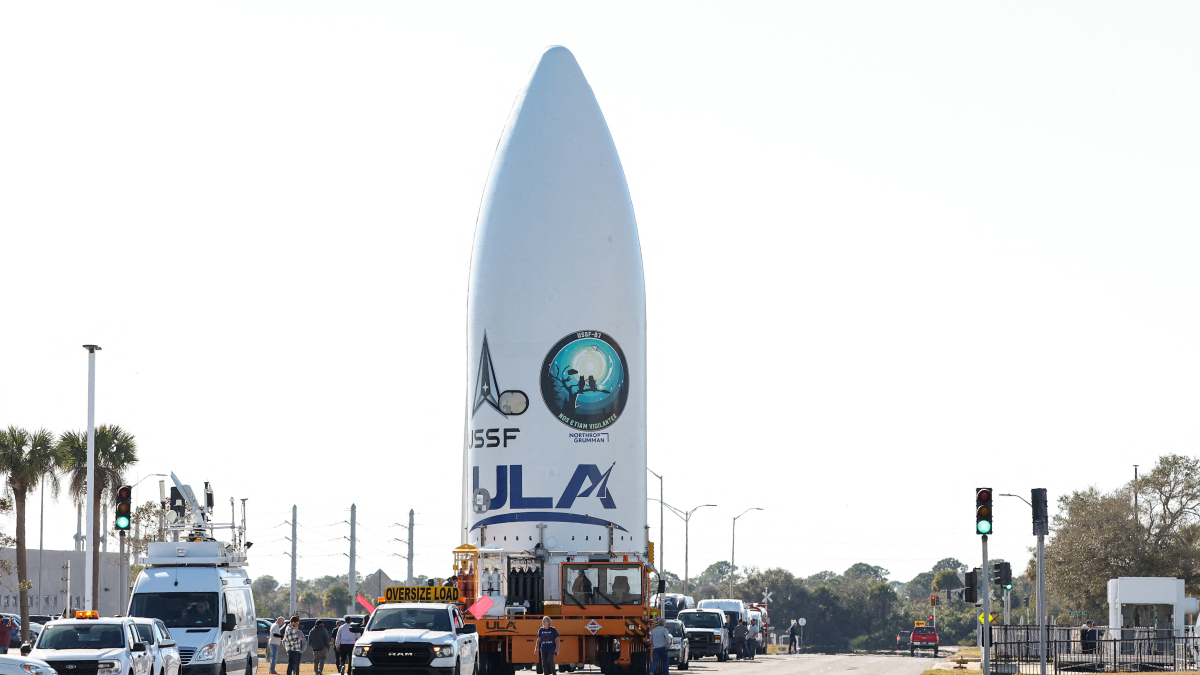
A Vulcan rocket owned by United Launch Alliance, the joint venture of Boeing and Lockheed Martin, failed on Sunday (15 November) shortly after liftoff from Florida, destroying its payload of 40 satellites from Amazon's Leo internet network in the launch company's first mission failure.
The rocket failed roughly 10 minutes after liftoff from the Cape Canaveral Space Force Station in Florida, and the cause was not immediately clear. It represented a major setback for the two-decade-old company's new flagship rocket as ULA sought to begin a regular cadence of launches for Amazon's burgeoning satellite internet constellation.
“Based on data received by our Launch Director, we confirm that the Vulcan vehicle launched from Space Launch Complex 41 suffered an anomaly 10 minutes into the flight and failed to deliver the Amazon mission to orbit,” ULA said in a statement.
“Every flight generates data, and every flight teaches us something. Since the anomaly just occurred, we don't have any specific data yet to understand what occurred today,” ULA said.
Investigation
The failure is expected to lead to a lengthy technical investigation that would keep the rocket off the market for months. This could deepen a U.S. launch bottleneck brought on by other rocket mishaps and challenges across the industry as well as the looming retirement of SpaceX's Falcon 9, the world's most active rocket. SpaceX is no longer accepting bookings for the Falcon 9.
“There is risk with any launch, and that's especially true for inaugural missions like LV-01,” Amazon said in a statement, referring to the name of Sunday's mission. “ULA has been a trusted partner for Amazon, and we believe they'll learn from this mission and deliver on their long-term plans for Vulcan.”
The Sunday flight was Vulcan's fifth since its 2024 debut and first in nine months, following a launch hiatus drawn out by separate technical investigations into its solid rocket side boosters and its core BE-4 engines, which are supplied by Amazon founder Jeff Bezos' Blue Origin space company.
Blue Origin is working with ULA in the investigation into Sunday's failure, according to a person familiar with the matter who spoke on condition of anonymity.
The boosters were being scrutinised for issues encountered on Vulcan's last two flights, including a mission in February for the U.S. Space Force. Both missions successfully delivered their payloads to orbit, but the Pentagon had not yet approved the rocket to resume flying national security payloads, pending its performance with the Amazon mission on Sunday.
BE-4 engine explosion in May
Blue Origin's New Glenn rocket with the BE-4 engine had a launchpad explosion in May, and its investigation determined the engine was the cause. That led the company to modify those delivered to ULA for Vulcan, ULA spokesperson Jessica Rye told Reuters in August.
It was unclear if the BE-4 engines played a role in Sunday's mission failure. It appeared to occur after the separation of Vulcan's second stage, the portion carrying the Amazon satellites, from the first-stage booster powered by the BE-4 engines.
ULA was formed in 2006 in a merger of Boeing's Delta rocket programme and Lockheed Martin's Atlas rocket programme. The company had embraced what was a 100 per cent mission success record ever since. Its Delta and Atlas rockets had only suffered a handful of failures in the decades before the merger.
Amazon's elusive access to space
The failure is another setback for Amazon as it races to deploy satellites using third-party launch providers, many of which have had groundings and failures. The New Glenn explosion in May happened days before it was due to launch Amazon Leo satellites.
The rocket failures have persistently held up Amazon's bid to rival SpaceX's vast Starlink internet network, which has more than 11,000 satellites and millions of customers worldwide.
SpaceX's wide lead over its satellite rivals is due in part to the advantage of having its own rocket to launch its satellites, while other companies spend billions of dollars on external launches.
Since 2025, 398 Leo satellites have been deployed across 14 launches, about 12 per cent of the 3,236 satellites Amazon needs for global service coverage. The company has hoped to start initial internet service this year.
Read more about space:











What is your opinion on this topic?
Leave the first comment