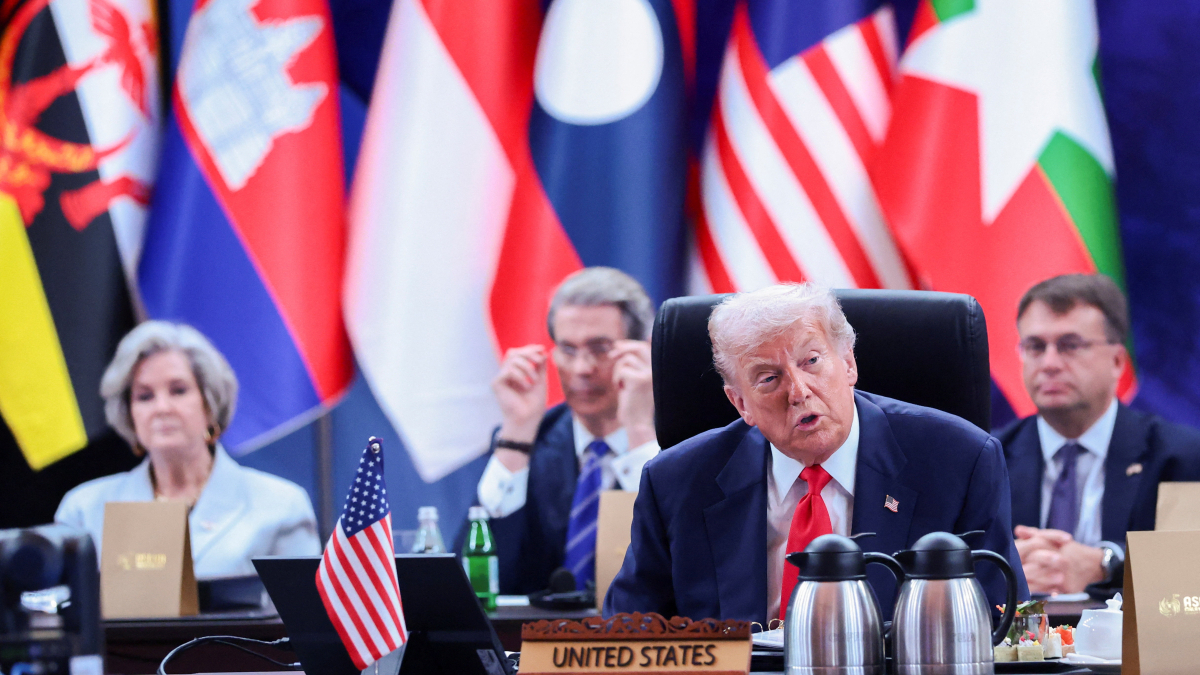
U.S. President Donald Trump is expected to arrive in Manila on Tuesday, 17 November, for a special summit with Southeast Asian leaders, as Washington seeks to strengthen regional economic and security ties amid trade tensions and growing competition with China.
The Philippine Department of Foreign Affairs confirmed Trump's participation in the ASEAN-U.S. Special Summit, which will conclude the 49th Association of Southeast Asian Nations summit.
Trump is also expected to hold bilateral talks with Philippine President Ferdinand Marcos Jr.
His visit follows demonstrations in Manila opposing U.S. policies and Washington's role in regional security. It also comes ahead of the Asia-Pacific Economic Cooperation (APEC) leaders' meeting in Shenzhen, China, on 18–19 November.
What is on Trump's Manila agenda?
According to the Philippine Presidential Communications Office, the ASEAN-U.S. Special Summit will take place on 17 November, following meetings between Southeast Asian leaders and other international partners.
Philippine officials have identified regional security, economic growth, digital transformation and strategic cooperation as priorities for discussions with the United States.
The Department of Foreign Affairs said the summit is intended to strengthen partnerships and support collective responses to shared challenges.
Trump's planned meeting with Marcos will provide an additional opportunity to discuss bilateral relations.
According to the Philippine Presidential Communications Office, the two presidents last met in Washington in July 2025 to discuss trade, defence cooperation and bilateral ties.
They also held a telephone conversation in July 2026 covering economic developments and regional security concerns, including the South China Sea.
Hundreds of demonstrators gathered in Manila on Sunday, 15 November, to protest Trump's expected arrival and U.S. involvement in regional affairs.
Reuters reported that protesters and police clashed while attempting to march towards the ASEAN summit venue. Demonstrators carried banners and placards opposing Trump's visit.
According to Anadolu Agency, citing local media, at least two people were injured and several others arrested after police blocked protesters near the Philippine International Convention Center.
What could the visit mean for Southeast Asia?
The Philippine government said its 2026 ASEAN chairmanship focuses on peace and security, economic cooperation and people-centred development.
The bloc is also confronting rising energy costs, supply-chain pressures and tensions in the South China Sea.
ASEAN's 11 members have a combined population of approximately 693 million and economic output of about $4.3 trillion, according to Reuters.
For Southeast Asian economies, closer engagement with Washington could support discussions on market access, investment and technology cooperation. However, no new U.S.-ASEAN trade agreement or investment package has been confirmed for the Manila summit.
Security cooperation is another focus, particularly for the Philippines, which has longstanding defence ties with the United States.
What could Washington gain?
For the United States, the meetings offer an opportunity to reinforce diplomatic and economic engagement with Southeast Asia before Trump travels to China.
The APEC Secretariat says the organisation's 21 member economies are working to advance trade integration, supply-chain resilience, digital innovation and artificial intelligence cooperation.
In a statement ahead of the Shenzhen meetings, APEC Executive Director Eduardo Pedrosa identified economic uncertainty, technological change and trade tensions as major challenges facing the region.
APEC has identified openness, innovation and cooperation as the priorities of China's 2026 host year.
In a commentary published by the Council on Foreign Relations (CFR), the author identified trade agreements, technology cooperation and high-level diplomacy as potential priorities for Trump's Asia visit.
The commentary suggested Washington could seek commitments from Southeast Asian governments to its Pax Silica initiative, which aims to strengthen cooperation on semiconductors, artificial intelligence, critical minerals and technology supply chains.
It also raised the possibility of new trade frameworks with Vietnam and Thailand, while questioning whether the agreements would translate into binding commitments.
Regarding Trump's subsequent visit to China, the CFR analysis identified a possible extension of the U.S.-China trade truce and further discussions on rare-earth exports as potential outcomes of talks with President Xi Jinping.
The author also raised the possibility of a meeting involving Trump, Xi and Russian President Vladimir Putin, although no such trilateral summit has been officially confirmed.
From Manila to Shenzhen
Trump's Asia visit will continue against the backdrop of U.S.-China economic competition and broader regional security concerns.
The APEC Economic Leaders' Meeting is scheduled for 18–19 November in Shenzhen, where trade, artificial intelligence and economic resilience are expected to feature prominently.
For ASEAN governments, the immediate significance of Trump's visit will depend on whether discussions produce specific commitments on trade, technology or security.
For Washington, the meetings will provide an opportunity to set out its regional priorities and engage Southeast Asian partners before the next stage of the president's Asia trip.











What is your opinion on this topic?
Leave the first comment