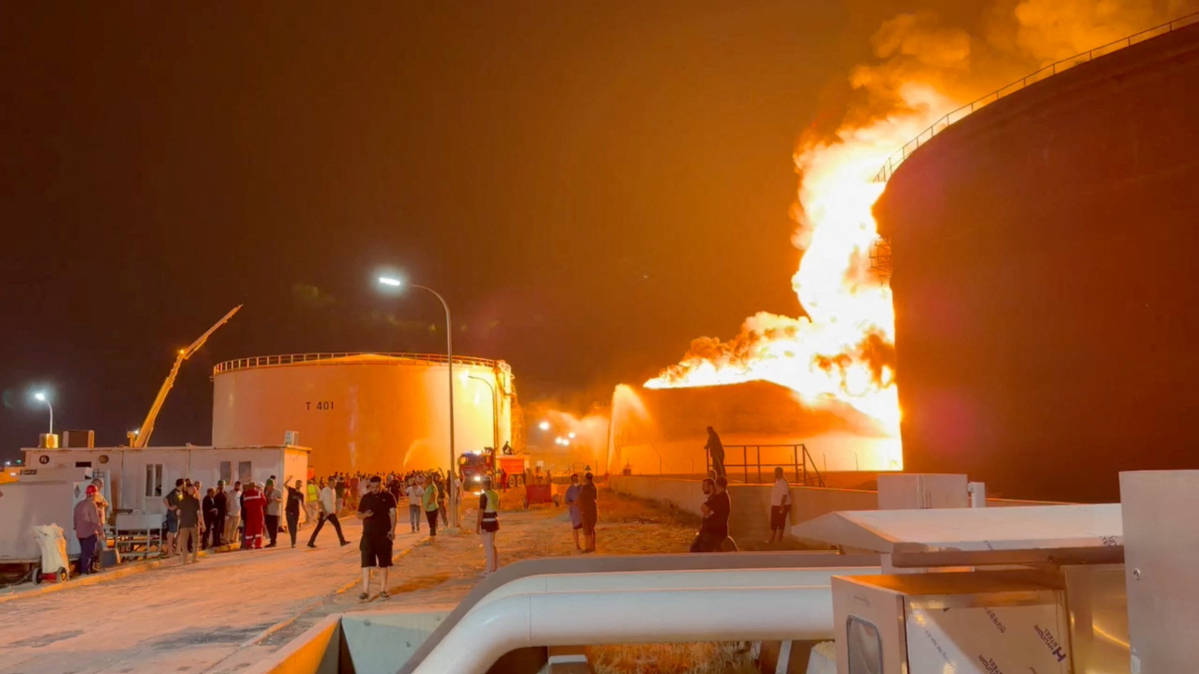
Firefighters were continuing to battle a massive blaze at the Zawiya refinery on Tuesday as Libya's National Oil Corporation (NOC) said it could declare force majeure and completely halt operations if drone attacks on oil assets in the city continued.
NOC said the latest third drone attack targeted an oil blending and filling plant operated by the Zawiya Oil Refining Company, falling near its main oil tank and a pipeline network used to produce oils for the domestic market. No casualties or material damage were reported.
There was no immediate claim of responsibility for the attacks, and authorities did not say who they believed was behind them.
Zawiya refinery faces repeated attacks
The Zawiya refinery, located around 40 km (25 miles) west of Tripoli, has a capacity of 120,000 barrels per day, making it Libya’s largest operating refinery.
The attacks began on Saturday when a drone hit an untreated naphtha tank, causing a fuel leak.
Tuesday's incident follows an attack on a gasoline storage tank at the Zawiya oil depot, which sparked a major fire and prompted the NOC to declare a state of maximum emergency. The tank, which contained 4.5 million litres of gasoline, collapsed as emergency crews worked to contain the fire and prevent it from spreading to other facilities.
The NOC is urging relevant authorities to intervene. The corporation has warned that if the attacks continue, it could declare force majeure, which would bring operations at the Zawiya refinery to a complete halt.
Libya’s security challenges
Security challenges continue in the country. The United Nations Support Mission in Libya (UNSMIL) has sought to broker a political settlement leading to elections. Many Libyans hope that this will end the political divisions and armed conflict since the 2011 ouster of Muammar Gaddafi.
However, the country remains divided between two rival governments with both vying for power - the internationally recognised Government of National Unity, headed by Prime Minister Abdul Hamid Dbeibeh and based in Tripoli, administers western Libya, and a government appointed by the House of Representatives in 2022, currently headed by Osama Hammad and based in Benghazi, administers the east and most of the south.
There has been no clear indication of who is behind the attacks.
Read more:










What is your opinion on this topic?
Leave the first comment