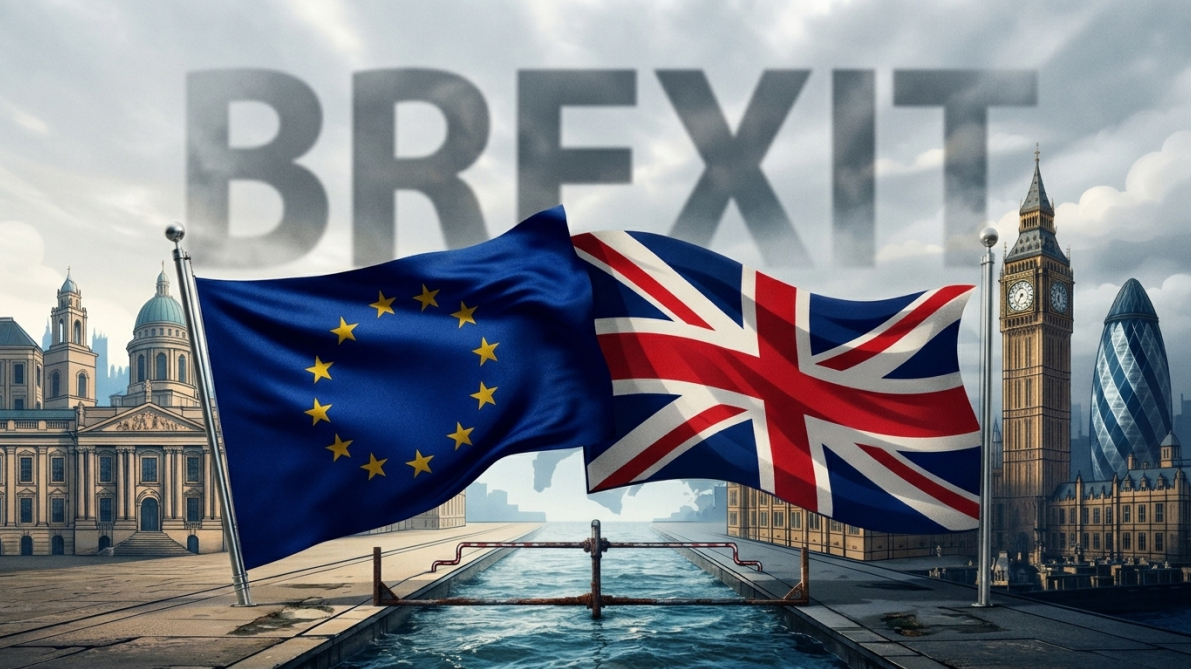
When UK Prime Minister Andy Burnham meets the European Union’s leaders in Brussels on Friday (20 November), the agenda will be about trade rules, carbon markets and youth visas. In the background is a larger question: a decade after Britain voted to leave, what has Brexit actually delivered?
Burnham will meet European Council President António Costa and European Commission President Ursula von der Leyen for the second EU-UK summit. The meeting will review progress since the first summit, held in London in May 2025, when the two sides agreed a renewed strategic partnership.
'We’ve now got the evidence'
For some Londoners, the summit is a chance to take stock of Brexit’s effect.
“The economic impact that we’ve gone through, I think it’s clear. It’s obfuscated by a few macro factors, but I think there’s no denying that Brexit has hurt us economically, and it’s worth exploring,” said Ket Thiru, a management consultant.
Others say the years since Britain’s departure have produced the facts that were missing at the time of the referendum.
“Well, I think we didn’t get very clear facts on either side the first time. We’ve now got the evidence, we’ve actually done it, we’ve seen the results. So if we analyse those results and they’re bad, then we should go back,” said Chris Vesey, an IT manager.
What the numbers say
Economists have tried to measure that evidence. The Office for Budget Responsibility, Britain’s fiscal watchdog, estimates that Brexit will reduce the UK’s long-term GDP by about 4 per cent. A briefing by the research group UK in a Changing Europe notes that newer research suggests the damage could be larger.
By contrast, the brief estimates that the current “reset” would raise long-term GDP by only 0.3 to 0.7 per cent. The government’s own estimate is about 0.3 per cent by 2040.
Public opinion has also shifted. A poll of polls cited by UK in a Changing Europe found that 62 per cent of Britons would vote to rejoin the European Union, against 38 per cent who would stay out. Support fell to about 52 per cent in one study once respondents were told of possible costs, such as adopting the euro, granting fishing access and paying into the EU budget.
Burnham himself told his Labour Party conference that “Brexit has done more harm than good”, and last month called for an “honest discussion” about Britain’s future relationship with the EU.
Even so, his government says its red lines remain: no return to the EU, the single market, the customs union or freedom of movement.
Three deals 'down to the wire'
Friday’s summit is expected to focus on three agreements:
- Food and drink: A deal to cut paperwork and barriers on agricultural trade, which the government says could add up to about $6.7 billion a year to the economy.
- Carbon markets: Linking the two sides’ emissions trading systems, which the government values at up to about $5 billion a year, and which would help shield British exporters from EU carbon border charges.
- Youth experience scheme: A scheme allowing young people to live, study and travel in each other’s territory.
Burnham said after meeting European leaders in Dublin last week that the talks were likely to “go down to the wire”.
“I will fight now over the days to come to make sure we get this deal over the line,” he said.
According to UK in a Changing Europe, the youth scheme is the main sticking point, and the EU has linked the other two deals to it. Disputed issues include a cap on numbers, age limits and the EU’s demand that British universities charge European students lower fees. A senior EU diplomat said the three deals were largely complete, but that the “choreography” of how they fit together was still being discussed.
Wider agenda
Beyond trade, leaders are expected to discuss security and defence, migration, judicial cooperation and closer links between citizens.
Ukraine is expected to be high on the agenda, along with the Middle East, the Indo-Pacific, hybrid threats and cybersecurity. Both sides are expected to reaffirm their commitment to a rules-based international order and to strengthening Europe’s wider security architecture.
The summit will also consider how to build a more resilient economic relationship while keeping up cooperation on climate and development.
Other unresolved issues include the UK’s financial contribution to the EU’s SAFE defence borrowing scheme, under which about $23 billion remains to be allocated by June 2027. British carmakers are also concerned that they would be excluded from the EU’s “Made in Europe” industrial policy.
Rules since 2020
The UK formally left the EU in January 2020. Relations are governed by the Withdrawal Agreement, the Trade and Cooperation Agreement and more recent arrangements, including the agreement on Gibraltar.
Friday’s meeting is expected to test how far both sides are prepared to go beyond that post-Brexit framework. Burnham is also expected to use it to gauge the EU’s appetite for closer ties before a wider national debate on Britain’s options, which UK in a Changing Europe says is likely to begin in earnest next year.
Read more:










What is your opinion on this topic?
Leave the first comment