Britain is expanding military training with Azerbaijan following the lifting of its arms embargo, but the UK's ambassador to Baku says the growing defence relationship does not amount to a mutual defence pact.
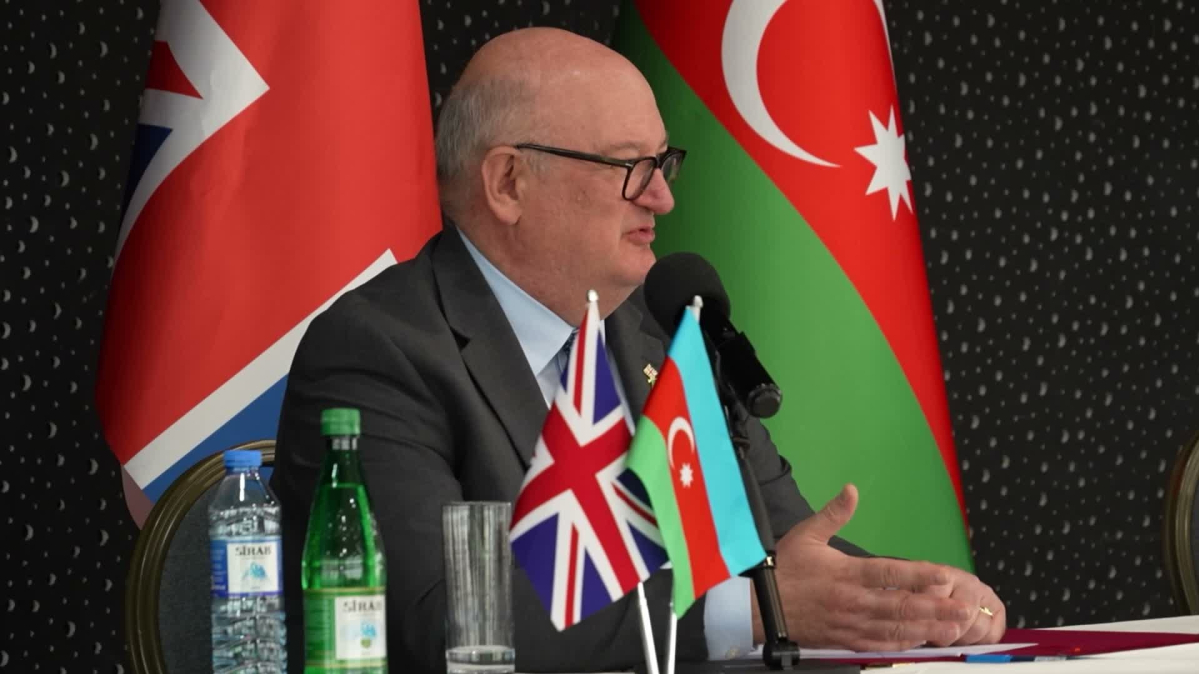
Britain’s ambassador to Azerbaijan, Duncan Norman, has reaffirmed London’s support for peace efforts between Azerbaijan and Armenia, saying a peace agreement would help unlock the economic potential of the Middle Corridor trade route.
Speaking to AnewZ journalist Orkhan Amashov in Baku, Norman confirmed that defence cooperation was expanding, with Azerbaijani military personnel training alongside British forces following the lifting of the UK's arms embargo.
The interview follows the UK and Azerbaijan's decision to elevate their relationship to a strategic partnership at the ninth European Political Community summit in Dublin. The agreement focuses on three key areas: trade, investment and economic growth; innovation and education, including artificial intelligence; and defence and security.
Peace could unlock regional trade
Amashov asked how the Azerbaijan-Armenia peace process could advance Britain's wider regional interests, including normalisation between Türkiye and Armenia and improved access to Central Asia through the South Caucasus.
Norman said peace was essential not only for Azerbaijan and Armenia but also for economic growth across the region, particularly through the Middle Corridor, a trade route connecting Central Asia and Europe.
“So it matters for the world economy too,” he said. “Anything that’s good for the world economy is good for all countries. So we are keen to support it.”
However, he warned that developing the route would take time.
“To be able to build an effective route through the middle corridor is going to take a long time,” he said. “But it started already. The peace process is a big part of that, and it’s about putting those building blocks in place.”
Norman acknowledged Britain's broader strategic interests in the South Caucasus but stressed that finalising the peace process must come first, “and then start really being able to reap the benefits, the economic benefits or the other benefits that peace will bring”.
At the Dublin summit, President Ilham Aliyev and Armenian Prime Minister Nikol Pashinyan discussed rail and road connections, electricity grid integration, cross-border water management and border delimitation.
The talks followed the Washington summit on 8 August 2025, where the peace agreement was initialled. It has yet to be formally signed.
“Not a defence agreement”
Amashov also raised concerns about regional security following an Iranian drone attack targeting Nakhchivan airport in March 2026, asking whether closer defence cooperation with Britain could offer Azerbaijan additional protection against the risk of the conflict involving Iran spilling across its borders.
“It’s not acceptable for any country to attack another country, and we were very quick to condemn that,” Norman said, adding that London would respond similarly to any future attack.
But he made clear that Britain's military relationship with Azerbaijan remains at an early stage. The UK lifted its arms embargo roughly a year ago, while a British defence attaché has been based in Baku for around 18 months.
“It’s a defence relationship. This is not a defence agreement,” Norman said. “This is not like NATO comrades where we have an obligation to come to their defence.”
Training with the Army and Navy
Norman said the UK's priority was “helping to upskill Azerbaijan’s defence capabilities”. Azerbaijani military personnel are already receiving training with the British Army and Royal Navy.
He said cooperation would develop both bilaterally and through Britain's membership of NATO, highlighting recent contacts between Azerbaijani and alliance officials.
“Having those wide defence relationships for Azerbaijan works...helps as a deterrent,” he said.
The ambassador also expressed hope for a diplomatic breakthrough in the conflict involving Iran.
“Let’s hope that in the coming weeks and months that we can help to find a diplomatic solution to what’s happening south of Azerbaijan’s border, because I think that would be the best thing for all of us.”
Military cooperation has gathered pace in 2026, with the two countries holding their first joint defence cyber exercise. Norman has also described bilateral military training as reaching an unprecedented level.
British Defence Minister Lord Vernon Coaker attended the ADEX defence exhibition in Baku on 30 September, accompanied by representatives from 18 British companies.
Nakhchivan and new economic ties
Beyond security, Britain is exploring new economic opportunities in Azerbaijan, particularly in Nakhchivan, which could become an important logistics hub along the Middle Corridor.
During his first visit to the autonomous republic, Norman met the president’s special representative and Nakhchivan's prime minister, discussing opportunities in logistics, energy, tourism and agriculture.
He also highlighted British expertise in railway modernisation, signalling and project management as Azerbaijan develops its transport infrastructure.
British architecture firm Chapman Taylor, which is already involved in reconstruction projects in Garabagh, is preparing a 20-year master plan for Nakhchivan city.
The UK remains Azerbaijan's largest source of foreign direct investment, largely driven by BP's involvement in the country's energy sector since independence.
But economic ties are expanding beyond oil and gas. New areas of cooperation include dual listings through the London and Baku stock exchanges, British participation in advanced data-centre infrastructure and investment opportunities in the Alat Free Economic Zone.
Read more:









What is your opinion on this topic?
Leave the first comment