A newly uncovered chapel near the Nagzauri monastery complex offers another glimpse into Georgia’s early Christian heritage, with architectural details shedding light on how religious communities worshipped and built their churches more than a thousand years ago.
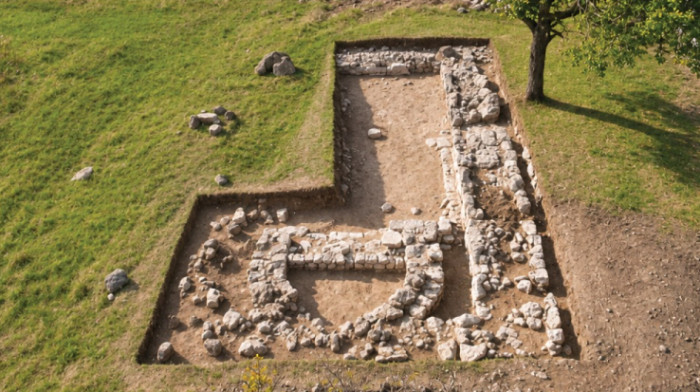
Archaeologists uncovered the remains of a previously unknown early Christian church in southern Georgia, adding a new piece to the history of one of the country's important early medieval religious sites.
The discovery was made near the village of Gantiadi in Dmanisi municipality, in the Kvemo Kartli region, just west of the Nagzauri monastery complex, which dates from the 5th to 8th centuries. Georgia's National Agency for Cultural Heritage Preservation announced the find on 13 November.
Although only parts of the building have survived, its architectural features are already offering clues about how the church was constructed and used.
According to the agency, the structure was built from large stones, with walls reaching up to 1.5 metres in thickness. The surviving sections stand approximately 1.3 metres high. Archaeologists have so far examined the main nave and apse, identifying several details of particular interest.
Among the finds are fragments of an ambo – a raised platform used for readings and religious ceremonies – and a niche in the altar screen, which separated the sanctuary from the main worship area.
A stone column base was also discovered in the centre of the nave. Researchers believe it may have supported a wooden roof structure. A fragment of a roof tile found at floor level provides further evidence of the materials used in the building's construction.
These details matter because they offer more than a glimpse of the church's physical appearance. They can help researchers understand its internal arrangement, architectural design and the way religious services were organised in the early Christian period.
Monastery with more than one church
The discovery is particularly interesting because Nagzauri was already known as an unusual early Christian religious complex.
Previous archaeological investigations identified several churches within a relatively small, enclosed area, alongside remains of other buildings believed to have served residential and practical purposes. The layout suggests that the site was not simply a place of worship, but a functioning monastic community with different buildings serving religious and everyday needs.
A 2012 publication by the Georgian National Museum, The Early Christian Period Church Complex from Dmanisi, documents earlier excavations at the site. Researchers recorded four church structures, two smaller buildings and 14 burials. They also uncovered around 170 fragments of carved stonework, including crosses, columns, capitals and reliefs depicting human and animal figures. Some of the fragments bear inscriptions in the ancient Georgian Asomtavruli script.
The site's archaeological history goes back to 1998, when construction work to lay a fibre optic telecommunications cable unexpectedly exposed pottery fragments, roof tiles and traces of ancient walls. The discovery led to further excavations in 2001–2004 and another phase of research in 2010. Work was subsequently interrupted before the National Agency for Cultural Heritage Preservation resumed funding archaeological investigations in 2025.
Why the discovery matters for Georgia's early Christian history
Nagzauri is located in a region with an exceptionally rich early Christian heritage. Christianity began spreading across Kvemo Kartli from the 4th century AD, and the area subsequently became home to numerous churches, monasteries, stone crosses and other religious monuments.
Among its best-known examples is the Bolnisi Sioni Basilica, one of Georgia's oldest and largest three-nave basilicas. The region is also home to the remains of a 5th-century rotunda-type church near Dmanisi and the early Christian cave monastery of Muguti in the Khrami River Gorge.
Against this background, the newly identified chapel adds another element to the picture of how Christianity developed in southern Georgia during the early medieval period.
Its architectural details, together with the remains already documented at Nagzauri, could help researchers establish how different religious buildings were arranged within the complex, what construction techniques were used and how monastic spaces evolved over time.
For now, excavations have focused on the church's main nave and apse. Further archaeological research will be important in determining the building's precise characteristics and its relationship with the wider monastery.
The latest discovery is a reminder that Georgia's early Christian heritage is still being uncovered – sometimes just a short distance from monuments that archaeologists have been studying for decades.
Read more on culture:

















What is your opinion on this topic?
Leave the first comment