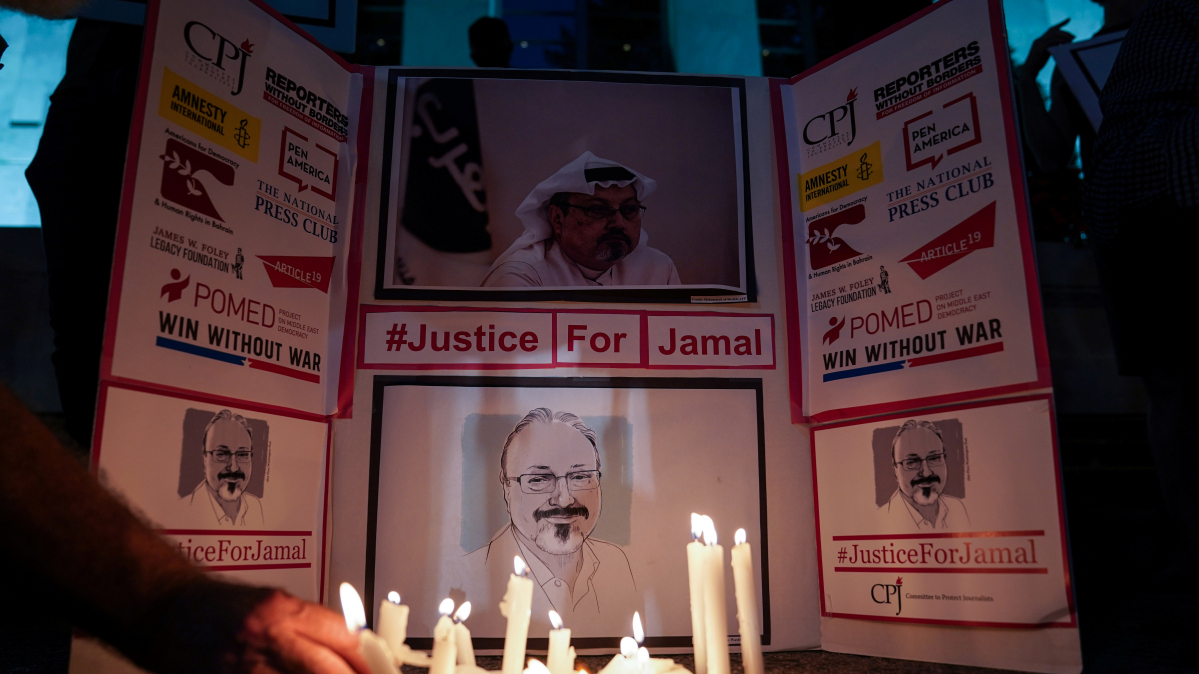
French authorities have opened a new judicial inquiry into the killing of Saudi journalist Jamal Khashoggi, bringing renewed legal attention to a case that continues to draw international focus nearly eight years after his killing.
France’s national anti-terrorism prosecutor’s office confirmed on Saturday (16 May) that an investigative judge has been appointed to examine allegations linked to Khashoggi’s killing, including torture and enforced disappearance.
The decision follows a ruling by the Paris Court of Appeal on 11 May, which found complaints submitted by human rights organisations TRIAL International and Reporters Without Borders admissible under French law.
Rights groups pursued case in France
The legal effort in France began during a visit by Saudi Crown Prince Mohammed bin Salman to Paris in July 2022.
Khashoggi’s former employer, Democracy for the Arab World Now (DAWN), alongside TRIAL International, initially petitioned French courts to examine the case. Reporters Without Borders, also known by its French acronym RSF, later joined the proceedings.
According to French prosecutors, however, the separate complaint filed by DAWN was ultimately ruled inadmissible, while the submissions from TRIAL International and RSF were accepted.
The appointment of an investigative magistrate marks a significant step in the French judicial system, where judges have broad powers to conduct independent inquiries into serious crimes.
Killing inside the Saudi consulate shocked the world
Jamal Khashoggi, a Saudi journalist living in the United States and a columnist for The Washington Post, was killed inside the Saudi consulate in Istanbul in October 2018.
Turkish investigators concluded that he was strangled before his body was dismembered by Saudi agents inside the diplomatic building.
The killing triggered widespread international condemnation and placed intense pressure on Saudi Arabia’s leadership. U.S. intelligence agencies later assessed that Crown Prince Mohammed bin Salman had likely approved the operation.
The Saudi crown prince has consistently denied ordering the killing directly, although he later acknowledged that the incident happened “under my watch”.
Limited international legal progress
Despite the global reaction following Khashoggi’s death, legal accountability efforts have largely stalled in several countries.
In Türkiye, a court halted the trial of 26 Saudi suspects in 2022 before transferring the case to Saudi Arabia, a move criticised by rights organisations and press freedom groups.
In the United States, a civil lawsuit brought by Khashoggi’s fiancée was dismissed after the Biden administration granted Mohammed bin Salman immunity following his appointment as Saudi prime minister.
The French inquiry, therefore, opens a new legal avenue in a case that many campaigners argue has seen limited judicial follow-up internationally.
France’s legal framework
French law allows courts to investigate certain serious offences committed abroad, including crimes involving torture or enforced disappearance. However, prosecutions in France generally require suspects to be physically present on French territory.
It remains unclear how far the new inquiry could progress or whether it could eventually lead to criminal proceedings.
Saudi Arabia’s government media office did not immediately respond to requests for comment from international media organisations.
Continuing international interest
Khashoggi’s killing remains one of the most politically sensitive cases involving Saudi Arabia in recent years, particularly because of the allegations surrounding senior officials and the circumstances of the operation inside a diplomatic mission.
For press freedom organisations and human rights advocates, the French investigation represents another effort to maintain international legal pressure as calls for accountability continue nearly a decade after the journalist’s death.

















What is your opinion on this topic?
Leave the first comment