France and Armenia are set to strengthen cooperation in defence, technology and the economy during a state visit by President Emmanuel Macron, Armenia’s Deputy Foreign Minister has confirmed.
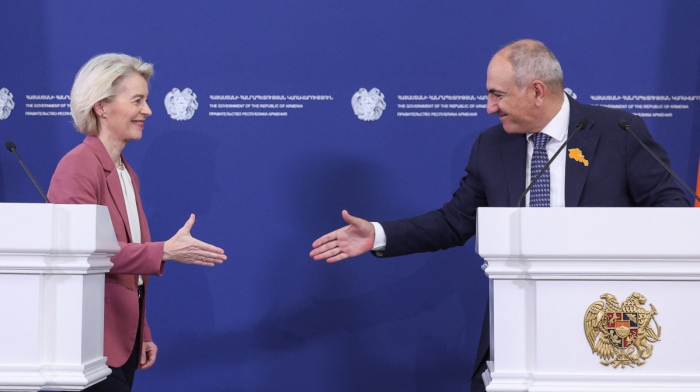
On 5 May, Macron and Armenian Prime Minister Nikol Pashinyan will meet to sign a strategic partnership agreement covering a range of sectors. Additional agreements on education, military-technical cooperation, and artificial intelligence are also expected to be finalised.
Speaking to AnewZ, Vakhtang Maisaia, professor and head of the MA programme in Global Politics and Security Studies at Caucasus International University, described the visit as “very significant”, both politically and regionally.
“It means that France attaches great importance to the region,” he said, adding that the timing also reflects “steady support” for Armenia ahead of upcoming parliamentary elections.
Macron’s visit is seen by many as a show of diplomatic backing for Pashinyan, who faces mounting domestic pressure over high unemployment and inflation.
Nearly four in ten Armenians surveyed earlier this month by the International Republican Institute’s Center for Insights in Survey Research said they were undecided or unwilling to disclose their voting preference, while Pashinyan’s Civic Contract party leads with 28%.
Maisaia noted that the visit comes at a sensitive political moment for Armenia.
“Pashinyan may face problems ahead of the elections due to internal turbulence and pressure from Russia,” he said, adding that the trip signals Armenia’s continued shift towards closer ties with Europe.
“It indicates Armenia is steadily moving towards European Union integration,” he said, pointing to France’s role as a leading EU member supporting that trajectory.
Defence reforms and regional security
The visit will also take place against the backdrop of the first-ever EU-Armenia summit, expected to focus on strengthening cooperation in energy, security, connectivity and economic development in the South Caucasus. Macron is expected to attend.
Maisaia said the planned Strategic Partnership Agreement could have practical implications for Armenia’s defence reforms.
“It could mean that Armenia’s defence reforms will be based more on European standards and experience,” he said.
“This cooperation is likely to strengthen civilian control over the armed forces and contribute to regional security.”
He added that the partnership would focus on defensive, rather than offensive, military capabilities and could support Armenia’s participation in international peacekeeping efforts.
Beyond defence, the agreement is also expected to expand technological cooperation.
“It will help develop technological ties between France and Armenia,” Maisaia said, adding that the broader aim is to deepen European engagement across the South Caucasus.
Regional balance and peace
In 2025, Macron was a key advocate of a draft peace treaty between Armenia and Azerbaijan aimed at ending a near four-decade conflict.
Addressing concerns previously raised by Baku over France’s support for Armenia, Maisaia said the issue of Garabagh was no longer central.
“The Garabagh problem is no longer a real issue,” he said, adding that enhanced cooperation between Armenia and Europe should not be seen as a threat to regional stability.
“I think this is a positive development that could further encourage peaceful relations in the region,” he added.









What is your opinion on this topic?
Leave the first comment