Exclusive flight-tracking material obtained by AnewZ has raised new questions about French military aircraft movements linked to President Emmanuel Macron’s recent diplomacy with Armenia and the wider scope of France’s defence cooperation with Yerevan.
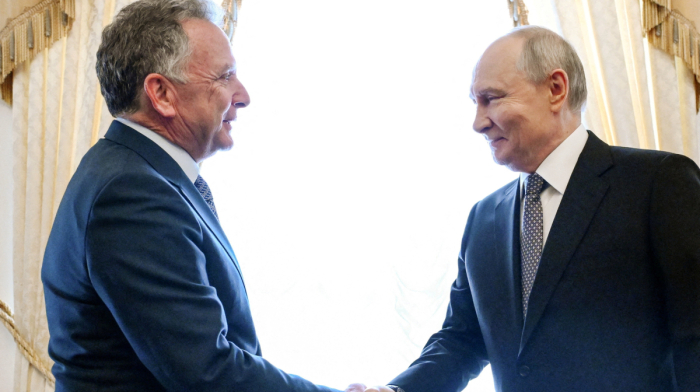
French President Emmanuel Macron’s visit to Armenia was presented as a diplomatic milestone.
According to Le Figaro, Macron’s visit to Yerevan centred on a strategic partnership with Armenia. Defence cooperation was already part of that picture, with Armenia’s 2024 order of 36 French-made Caesar howitzers.
But exclusive material obtained by AnewZ raises questions that go beyond the public partnership.
The question is whether diplomacy was moving alongside a deeper military track.
Flights tracked
AnewZ has exclusively obtained ADS-B flight-tracking material showing F-UJCS, an Airbus A330-200 of the French Air and Space Force, flying towards Yerevan on May 4. The next day, the aircraft left Yerevan for Paris. Hours later, it flew from Paris to Istres-Le Tubé, a French military air base near Marseille.
The records do not prove what was on board. But they raise a broader logistics question about whether this was only official transport after the visit, or part of a wider military support chain operating alongside France’s expanding defence relationship with Armenia.
The same aircraft also appears earlier in separate tracking material linked to Japan and South Korea. Screenshots reviewed by AnewZ show F-UJCS, callsign CTM021, moving east from Europe on March 28, then appearing around South Korea and Japan on March 29, April 2 and April 3.
Important timing
That timing matters. Macron’s Asia tour ran from March 31 to April 3. In Japan, French and Japanese defence ministers signed the Japan-France Defense Roadmap on April 1. In South Korea, Macron and President Lee Jae Myung agreed on April 3 to deepen cooperation, including in defence and energy.
Again, this proves movement, not cargo. But it places the aircraft within a wider pattern of defence-linked diplomacy.
Then came the A400M file.
A tracking image from May 11 shows a French military A400M, callsign CTM2025, moving eastwards towards the South Caucasus. According to the claim being examined by AnewZ, cargo linked to this route was declared to Georgia as gas cylinders, lithium batteries and chemical substances.
Question marks over cargo
The key question is whether the actual cargo was different, possibly Caesar-related components, assemblies or support equipment.
That question became sharper after Caesar howitzers appeared in footage from Yerevan ahead of Armenia’s May 28 Republic Day parade. Public reporting says Armenia signed a 2024 contract for 36 Caesar systems, while recent footage from Armenia showed the systems during parade preparations.
If those systems are displayed publicly, they are no longer only part of a contract. They become a visible military reality on the ground.
Airspace permission
The legal issue is also significant.
Under the 1944 Chicago Convention, civilian and military aircraft operate under different legal regimes. If military cargo was moved under a misleading declaration, it would raise questions about airspace permission, transit approval and the integrity of civil aviation rules.
For now, there is no final proof. The public record shows partnership. The exclusive flight records obtained by AnewZ show movement. The footage shows Caesar systems in Armenia. The cargo claim still requires verification.
The key documents remain the A400M manifest, Georgia’s transit permission, ICAO compliance records and independent confirmation of what was actually on board.
READ MORE:











What is your opinion on this topic?
Leave the first comment