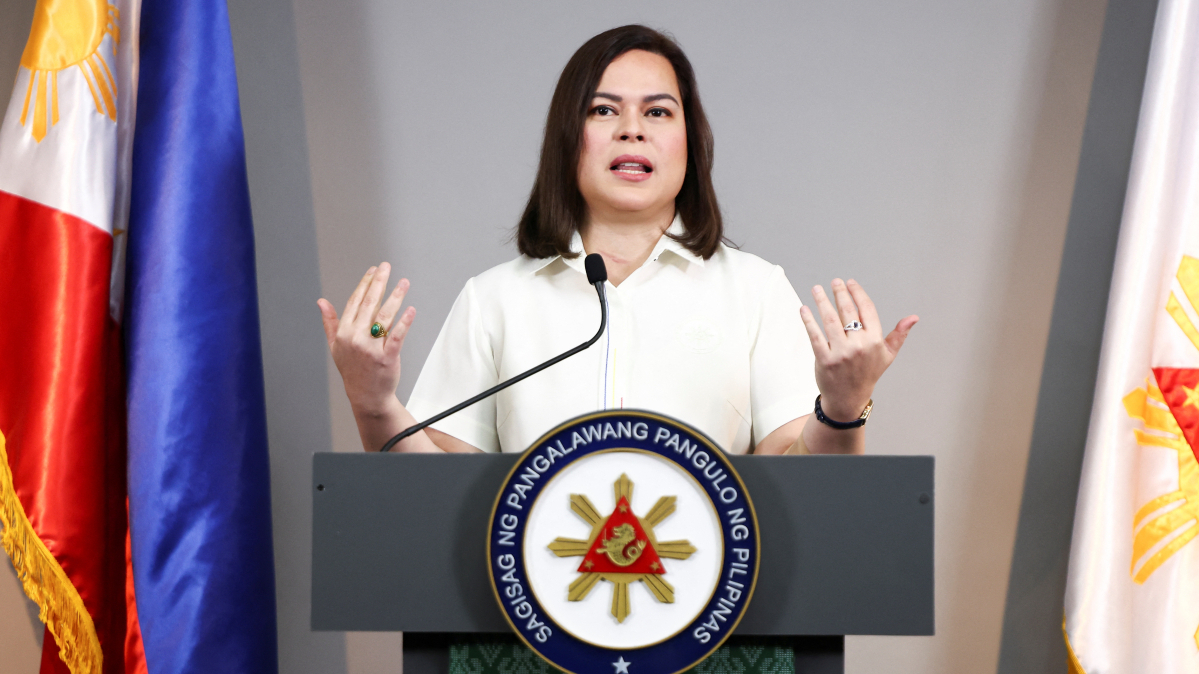
Philippine Vice President Sara Duterte has again been impeached by the country’s lower house, more than a year after an earlier impeachment complaint against her was dismissed on constitutional grounds.
The latest complaint accuses Duterte, the daughter of former President Rodrigo Duterte, of misusing public funds, amassing unexplained wealth, and allegedly threatening the lives of President Ferdinand Marcos Jr., the First Lady, and a former House Speaker.
Duterte has rejected all allegations, while her legal team has described the complaints as “defective” and labelled the impeachment proceedings a “fishing expedition”.
What happens after the lower House votes?
Under the Philippine Constitution, once the House of Representatives approves an impeachment complaint, the case is passed to the Senate, which then transforms into an impeachment court.
Senators serve as judges during the proceedings, while the Senate President presides over the trial. However, the process is not always straightforward in practice.
Earlier in 2025, the Senate returned a previous impeachment complaint against Duterte to the lower house, requesting clarification over whether it complied with constitutional rules. In past cases, impeachment proceedings have also collapsed when officials resigned before a verdict could be reached.
One of the country’s most notable impeachment cases involved former President Joseph Estrada in 2001, whose trial fell apart after prosecutors staged a walkout.
Why is this impeachment different?
This time, lawmakers waited until the constitutional one-year ban on repeat impeachment filings had expired before proceeding with a fresh complaint. That removed the legal obstacle that undermined the previous case and increased expectations that the Senate could now conduct a full trial.
However, the political environment has changed significantly.
Before the House vote, Duterte allies in the Senate backed a leadership reshuffle that installed Alan Peter Cayetano, a close ally of the Duterte family, as Senate President. As a result, he is expected to oversee the impeachment proceedings.
The leadership change was reinforced by the sudden return of Senator Ronald dela Rosa, who had been absent from Senate sessions for several months before reappearing to support Cayetano’s appointment.
Dela Rosa, a longtime Duterte ally and former Police Chief, has faced legal scrutiny linked to the International Criminal Court investigation into the controversial anti-drugs campaign launched during Rodrigo Duterte’s presidency.
Political analyst Jean Encinas-Franco of the University of the Philippines said Senate leadership could heavily influence the direction of the impeachment trial.
According to her, senators aligned with the majority often have the political flexibility to steer proceedings in ways that benefit their allies.
Will there be enough votes to convict?
It remains uncertain whether Duterte’s opponents can gather enough support in the Senate to secure a conviction.
Backers of the impeachment argue that the evidence against her is substantial and could justify a guilty verdict. Yet recent political realignments and the growing influence of Duterte allies in the Senate have complicated the picture.
Analysts note that political loyalties in the Philippines can shift rapidly, particularly with attention already turning towards the 2028 presidential election, which Sara Duterte has said she intends to contest.
What has Marcos said?
President Ferdinand Marcos Jr. has publicly distanced himself from the impeachment effort, insisting that the matter falls under Congress’ authority.
Nevertheless, the proceedings come amid increasingly strained relations between Marcos and Duterte, once political allies.
A communications undersecretary for the President recently stopped short of openly supporting an impeachment trial but said the allegations should go through proper legal and constitutional procedures.
She also stressed the importance of accountability and said hearings were necessary to establish the truth.
How rare are impeachments in the Philippines?
Sara Duterte is among the highest-ranking officials in Philippine history to face impeachment proceedings.
Others include former President Joseph Estrada, former Supreme Court Chief Justice Renato Corona, an ombudsman, and a former Chairman of the Commission on Elections.
Of those cases, only Corona was ultimately convicted. Several other officials resigned before their trials concluded, while Estrada’s impeachment trial ended abruptly after prosecutors withdrew.
What is needed to remove Duterte from office?
To convict Duterte, at least two-thirds of the Senate must vote in favour, equivalent to 16 out of the chamber’s 24 senators.
If convicted, she would be removed from office and could also be permanently barred from holding public office in the future, potentially ending her presidential ambitions.
Should the Vice President be removed, the President would nominate a replacement from among members of Congress. That appointment would then require confirmation by a majority vote in both chambers of the legislature, voting separately.
Read more:















What is your opinion on this topic?
Leave the first comment