Deep in the ancient forests of southern China, researchers have discovered a small, shy snake with an extraordinary survival trick: when threatened, it creates the illusion that it has two heads.
When threatened, it does not bite, flee or hiss. Instead, it simply pretends to have two heads.
The newly discovered species, formally named Calamaria incredibilis and nicknamed the Guangxi two-headed snake, was identified by researchers from the Natural History Museum of Guangxi during a biodiversity survey in the Huaping National Nature Reserve.
The findings have been published in the international taxonomy journal Zoosystematics and Evolution.
Small, harmless, and easy to miss
The snake is small, slender and non-venomous, measuring only about 22 centimetres in length - roughly the size of a standard ruler.
Its appearance is understated: a slender, brownish body with seven dark intermittent stripes running along its back and a distinctive net-like pattern formed by dark pigment along the edges of its scales. At first glance, there is little to suggest anything unusual - until something startles it.
The ‘two-headed’ illusion
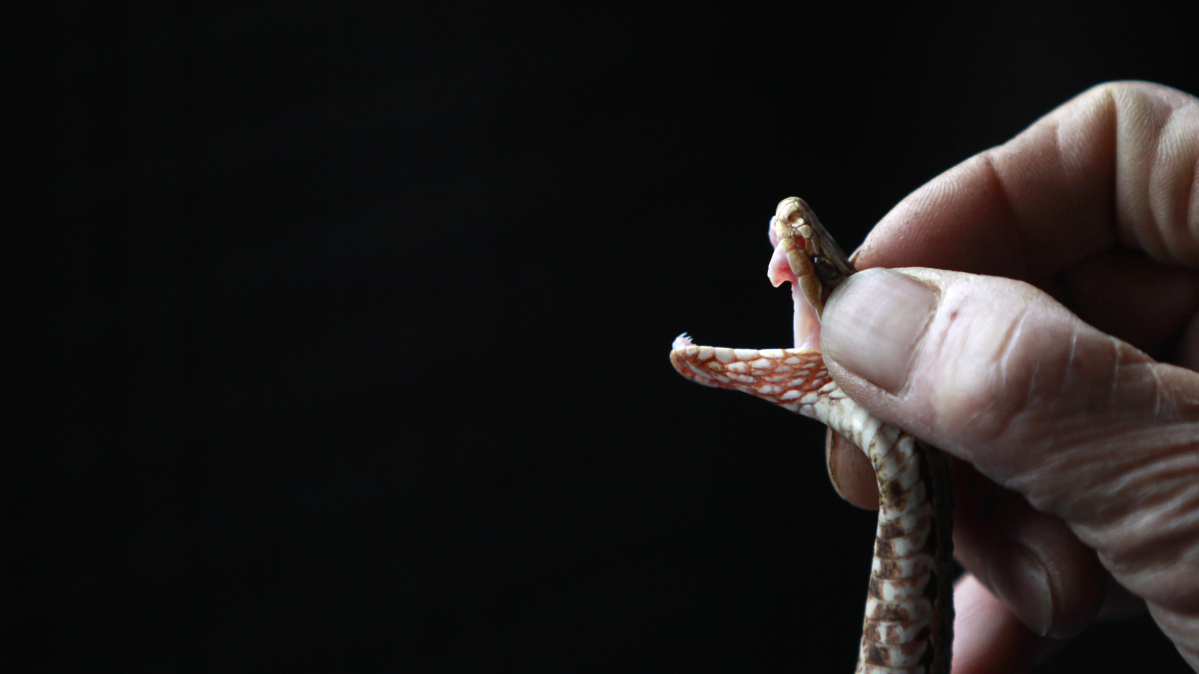
When threatened, the snake coils its body into a figure-eight shape and raises its blunt, rounded tail to mimic the appearance of its own head - a behaviour so convincing that it has earned the creature the nickname “the two-headed snake”.
For predators moving across the forest floor, the sight of what appears to be a snake facing in two directions at once is enough to cause hesitation.
Researchers believe that brief moment of uncertainty is all the snake needs. Despite the dramatic display, the species was described as docile and non-aggressive. It is a bluffer, not a fighter.
A hidden life beneath the forest floor
The species is primarily nocturnal and semi-fossorial, meaning it spends much of its life hidden beneath leaf litter, in decaying soil and within rock crevices.
Field teams found it in broadleaf forests at an altitude of approximately 760 metres, where it feeds on a specialised diet of earthworms and soft-bodied insect larvae.
It is, in other words, a creature built for a quiet, hidden life - which is probably why it went undetected for so long.
Scientists confirm a completely new species
Researchers confirmed the species by combining detailed physical observations with molecular analysis, ruling out the possibility that it was simply a variation of an already known species.
The name Calamaria incredibilis - roughly translating as “incredible” or “unbelievable” - is a nod to the snake’s extraordinary defensive trick.
A biodiversity hotspot still revealing secrets
The discovery is not an isolated one. It is the second significant find in the Huaping National Nature Reserve this year alone, following the identification of a new toad species, the Huaping leaf-litter toad, earlier in 2026.
Researchers say the back-to-back discoveries point to something important: the reserve’s ancient forests are far richer in undiscovered life than previously understood, and the region is increasingly being recognised as a vital global reservoir of rare and unique species.


















What is your opinion on this topic?
Leave the first comment