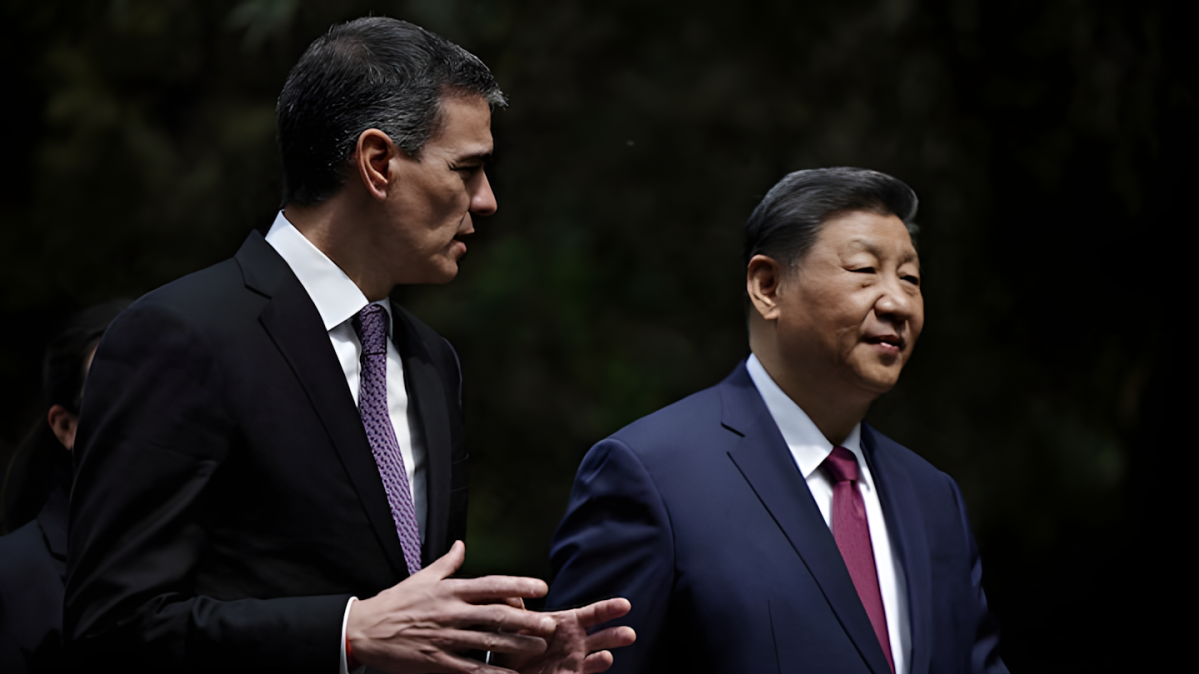
Spanish Prime Minister Pedro Sanchez declared on Monday that China must assume a far more substantial leadership role on the global stage, urging Beijing to take the helm on critical issues ranging from climate change and security to defence and the fight against extreme inequality.
Delivering a keynote address at Beijing's prestigious Tsinghua University, Sanchez framed this geopolitical pivot as an absolute necessity for global stability, bluntly noting that Europe will also be forced to redouble its international efforts as the United States actively withdraws from its historical leadership roles on multiple fronts.
Sanchez is currently undertaking his fourth official visit to China in four years, a frequency that highlights the premium Madrid places on the bilateral relationship. His visit occurs against a complex backdrop, as numerous Western governments struggle to balance the necessity of maintaining diplomatic engagement with Beijing against lingering, deep-seated anxieties regarding national security and severe trade imbalances. Notably, his trip follows a flurry of similar diplomatic missions to China earlier this year by the prime ministers of Britain, Ireland, Canada, and Finland.
Successive administrations in Madrid have positioned the country as one of Europe's most vocal and persistent proponents of expanding bilateral trade. Unlike hawkish factions within the European Union bloc that advocate for "de-risking" or decoupling, Spain has consistently argued for treating China as an indispensable strategic ally rather than an inevitable economic and geopolitical rival.
Call for shared global stewardship
During his address to university students, Sanchez was specific about the areas where he believes Chinese leadership is now essential. He stated that China possesses the capacity to do significantly more in terms of financing the fight against climate change, promoting global health initiatives, controlling the rapid development of responsible artificial intelligence (AI), and halting the proliferation of nuclear weapons.
The Spanish Prime Minister also praised Beijing’s recent diplomatic positioning, suggesting that China’s immense geopolitical weight could be used to enforce international stability. He cited the need for China to act "by demanding, as it is doing, that international law be respected and that the conflicts in Lebanon, Iran, Gaza and the West Bank, and Ukraine cease."
The underlying premise of Sanchez's speech was the changing nature of the transatlantic alliance and the reality of a fracturing global order.
"Europe will also have to redouble its efforts, especially now that the United States has decided to withdraw from many of these fronts," Sanchez noted.
Economic imperative: Addressing the trade deficit
While the public rhetoric focused heavily on the architecture of a multipolar world, the core of Sanchez's mission is fundamentally economic. On Tuesday, the Spanish Prime Minister is scheduled to hold a highly anticipated bilateral meeting with Chinese President Xi Jinping, where they are expected to focus heavily on the intersection of geopolitics and commerce.
Behind the diplomatic warmth lies a staggering economic imbalance that Madrid is desperate to correct. During his speech, Sanchez highlighted the sobering reality that China currently accounts for a massive 74% of Spain's total national trade deficit. He argued that deeper cooperation is vital to building a "balanced, globalised economy that generates shared prosperity," rather than one that hollows out European manufacturing.
The Spanish government hopes that the goodwill generated by Sanchez's frequent visits will translate into tangible economic concessions, specifically aiming to narrow a trade deficit that more than doubled over the past four years, ballooning to nearly $50 billion in 2025.
Madrid is also looking to boost its agricultural and high-end manufacturing exports to the Chinese mainland, seeking preferential market access to offset the overwhelming volume of cheap Chinese imports flooding the Spanish market.
Beijing appears receptive to the diplomatic overtures. China's official state news agency, Xinhua, published a glowing editorial on Monday stating that Sanchez's visit was set to further consolidate bilateral ties. The agency pointed to the relationship between Madrid and Beijing as an example of a "broader pathway for steady engagement between China and Europe at a time of growing global uncertainty," signalling that China views Spain as a crucial, friendly wedge within the often-sceptical EU.
















What is your opinion on this topic?
Leave the first comment