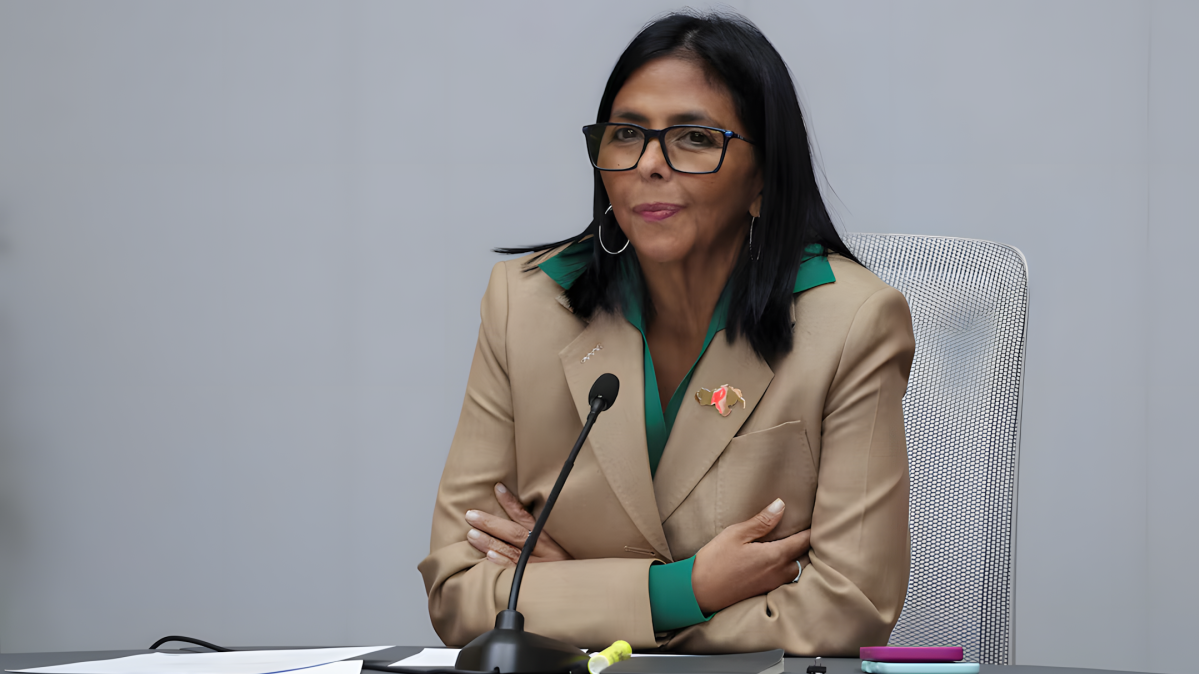
In a major policy reversal, the U.S. Treasury has removed Venezuela’s acting president, Delcy Rodríguez, from its sanctions list, signalling a sharp shift in Washington’s approach to Caracas.
The announcement, published quietly on the Treasury’s website on Wednesday, follows three months of intense behind-the-scenes diplomacy. It comes after the unprecedented U.S. military raid on 3 January that led to the capture and extradition of Nicolás Maduro.
Since then, Washington has moved quickly to engage with Rodríguez’s interim government. The shift marks a departure from its previous “maximum pressure” strategy towards a more pragmatic approach aimed at reopening Venezuela’s vast oil reserves to Western investment.
A rapid geopolitical realignment
The speed at which the Trump administration has legitimised the new leadership in Caracas has surprised many observers. Washington formally recognised Rodríguez as Venezuela’s head of state in March, a move that allowed her government to begin reopening embassies and consulates across the U.S.
This engagement has gone well beyond symbolism. The White House has already sent the U.S. Secretaries of Energy and the Interior to Caracas, alongside prospective investors.
These visits have led to agreements enabling the U.S. to market and sell Venezuelan crude on global markets. Washington has also welcomed legislative reforms in Caracas aimed at opening the oil and mining sectors to foreign capital, rewarding these steps with targeted sanctions relief.
Leverage remains in place
Despite the warming ties, strict limits remain. Several senior figures from Maduro’s former inner circle are still under heavy U.S. sanctions.
Among them are former Interior Minister Diosdado Cabello and former Defence Minister Vladimir Padrino, both of whom face drug trafficking and narco-terrorism charges in U.S. federal courts. They deny the allegations.
Neither Rodríguez nor her brother Jorge Rodríguez, head of the National Assembly, has been formally charged. However, the threat of legal action continues to loom.
Reports suggest the Trump administration has been quietly building a legal case against Rodríguez, giving Washington significant leverage as it pushes for structural reforms and seeks to counter the influence of Russia and China.
Battle for Citgo and economic reset
The immediate impact of lifting sanctions is economic. By removing Rodríguez from the Office of Foreign Assets Control blacklist, the U.S. has enabled her to act as Venezuela’s official representative in international business and legal affairs.
Her administration is now preparing to assert control over the boards of PDVSA’s U.S.-based subsidiaries. The most significant of these is Citgo Petroleum.
Since 2019, the Houston-based refiner has been controlled by boards appointed by a now-defunct, U.S.-backed opposition congress. Reclaiming Citgo would deliver a major financial boost to the interim government and mark a decisive break from the opposition movement previously supported by Washington.
Push for full normalisation
Rodríguez welcomed the decision, calling it a step towards improved relations. Writing on X, she said it marked “a step in the direction of normalising and strengthening relations between our countries.”
She added that her government ultimately seeks the full lifting of sanctions.
“We trust that this progress will allow for the lifting of the sanctions currently in place on our country, enabling the building and guaranteeing of an effective bilateral cooperation agenda for the benefit of our peoples,” she said.
Possible Trump summit
Diplomatic momentum appears to be building towards a potential high-profile meeting. Rodríguez is reportedly preparing for a visit to the U.S. for a summit.
While she has hosted international delegations in Caracas, she has yet to meet a head of state in person as acting president.
A meeting with President Trump would mark a significant milestone, cementing a controversial but potentially lucrative new phase in U.S.-Venezuela relations following Maduro’s downfall.















What is your opinion on this topic?
Leave the first comment