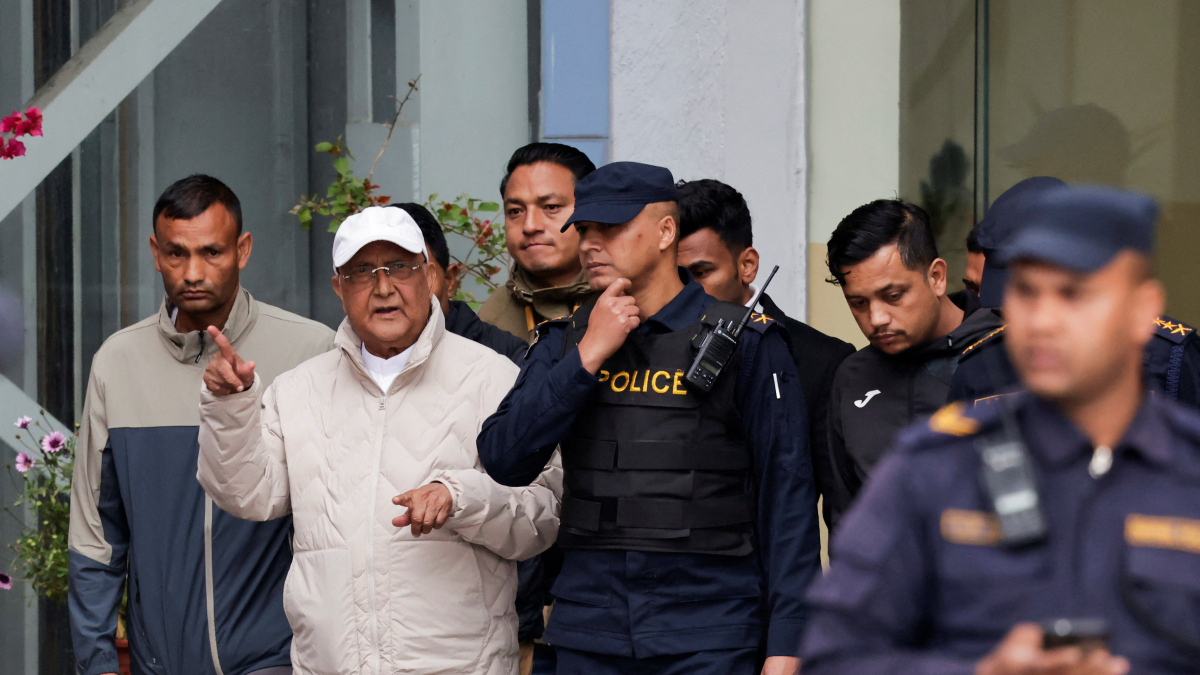
Nepal’s ousted former prime minister, KP Sharma Oli, and former home minister Ramesh Lekhak have been arrested over alleged negligence linked to the deaths of protesters during anti-corruption demonstrations last September.
“Promise is promise. No one is above law,” current Home Minister Sudan Gurung wrote on Facebook. “Former prime minister KP Sharma Oli and former home minister Ramesh Lekhak are taken under control.”
Gurung, who took part in the mass protests, said the arrests were not driven by revenge. “It’s just the beginning of justice. I hope the country will take a new direction,” he said.
Police said Oli and Lekhak were detained as part of an investigation into whether they failed to prevent dozens of deaths during the protests.
They were arrested a day after Balendra Shah, a rapper-turned-politician, was sworn in as prime minister, following a recommendation by a Nepali panel that both men should be prosecuted for negligence.
A total of 76 people were killed over two days of unrest, which ultimately led to Oli’s resignation.
Police spokesman Om Adhikari said both men were being held at the Kathmandu Police Office and would be produced before a court on Sunday, a working day in Nepal.
"We have arrested them as per the recommendations made by the investigation commission," he said.
Oli, 74, who has previously undergone two kidney transplants, was later transferred from the police office to a hospital, according to witnesses.
His lawyer, Tikaram Bhattarai, said the arrest was unjustified.
"They have said it (the arrest) is for investigation. It is illegal and improper because there is no risk of him fleeing or avoiding questioning," he said.
Lekhak and his lawyer could not immediately be reached for comment.
Oli leads the Communist Party of Nepal (Unified Marxist–Leninist), while Lekhak is a senior figure in the Nepali Congress.
Dozens of police officers were deployed to Oli’s residence in Bhaktapur after the cabinet approved the implementation of a report by a judicial commission set up to investigate last year’s protests.
The commission, led by retired special court chairman Gauri Bahadur Karki, recommended investigations into Oli, Lekhak and Police Chief Chandra Kuber Khapung for alleged criminal negligence.
The panel held Oli responsible for failing to act to stop hours of gunfire, which killed at least 19 protesters on the first day of demonstrations.
Supporters of Oli’s party clashed with police outside his residence, but officers eventually cleared the area and detained him.
The cabinet also moved to establish a committee to examine the role of security officials accused in the shootings.
Leaders from both the UML and the Nepali Congress have described the report as incomplete and biased. The UML has called an emergency meeting to assess the situation.
“It's prejudice and revenge against us,” said Mahesh Basnet, a UML secretary. “The emergency meeting will decide our future course,” he added.
At least 25 protesters, most of them young people, were killed and about 700 others injured during the demonstrations. The unrest followed a ban on social media companies and ultimately led to the removal of Oli’s government.
Anger over the deaths helped propel Shah’s Rastriya Swatantra Party to a landslide election victory earlier this month.










What is your opinion on this topic?
Leave the first comment