Four years into Russia’s invasion of Ukraine, the war can be measured not only in lives and territory, but in money. In Part One, the war’s cost was measured in casualties and kilometres. In Part Two, it is measured in billions of dollars.
In the second part of this series, the focus shifts from the battlefield’s human toll to the financial and industrial machinery sustaining the fight.
The money behind the war in Ukraine: Who pays and how much?
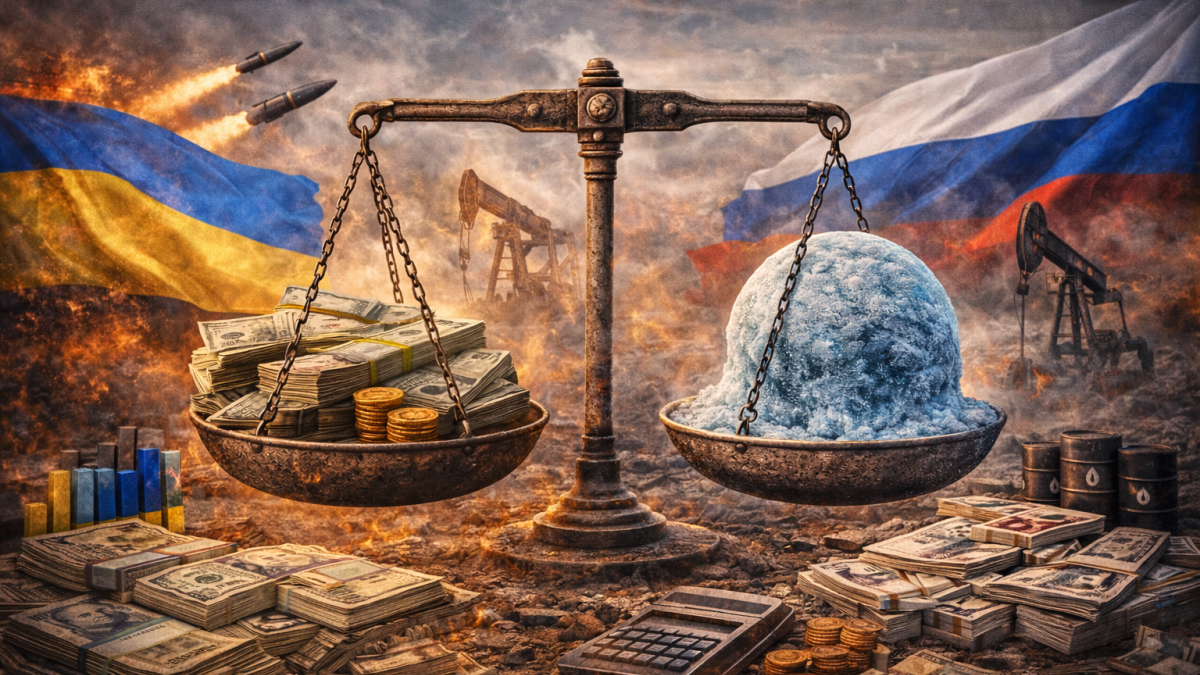
The war is sustained not only by weapons and manpower, but by budgets, borrowing and export revenues. The financial contest now rivals the battlefield in determining the duration of the conflict.
More than 400 billion U.S. dollars pledged to Ukraine
Since February 2022, Western governments and partners have pledged over 400 billion U.S. dollars in combined military, financial and humanitarian assistance to Ukraine. That figure includes military equipment, macro-financial support, humanitarian aid and refugee assistance. It reflects pledges and approved packages, not only disbursed cash.
United States
The United States remains the largest single national donor.
Since 2022, Congress has approved approximately 175 to 180 billion U.S. dollars in Ukraine-related funding.
Of that total:
Roughly 66 to 70 billion U.S. dollars has been allocated for military assistance
The remainder covers economic support, humanitarian aid and replenishment of U.S. defence stockpiles
Not all approved funding has been spent. A portion remains allocated for future deliveries and long-term programmes.
European Union and member states
The European Union and its member states collectively rival U.S. commitments when military, financial and humanitarian support are combined.
Key confirmed figures:
- The EU’s Ukraine Facility provides 50 billion euros for 2024 to 2027
- EU macro-financial assistance since 2022 exceeds 40 billion euros
- Total EU institutional and member state support combined runs well above 150 billion euros across all categories
In 2025 alone, European military aid reached approximately 29 billion euros, a significant increase compared with the 2022 to 2024 annual average.
European financial and humanitarian flows in 2025 reached roughly 35 billion euros, most of it channelled through EU institutions.
On 30 January 2026, the European Commission announced 183 million dollars in emergency assistance for Ukraine.
United Kingdom
The United Kingdom has committed more than £20 billion (approximately 27 billion USD) since 2022, primarily in military and financial assistance.
Recently, the UK has pledged $205 million to help send U.S.-made weapons to Ukraine, as allies step up efforts to reinforce Kyiv’s air defences and battlefield capabilities.
UK Defence Secretary John Healey said Britain would commit £150 million (approximately 202.6 million USD) under the Prioritised Ukraine Requirements List (PURL) initiative. The programme was established last summer to maintain the flow of American weapons to Ukraine at a time when new U.S. military assistance had stalled in Congress.
The scheme enables allies to finance the purchase of U.S.-produced air defence systems and other critical equipment for Ukraine, rather than waiting for direct transfers from Washington.
According to Matthew Whitaker, the U.S. ambassador to NATO, allied countries have already committed more than $4.5 billion through the programme.
Ukraine’s allies have also pledged nearly 48 billion U.S. dollars in military support at a meeting of the Ukraine Defence Contact Group in Brussels, promising to step up pressure on Russia and reinforce Kyiv’s position on the battlefield.
NATO Secretary General Mark Rutte said five countries committed new funding to buy American weapons under Ukraine’s Priority Requirements List, thanking the UK, Iceland, Norway, Sweden and Lithuania for contributions worth “hundreds of millions of dollars”.
Canada, Japan and other NATO partners have pledged additional multi-billion-dollar packages.
Frozen Russian reserves: 280 billion U.S. dollars
Shortly after the invasion began, Western governments froze approximately 280 billion U.S. dollars in Russian central bank reserves.
These assets remain immobilised.
Rather than confiscating the principal, G7 governments agreed to use profits generated from the frozen reserves to back a 50 billion U.S. dollar loan facility for Ukraine.
The principal remains legally contested and has not been seized.
Sanctions pressure
Sanctions remain the primary financial pressure mechanism on Moscow.
As of late 2025, the European Union adopted its 19th sanctions package, expanding restrictions on:
- Russian financial institutions
- Energy and shipping networks
- Sanctions circumvention through third-country intermediaries
- Dual-use technology exports
A 20th package has been proposed and is under discussion, but had not yet been formally approved, as of February 2026.
Since 2022, EU–Russia trade volumes have fallen sharply. Russian oil exports have shifted toward Asian markets, often at discounted prices. Sanctions have not caused systemic financial collapse in Russia, but they have increased structural constraints on capital access, technology imports and long-term growth.
Defence burden in percentage terms
Absolute totals tell only part of the story. The relative burden on national economies is also significant.
Ukraine
- Defence spending has reached approximately 25 to 30 percent of GDP at peak wartime levels
- Military expenditure has accounted for roughly half of total state spending in some fiscal cycles
- External assistance finances much of Ukraine’s civilian budget
Russia
- Defence and security spending now consumes roughly one third of the federal budget
- Military expenditure is estimated at 6 to 8 percent of GDP, the highest share in the post-Soviet period
Across Europe, many NATO members now exceed 2 percent of GDP in defence spending, with some eastern flank states surpassing 3 percent.
How Russia funds the war
Russia finances its military campaign primarily through:
- Federal budget allocations
- Oil and gas export revenues
- Domestic borrowing
Energy income remains central despite price caps and sanctions. Defence production has become a major component of industrial output.
Russia has increased domestic debt issuance to sustain elevated military spending.
Inflationary pressure and labour shortages remain constraints, but there has been no fiscal collapse.
Reconstruction and long-term costs
Ukraine’s reconstruction needs are estimated at well above 400 billion U.S. dollars, according to joint international assessments.
That figure reflects damage to housing, energy infrastructure, transport networks and industry.
Current pledged reconstruction financing covers only a portion of projected long-term needs. The total cost will rise if fighting continues.
A war measured in billions
Four years into the full-scale invasion of Ukraine, the financial dimension is defined by:
- More than 400 billion U.S. dollars pledged to Ukraine
- Approximately 280 billion U.S. dollars in frozen Russian reserves
- A 50 billion U.S. dollar G7 loan backed by frozen asset profits
- Defence spending equal to 25 to 30 percent of Ukraine’s GDP
- Military and security spending consuming roughly one third of Russia’s federal budget
- Reconstruction needs exceeding 400 billion U.S. dollars
- EU announces €153 million in humanitarian aid for Ukraine, €8 million for Moldova
- EU aid for Ukraine expected to increase in 2026
- Ukraine receives $2 billion military aid under PURL programme
- U.S. approves first Ukraine arms aid paid for by NATO allies, sources say
Major military systems supplied
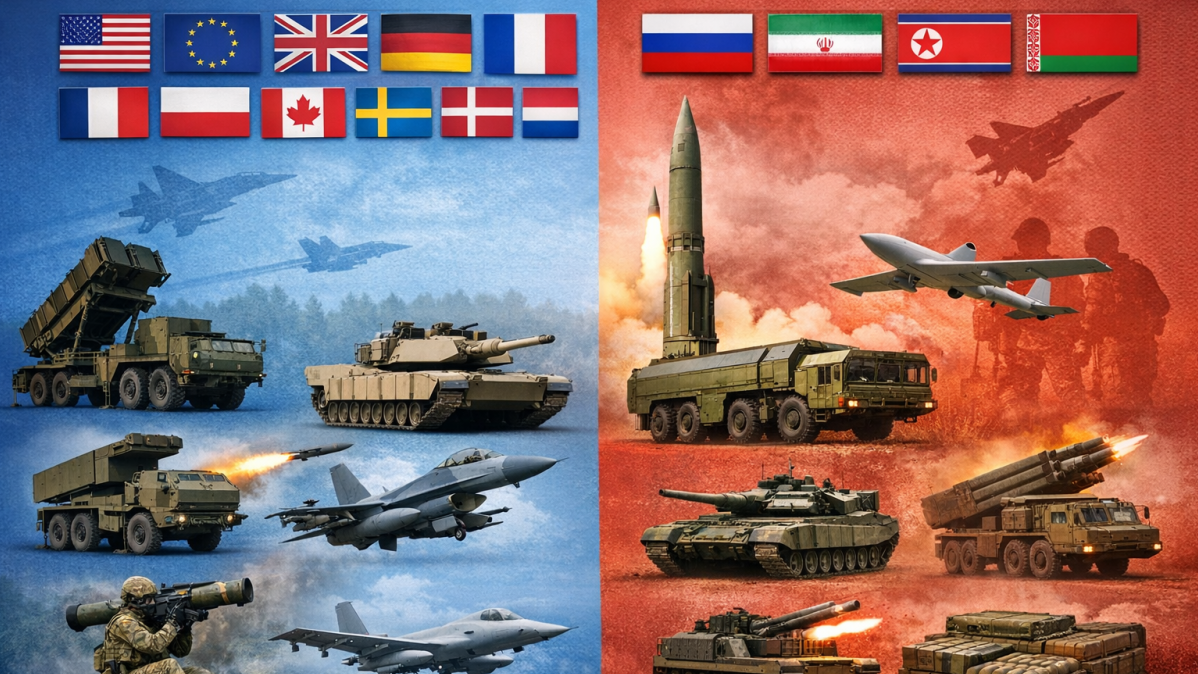
What began with portable anti tank weapons evolved into deliveries of long range air defence, heavy armour, precision strike systems, modern artillery and Western fighter aircraft.
By 2025, Europe increased its share of military assistance as U.S. budget flows slowed compared with earlier phases, although the United States remains the largest single military supplier overall since 2022.
Long-range air defence systems
Air defence has become one of the most strategically critical components of support.
Ukraine has received multiple Patriot air defence systems, supplied by the United States and European partners including Germany and the Netherlands. Patriot batteries are capable of intercepting ballistic missiles, cruise missiles and high altitude aircraft, making them central to the protection of major cities and energy infrastructure.
Additional Patriot interceptors and components have been financed through coordinated allied mechanisms.
The United States has also delivered more than a dozen NASAMS (National Advanced Surface-to-Air Missile System). Germany has supplied several IRIS T SLM surface-to-air missile systems.
Germany transferred more than 50 Gepard anti aircraft tanks, widely used to counter drones at shorter range.
As Russian missile and drone attacks intensified in 2024 and 2025, European funding for air defence increased further. Germany’s 2026 military allocation includes financing for the replacement of two Patriot systems alongside artillery, drones and armoured vehicles.
Heavy armour and main battle tanks
The transfer of Western main battle tanks marked a significant escalation in support.
European nations collaborated on Leopard 2 deliveries, with a combined total of roughly 80 to 100 Leopard 2 variants pledged.
The United Kingdom supplied 14 Challenger 2 tanks.
The United States committed 31 M1 Abrams tanks. Australia pledged an additional 49 Abrams tanks, bringing total Abrams commitments to around 80 vehicles.
Earlier in the war, Poland and other Central European states transferred hundreds of Soviet era T 72 tanks and armoured vehicles.
In 2025, Germany provided approximately 9 billion euros in military aid, making it Europe’s largest single donor that year. That represented an increase of roughly 130 percent compared with its annual average between 2022 and 2024.
Long range precision strike systems
Precision strike systems extended Ukraine’s operational reach.
The United States delivered more than 30 HIMARS launchers, along with guided rockets.
Later transfers included ATACMS long-range missiles, capable of striking targets beyond 160 kilometres.
The United Kingdom and France supplied Storm Shadow and SCALP cruise missiles, enabling deep strikes against logistics hubs and command infrastructure.
Artillery and ammunition
Artillery remains central to high intensity warfare.
The United States supplied more than two million 155 millimetre artillery rounds. European countries pledged over one million additional shells under joint procurement initiatives.
France delivered Caesar self propelled howitzers. Sweden supplied Archer artillery systems and additional armoured platforms.
In 2025 alone, European countries provided approximately 29 billion euros in military aid, compared with an annual average of 17 to 18 billion euros between 2022 and 2024, an increase of roughly two thirds.
Fighter aircraft
A coalition led by the Netherlands and Denmark pledged more than 60 F-16 fighter aircraft.
Deliveries began in phases following pilot and maintenance training.
The introduction of Western fighter aircraft represents one of the most significant upgrades to Ukraine’s air capabilities since the invasion began.
Tactical anti tank systems
In the opening months of the war, portable anti tank systems were decisive.
The United States delivered tens of thousands of Javelin missiles. The United Kingdom supplied thousands of NLAW (Next generation Light Antitank Weapon) systems.
These systems were instrumental in halting early armoured advances.
Unmanned systems
Unmanned systems have become a defining feature of the conflict.
Türkiye supplied Bayraktar TB2 drones early in the war. Western partners later provided reconnaissance drones, loitering munitions and counter drone systems.
Drones now form a core element of reconnaissance, targeting and strike coordination.
Russia’s external military support
Russia relies primarily on domestic defence production and state financing.
However, Iran supplied large numbers of Shahed type drones used in attacks on Ukrainian infrastructure.
North Korea has reportedly transferred significant quantities of artillery ammunition to replenish Russian stockpiles. Russia has also increased domestic production of shells, drones and missiles to sustain operations.
Four years into the invasion, the war can be measured in several ways: in lives lost, in kilometres of territory gained and retaken, and in the hundreds of billions of dollars committed to sustain the fight. Neither side shows signs of financial exhaustion. The map has started to solidify, but it has not settled. The casualty figures continue to rise. The aid packages continue to be negotiated.
As the war enters its fifth year, the defining question is no longer only who controls more land but who can sustain the cost the longest.












What is your opinion on this topic?
Leave the first comment