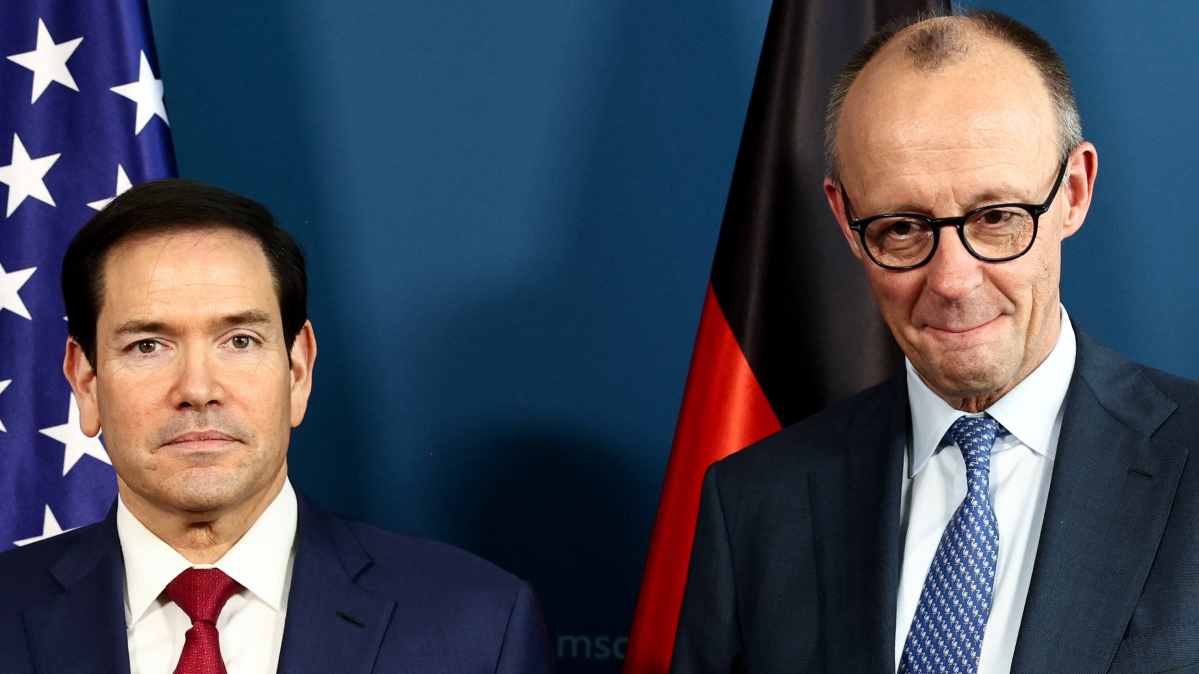
German Chancellor Friedrich Merz declared the end of the "world order" as the 2026 Munich Security Conference opened, warning of an era of “big power politics” driven by Russia, China and shifting U.S. leadership.
Chancellor Merz said the Conference had long served as a “seismograph for the political situation”, but argued that today’s global landscape is far more severe than in previous decades.
Referring to the Conference motto “Under Destruction”, he said the description was “grim” yet insufficient, insisting the international order had effectively collapsed.
Merz warned that Europe had “returned from a vacation from history” and now faced an era marked by “big power politics”, citing Russia’s “violent revisionism” behind its aggression in Ukraine and China’s ambition to reshape the global order in its own favour by leveraging economic dependencies. He added that the United States’ claim to global leadership “has been challenged and possibly lost”.
The German Chancellor argued that commodities, technology and supply chains are central to the emerging geopolitical order, as Washington seeks to catch up with Beijing in strategic sectors. He urged Europeans to accept the new reality and stop denying the scale of the challenge.
In unusually blunt terms, Merz acknowledged that German foreign policy in past decades had shown a “normative surplus of the best intentions”, often criticising violations of international rules without possessing the means to enforce solutions.
The widening gap between ambition and capability, he said, must now be closed.
Pointing to economic disparities, Merz noted that Russia’s GDP stands at roughly €2 trillion, compared with the European Union’s economy nearly ten times larger, yet Europe is “not 10 times as strong as Russia today”. Its military, political and technological potential remains underutilised, he said.
“So the most important thing is to turn the switch in our minds now,” Merz declared, warning that both excessive and insufficient state power can erode freedom.
Quoting Polish Foreign Minister Radosław Sikorski’s remark that he feared German inactivity more than German power, Merz framed Germany’s renewed responsibility as central to Europe’s response to global instability.
Macron pushes nuclear rethink
French President Emmanuel Macron used the same stage to argue that Europe must become a geopolitical power capable of guaranteeing its own security, including through a rearticulation of France’s nuclear deterrent in response to what he described as an enduringly aggressive Russia.
“This is the right time for audacity. This is the right time for a strong Europe,” Macron said. “Europe has to learn to become a geopolitical power. It was not part of our DNA.”
He insisted that even if a settlement were reached in Ukraine, Europe would continue to face a hostile Russia and could not accept a short-term accord that failed to address core security issues.
Macron said Europe must shift towards long-term strategic thinking, develop deep-strike capabilities and reassess how France’s nuclear doctrine could fit within a broader European security architecture.
“We have to reshuffle and reorganise our architecture of security in Europe,” he said, arguing that structures designed during the Cold War were no longer adapted to current threats. “We have to rearticulate nuclear deterrence in this approach.”
He confirmed that consultations had already begun with Chancellor Merz and other European leaders, including British counterparts, and that he would outline his vision for France’s nuclear role in Europe in a dedicated speech later this month.
“Everyone should take their cue from us, instead of criticising us,” Macron added, dismissing claims that Europe was in decline and defending efforts to regulate disinformation and social media practices that he said were undermining Western democracies.
Ukraine-China dialogue
Ukraine’s Foreign Minister Andrii Sybiha said he had invited his Chinese counterpart to visit Kyiv, suggesting Beijing could play a key role in ending Russia’s four-year war against Ukraine.
Speaking to Ukrainian broadcaster Novyny Live on the sidelines of the Munich Security Conference, Sybiha said he held a “very substantive and pragmatic conversation” with Chinese Foreign Minister Wang Yi and welcomed China’s stated support for Ukraine’s territorial integrity and sovereignty.
“China can play an important role in bringing about a just peace for Ukraine,” Sybiha said.
In a statement released by China’s foreign ministry, Wang said Beijing was “willing to provide new humanitarian assistance to Ukraine” and noted that dialogue efforts around the conflict were intensifying.
He added that China was prepared to maintain communication with Kyiv and work with the international community towards “an early political solution” to what Beijing describes as the “Ukraine crisis”.
Meanwhile, media report that Ukrainian President Volodymyr Zelenskyy has also arrived in Munich.
U.S. stance
“We are returning the world from the brink,” U.S. Ambassador to the United Nations Mike Waltz said at the Munich Security Conference, arguing that reform at the UN and a stronger US role are needed amid global security challenges.
Waltz argued that the United States will push for reform of the United Nations, calling for the organisation to return “to basics” in its peacekeeping and peacemaking mandate.
Waltz rejected characterisations of global affairs as a collapse of order, contending that reform of multilateral institutions was overdue and should be welcomed as part of broader efforts to tackle conflicts in Ukraine, Gaza and Iran.
He said U.S. President Donald Trump’s approach to the UN would mirror his pressure on NATO, insisting the world body needed to be put “on a diet” and made more efficient.
He stressed that Washington would begin paying some of its overdue dues to the UN budget in the coming weeks.
Opening remarks
Earlier, MSC chairman Wolfgang Ischinger opened the Conference with a quip about Davos and Macron-style sunglasses, drawing laughter from attendees, before pivoting to a serious message on global security.
Ischinger highlighted what he called “unprecedented challenges” in Europe and around the world, questioning whether a rules-based international order had ever truly existed.
Addressing leaders from the EU and the UN Security Council’s permanent members, specifically the United States and China, Ischinger sharply probed policies on European defence, nuclear non-proliferation and transatlantic alliances.
The chairman also touched on China’s potential role in persuading Russia to end its aggression in Ukraine, winning applause for his direct approach.
Bavarian Minister-President Markus Söder and German Chancellor Friedrich Merz are set to deliver keynote addresses on “Germany in Europe and the world” following Ischinger's speech.
Key topics
Discussions through the Conference are expected to place particular emphasis on transatlantic tensions, with U.S.-Europe relations coming under close scrutiny.
According to Germany’s foreign minister, Johann Wadephul, recent comments from U.S. officials have caused irritation within NATO, setting the stage for dialogue.
“This alliance is also under pressure. There is alienation, there is irritation about some of the things we hear from Washington. We need to talk about this here together. We want to define our common denominators and the meaning of NATO,” he told the press ahead of the conference.
According to media reports, Danish Prime Minister Mette Frederiksen plans to meet U.S. Secretary of State Marco Rubio to discuss Greenland, a semi-autonomous Danish territory, amid lingering tensions following President Donald Trump’s previous proposal to acquire the island.
Rubio-Zelenskyy meeting
Rubio, leading a sizeable U.S. delegation, is also expected to meet Ukrainian President Volodymyr Zelenskyy during the Conference.
Before departing for Munich, Rubio was asked whether Europeans should expect another combative address, similar to comments made last year by U.S. Vice President JD Vance, or a more conciliatory tone.
Rubio responded that officials would have to wait until Saturday, adding that he expects the speech to be “well received.” He said European leaders “want honesty” and “to know where we’re going, where we’d like to go, and where we’d like to go with them,” stressing that this is the U.S. delegation’s hope for the conference.
More than 50 members of the U.S. Congress, along with the governors of Michigan and California, are expected to attend the Conference, according to Chairman Ischinger.
Ischinger said the gathering will be a crucial forum to address the “considerable crisis of trust and credibility” in transatlantic relations, with Rubio expected to focus on U.S. foreign policy rather than domestic political disputes.













What is your opinion on this topic?
Leave the first comment