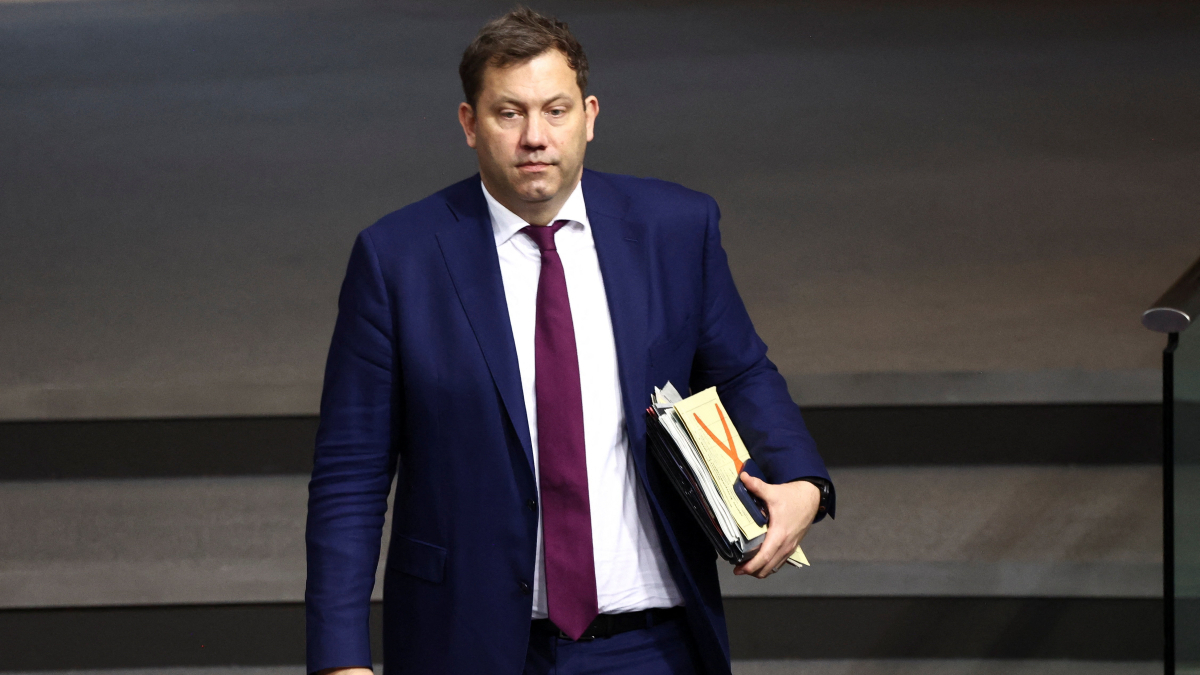
Germany’s finance minister has urged a new era of “European patriotism” to protect the continent’s economic interests, calling for state-backed companies to retain jobs in Europe and for public spending to prioritise European-made goods.
Speaking on Wednesday at a lecture hosted by the German Institute for Economic Research (DIW Berlin), Lars Klingbeil said Europe needed to fundamentally rethink its economic strategy as long-standing alliances weaken and trade is increasingly used as a political weapon.
“We need more European patriotism,” Klingbeil said, adding that public investment should be directed towards products manufactured in Europe.
He warned that the transatlantic relationship was changing rapidly, arguing that the alliance as previously understood was breaking down.
Referring to the Trump administration’s National Security Strategy, Klingbeil said the United States was increasingly “turning away from Europe, both politically and culturally”.
His remarks follow strong criticism of U.S. foreign policy by German President Frank-Walter Steinmeier earlier this week, when he spoke of a “breakdown of values” that had underpinned the global order for decades.
Klingbeil said global trade was becoming more confrontational, with subsidies, industrial overcapacity, tariffs and export controls placing growing pressure on Germany’s export-driven economy.
Europe’s largest economy shrank in both 2023 and 2024, and is expected to grow by just 0.2 per cent in 2025, with preliminary figures due to be released on Thursday.
“We have to become stronger and more sovereign so that we do not end up as pawns of the major powers,” Klingbeil said.
He warned that those who believed Germany could simply rely on exports to recover were underestimating the scale of the economic and geopolitical shifts under way.
He outlined a strategy focused on reinforcing European unity, diversifying trade relationships beyond the United States, and shielding European markets from unfair competition.
Klingbeil also highlighted Germany’s long-standing modernisation backlog, warning that it posed a serious threat to the country’s competitiveness.
He pointed to visible shortcomings such as crumbling bridges, delayed trains and rundown schools, as well as less obvious problems including lengthy approval processes and excessive regulation.
Germany’s coalition government plans to significantly increase public spending on defence and infrastructure, aiming to address years of underinvestment while pulling the economy out of stagnation.
According to Klingbeil, sustainable modernisation and growth can only be achieved through a combination of public and private investment. “The most dangerous thing at this point would be to accept the status quo,” he said. “If we do that, we will continue to lose economic strength, social cohesion and political legitimacy.”













What is your opinion on this topic?
Leave the first comment