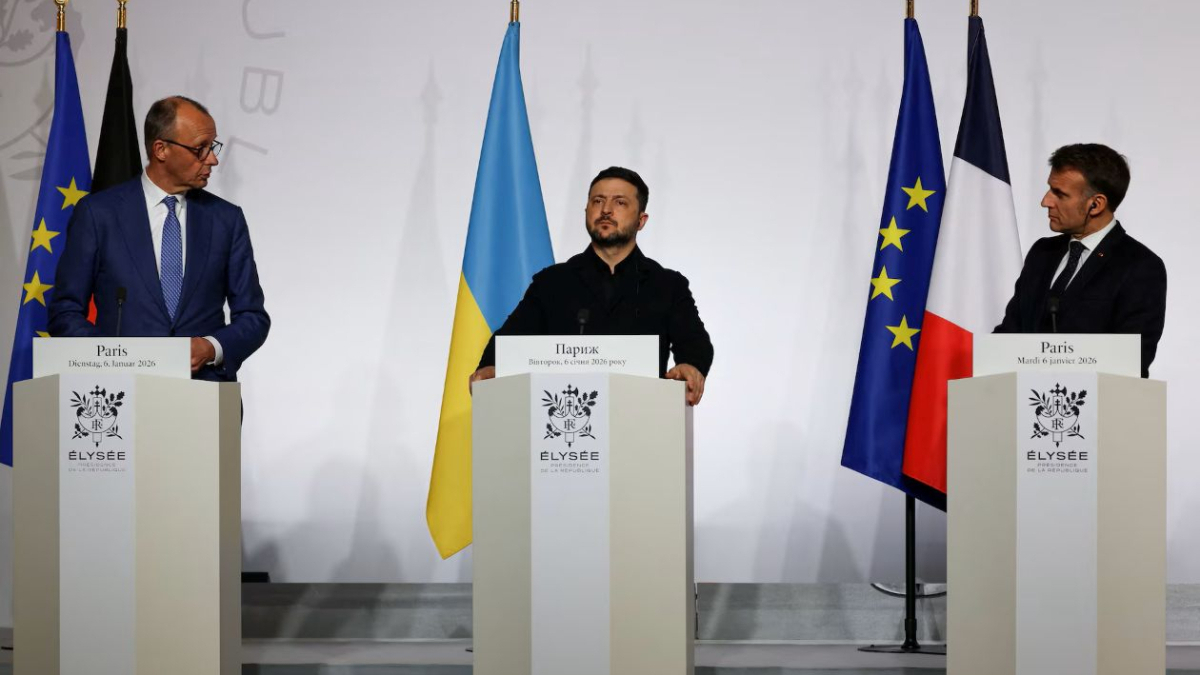
Leaders from the U.S. and European countries moved closer to finalising legally binding security guarantees for Ukraine following a “Coalition of the Willing” meeting in Paris on Sunday.
The package includes a high-tech mechanism to monitor a ceasefire, a multinational force led by France and the UK, and a legally binding commitment to assist Kyiv in the event of a future Russian attack.
Keir Starmer, UK Prime Minister, said the UK and France would establish military hubs across Ukraine and build protected facilities for weapons and military equipment once a ceasefire is in place.
Emmanuel Macron, French President, added that the multinational force would operate “away from the contact line” in the air, at sea, and on land, providing crucial reassurance to prevent another Russian attack. He noted that Türkiye would provide maritime support.
Macron emphasised that the security guarantees are designed to ensure that a peace agreement does not lead to Ukraine’s surrender or a new threat.
The guarantees also include a U.S.-led high-tech monitoring system and a commitment to provide assistance should Russia launch a renewed offensive. Modelled on NATO’s Article 5 of collective defence, the obligation could cover military, logistical, economic, and diplomatic support.
Ratification by each country’s parliament will be required, a process that could prove difficult in some European states where support for Ukraine is weakening. In the U.S., the agreement will require approval by Congress.
Friedrich Merz, German Chancellor, said Germany’s contribution would depend on Bundestag approval and limited troop deployments to NATO territories neighbouring Ukraine.
“Fundamentally, we rule nothing out,” Merz said.
Pedro Sánchez, Spanish Prime Minister, said Spain would hold discussions with relevant parties about its contribution, which could include troops.
“2026 could be the year the war ends. This is very good news,” he said. “Europe never wanted this war.”
The meeting brought together leaders from around 30 Western countries, alongside representatives from Türkiye, Australia, Japan, and New Zealand. The U.S. delegation was led by Steve Witkoff and Jared Kushner. Initially, Secretary of State Marco Rubio was expected to attend, but his schedule changed due to recent events in Venezuela.
Also present were European Commission President Ursula von der Leyen, European Council President António Costa, High Representative Kaja Kallas, and NATO Secretary General Mark Rutte, with NATO’s Supreme Allied Commander Europe, Alexus Grynkewich (SACEUR), also participating.
Von der Leyen described the meeting as “a strong display of unity.”
“We stand with Ukraine, and a safe, prosperous future lies ahead,” she said.
The leaders outlined the security guarantees around five main pillars: a U.S.-led ceasefire monitoring mechanism, military support for the Ukrainian army, the multinational force led by France and the UK, the legally binding commitment to assist Ukraine in case of a new attack, and long-term defence cooperation.
For Ukraine, a credible deterrent is a key condition to give up its constitutionally enshrined aspiration to join NATO, a move strongly opposed by Moscow and not supported under President Donald Trump’s administration.
However, realising an Article 5-style guarantee faces significant challenges. European governments will need to convince parliaments, some paralysed by political deadlock, to approve a consequential commitment.
The obligation to assist Ukraine would rely on a high-tech monitoring system along the contact line to detect potential violations and assign responsibility. If Russia is deemed responsible, the Article 5-style assistance would be triggered, though this would be a political, not automatic, decision, according to European officials.
Ukrainian President Volodymyr Zelenskyy, Ukrainian President, called the meeting “a major step forward” but added that the efforts are still insufficient.
“It will be enough when the war in Ukraine ends.”
At present, Russia has shown no willingness to compromise on a peace deal and continues drone and missile attacks on Ukrainian cities, causing significant civilian and infrastructure damage.
Keir Starmer said “We can only reach a peace deal if Putin is ready to compromise. Despite Russia’s words, Putin is not showing that he is prepared for peace.”
















What is your opinion on this topic?
Leave the first comment