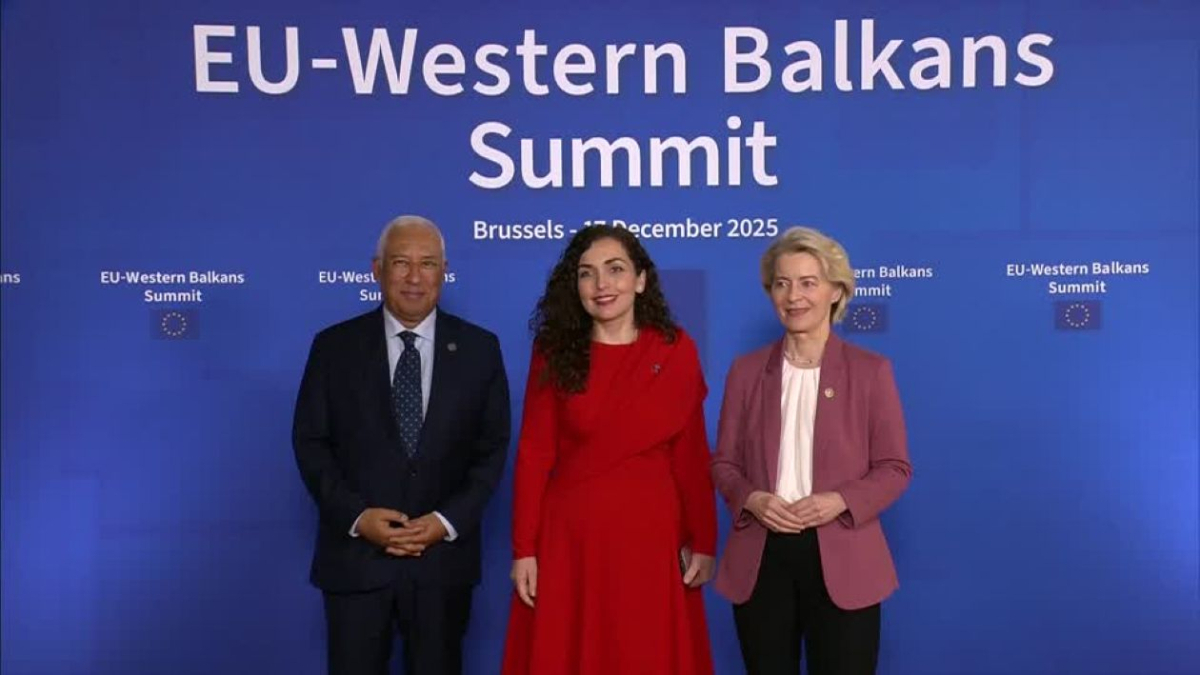
European Union and Western Balkans leaders met in Brussels on Wednesday for a high-level summit aimed at strengthening strategic ties and advancing the EU enlargement agenda, with officials emphasising the strategic importance of bringing the region into the bloc.
European Commission President Ursula von der Leyen and European Council President Antonio Costa greeted leaders from Kosovo, Albania, Montenegro, Bosnia and Herzegovina, and North Macedonia.
The European Commission said in November that the EU could welcome new members as early as 2030, praising Montenegro, Albania, Ukraine and Moldova for their reform progress.
Ahead of the summit, European Parliament President Roberta Metsola emphasised that EU enlargement is not a distant prospect.
“It is real, it is here, and it must happen. If we fail to recognise that enlargement is key for our geopolitical security, we risk meeting again in six months with no progress,” she said.
Hungarian Prime Minister Viktor Orban highlighted Serbia as a pivotal country.
“The enlargement process has failed over the past four years. Serbia has not moved an inch, while North Macedonia has made small progress. The Western Balkans are an economic gold reserve for the EU and play a key role in migration management,” Orban said.
Kosovo President Vjosa Osmani warned of external influence.
“The more Western Balkans countries advance towards the EU, the safer the Union. Ignoring our progress allows powers like Russia, China, and Iran to expand their influence, which is against the interests of both the Balkans and the EU.”
However, Montenegro President Jakov Milatovic expressed optimism for EU membership.
“We hope to join the EU as the 28th member state by 2028. The drafting of our accession treaty during Cyprus’ EU Council presidency will be a major step toward full membership.”
Agenda and strategic priorities
The summit underlined the political and economic importance of EU-Western Balkans relations. Leaders reaffirmed full support for the EU membership perspective of the Western Balkans and assessed progress in reforms, alignment with EU law (‘acquis’), regional cooperation, and good neighbourly relations.
Gradual integration and growth plan
The EU continues to support gradual integration of Western Balkan partners across multiple policy areas. The 2023 Growth Plan aims to further integrate the region into the EU single market, enhance economic cooperation, and encourage reforms, with up to €6 billion allocated for investments. Successful implementation is expected to accelerate economic growth and socio-economic convergence with the EU.
Foreign policy, security, and defence
Leaders reiterated solidarity with Ukraine and support for partners aligning with the EU’s Common Foreign and Security Policy (CFSP). Discussions included cooperation on security, defence, resilience to hybrid and cyber threats, and countering foreign interference and disinformation.
Migration and crime cooperation
Shared responsibilities were addressed in migration management, visa policy, combating human trafficking, border management, fighting corruption, organised crime, drug trafficking, and preventing terrorism and violent extremism.
Regular EU-Western Balkans summits have been held since 2018, with the last meeting in Brussels in December 2024.
The next summit is scheduled for June 2026 in Montenegro.











What is your opinion on this topic?
Leave the first comment