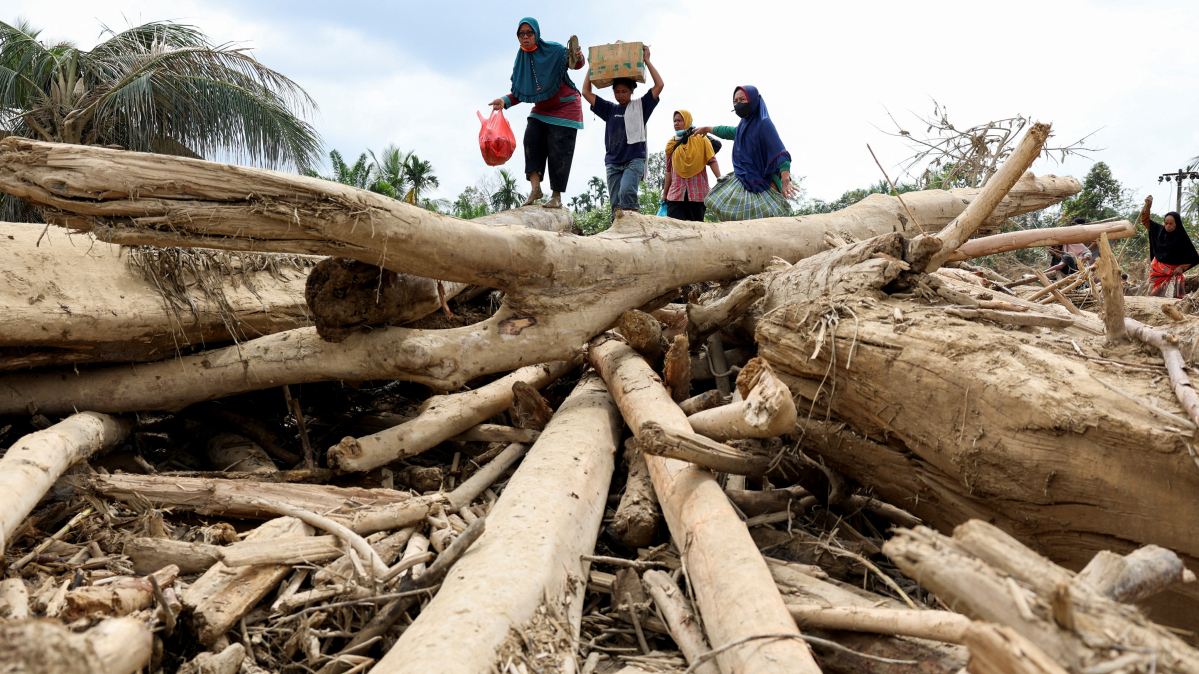
Residents in the Indonesian region of Aceh Tamiang climbed over slippery logs and walked for about an hour on Saturday to get aid, as the death toll from floods and landslides that hit Sumatra island this month rose to more than 900 people.
The death toll from the cyclone-induced floods and landslides across three Indonesian provinces on Sumatra, including Aceh, rose to 908 people on Saturday with 410 listed as missing, government data showed. The storm systems also killed about 200 people in southern Thailand and Malaysia.
Survivors in the Aceh Tamiang region, on the northeast coast of Sumatra, walked for an hour on Saturday, scrambling over scattered logs and passing overturned cars to reach an aid distribution centre set up by volunteers, they told Reuters.
Volunteers handed out clean clothes and brought in a tanker truck of fresh water so people could fill plastic bottles, Reuters witnesses said.
Dimas Firmansyah, a 14-year-old at an Islamic boarding school, said access in and out of Aceh Tamiang was cut, and that students had stayed at the school for a week, taking turns to search for food and boiling and drinking floodwater.
"We stayed for about a week there," Dimas said, urging the government to come to the area to see the calamity themselves.
Local government officials on Sumatra have called on the national government in Jakarta to declare a national emergency to free up additional funds for rescue and relief efforts.
Earlier this week, President Prabowo Subianto said the situation was improving and current arrangements were sufficient.
Halt on Companies
Green groups blame deforestation linked to mining and logging for amplifying damage from the floods, and Indonesia is investigating companies suspected of clearing forests around flood-hit areas.
Indonesia's environment ministry said it has temporarily halted the operations of the suspected companies, and that it will require them to perform environmental audits.
The companies include North Sumatra Hydro Energy, which runs the China-funded 510-megawatt hydropower plant in the Batang Toru region of North Sumatra, and miner Agincourt Resources, which operates the Martabe Gold Mine, also in Batang Toru.
Aerial surveys reveal land-clearing in Batang Toru that may have exacerbated the flooding, the environment ministry said.
North Sumatra Hydro Energy did not immediately respond to a query sent on LinkedIn. Agincourt Resources did not immediately respond to an emailed request for comment.
Survivors left living off looted goods
Flood survivors in Indonesia’s Aceh Tamiang district say they had to live off looted shop goods for days, accusing authorities of a slow aid response more than a week after deadly floods and landslides tore through their communities.
Police lines now ring ransacked convenience stores and a supermarket bearing the “Alfamidi” banner, even as families queue nearby for basic food packs being handed out from trucks.
Many describe a chaotic scramble in the first days after the floods, when shelves were stripped as people tried to feed their families.
“Oh dear, from the goods in the shop, or just take the goods out,” said 43-year-old resident Agus Suhaimi Azhar, standing by a mud-covered road lined with damaged buildings and cars. Asked whether there had been looting, he replied: “Yes, we survived on the spoils of looting.”
Another resident, 28-year-old Aidil Fitrah, said panic quickly took hold. “At that time, there was chaos everywhere, looting was happening, aid was too slow in coming,” he said.
According to him, relief supplies only began to arrive in earnest on the seventh and eighth days after the disaster, as authorities struggled with blocked roads and difficult access from other provinces.
Even as more trucks arrive, residents say urgent needs remain unmet. Fuel has become a lifeline for clearing debris, powering generators and transporting people, but is increasingly hard to find.
“What residents need right now is fuel, which is the most important thing,” Aidil said, adding that medicines, food and clean water are also in short supply. He said prices for basic goods have surged as stocks have run down.
Local people have also appealed directly to national leaders. Twenty-three-year-old Salman Alfaridzi called on President Prabowo Subianto to step in.
“So, Mr Prabowo, please help us with water, electricity, rice, oil and baby supplies, because there are many babies who need clothes,” he said. “Hopefully, we can get help for our lost homes.”
Indonesia’s military says it is trying to close the gap. Major General Ardianzah told reporters on Friday that soldiers are deploying mobile reverse osmosis units to turn polluted floodwater into drinking water, while aircraft continue to drop food and medical supplies to isolated communities cut off by damaged roads.
The disaster was triggered by a cyclone that brought intense rainfall, unleashing severe flooding and landslides across parts of Indonesia last week.
The national death toll rose to 867 on Friday afternoon, with a further 521 people still listed as missing, according to government data.
The same storm systems also caused heavy damage in southern Thailand and Malaysia, where about 200 people have been reported killed.
In Aceh Tamiang, however, the focus remains on the immediate struggle to restore power, secure clean water and rebuild homes - and on the lingering anger among survivors who say they were left to fend for themselves in the crucial early days.


















What is your opinion on this topic?
Leave the first comment