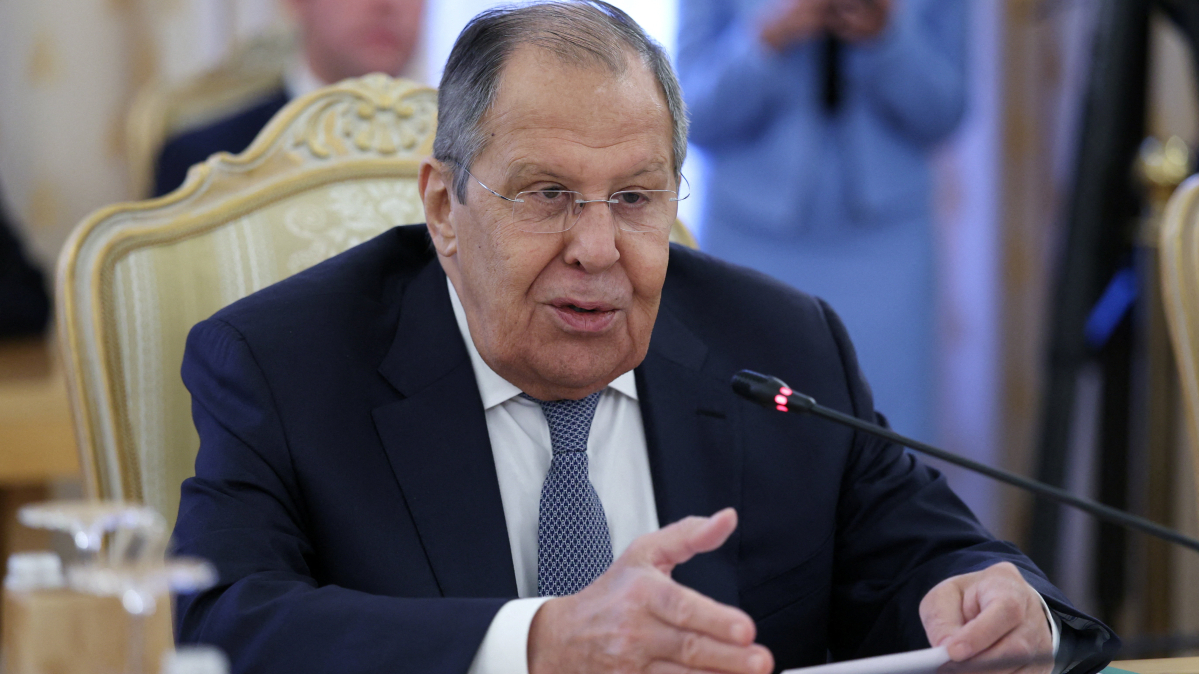
Russian Foreign Minister Sergei Lavrov said on Sunday that he was willing to meet U.S. Secretary of State Marco Rubio but reiterated that Moscow would not compromise on its main conditions for ending the conflict in Ukraine.
Efforts by U.S. President Donald Trump to mediate an end to the war — Europe’s deadliest since the Second World War — have so far failed. Last month, Trump abruptly cancelled a planned summit with President Vladimir Putin in Budapest.
The Kremlin on Friday dismissed Western media claims that Lavrov had fallen out of favour with Putin following the summit’s collapse, after the Foreign Ministry indicated Moscow was unwilling to soften its stance on Ukraine.
“Secretary of State Marco Rubio and I recognise the need for regular dialogue,” Lavrov told the state news agency RIA Novosti. “It is important for discussing the Ukrainian issue and advancing the bilateral agenda. That is why we speak by telephone and are ready to hold face-to-face meetings when necessary.”
Nearly four years since Russian troops entered Ukraine, Moscow’s forces continue to advance and now control around 19% of the country — territory Russia claims to have formally incorporated, though Ukraine and its Western allies refuse to recognise this.
Lavrov said the “understandings” reached between Putin and Trump during their August summit in Anchorage, Alaska, were based on Putin’s June 2024 demands and proposals from Trump’s envoy, Steve Witkoff.
Those demands include Ukraine renouncing its ambitions to join NATO and withdrawing troops from the four regions Russia claims as its own — Donetsk, Luhansk, Kherson, and Zaporizhzhia. Russia also controls Crimea, annexed in 2014, most of Luhansk, around 80% of Donetsk, 75% of Kherson and Zaporizhzhia, and small parts of several other regions.
Ukrainian President Volodymyr Zelenskyy has said Russian-held areas may be recognised as de facto occupied but insists there will be no de jure recognition. He maintains he has no mandate to cede territory, warning that doing so would expose Ukraine and Europe to renewed Russian aggression.
Lavrov said Moscow was awaiting confirmation from Washington that the Anchorage agreements still stand. He also stated that “no one questions Russia’s territorial integrity or the choice of the residents of Crimea, Donbas and Novorossiya” to join their “historical homeland.”
“Novorossiya” refers to a region of south-eastern Ukraine incorporated into the Russian Empire in the 18th and 19th centuries and is also used to describe a pro-Russian movement seeking to reassert control over the area.
Asked about European proposals to use €210 billion in frozen Russian state assets to support Ukraine, Lavrov said there was no legal mechanism to do so and warned that Russia would retaliate if such assets were seized.
He added that the United States had informed Moscow through diplomatic channels that it was considering Putin’s proposal to extend the limits of the New START nuclear arms treaty beyond its expiry in February 2026.










What is your opinion on this topic?
Leave the first comment