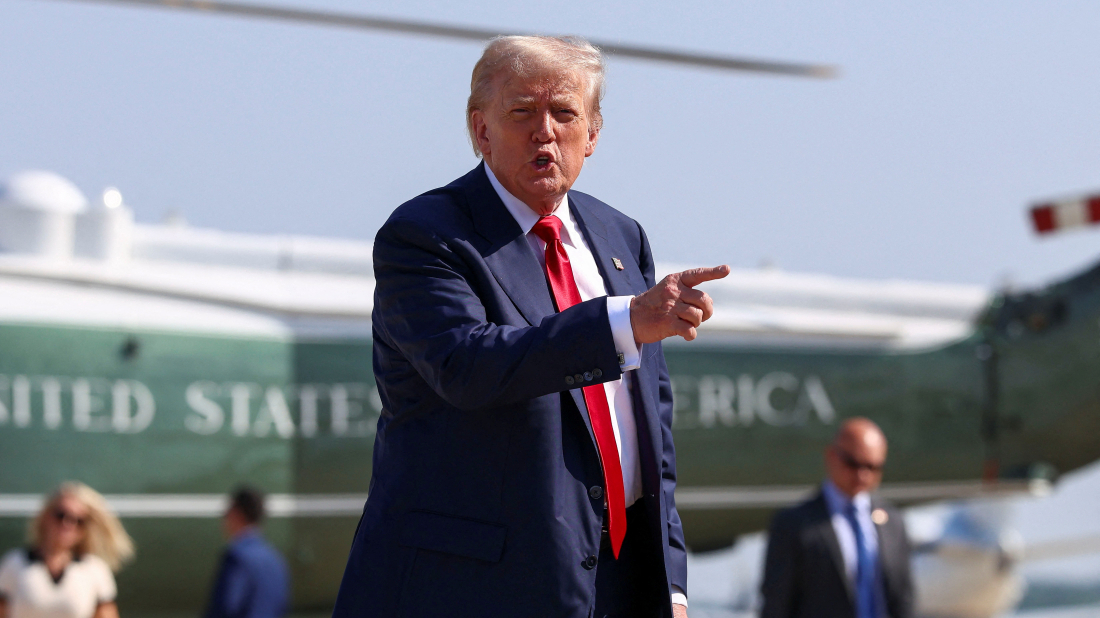
Abolishing mail-in ballots and voting machines is key to restoring election integrity ahead of 2026, according to U.S. President Donald Trump.
In a post on Truth Social, U.S. President Donald Trump said he would launch a movement to abolish mail-in ballots and voting machines, which he described as “highly inaccurate” and “seriously controversial.”
He claimed paper ballots with watermarks would better guarantee election integrity. Trump alleged that the U.S. is the only country still using mail-in voting and linked the practice to what he called “massive voter fraud.”
Trump declared he would sign an executive order to begin this process, warning that Democrats would oppose it because, in his words, “they cheat at levels never seen before.” He also asserted that states must follow federal directions in vote counting, portraying them as agents of the federal government.
Accusing Democrats of relying on “disproven” mail-in voting, he framed the practice as a "scam" and said it must end immediately. Trump concluded by tying election integrity to national sovereignty, saying without secure
elections and strong borders, the country lacks legitimacy.
Trump cites Putin on mail-in voting and 2020 outcome
Three days ago, after meeting with Russian President Vladimir Putin, Donald Trump told Fox News that Putin had sharply criticised mail-in voting, calling it incompatible with free and fair elections. According to Trump, Putin said, "Your election was rigged because you have mail-in voting... No country has mail-in voting. It's impossible to have mail-in voting and have honest elections."
Trump said that, during their meeting, Putin told him he had clearly won the 2020 election and that mail-in voting was to blame for changing the result. He quoted Putin as saying the conflict that followed would not have happened if Trump had remained in office. “You lost it because of mail-in voting,” Trump recalled, repeating his claim that the 2020 election was “rigged.”
Global landscape of postal voting
Many countries around the world allow postal voting, though the systems and eligibility vary widely. In the United States, several states conduct all elections by mail, while others offer absentee ballots upon request. The United Kingdom permits postal voting without requiring a reason, with a significant portion of voters using the option in recent elections.
Germany has similarly adopted a no-excuse postal voting system, with nearly half the electorate participating by mail. Australia allows postal voting primarily for those who are remote or unable to vote in person, and Switzerland stands out for its nearly universal use of mail-in ballots.
In contrast, countries such as India restrict postal voting to specific groups such as military personnel, and France abolished the practice in favour of proxy voting. Other nations, including Canada, Sweden, and Italy, offer postal voting mainly to citizens living abroad. Overall, postal voting remains a diverse and evolving method of participation in global democratic processes.





















What is your opinion on this topic?
Leave the first comment