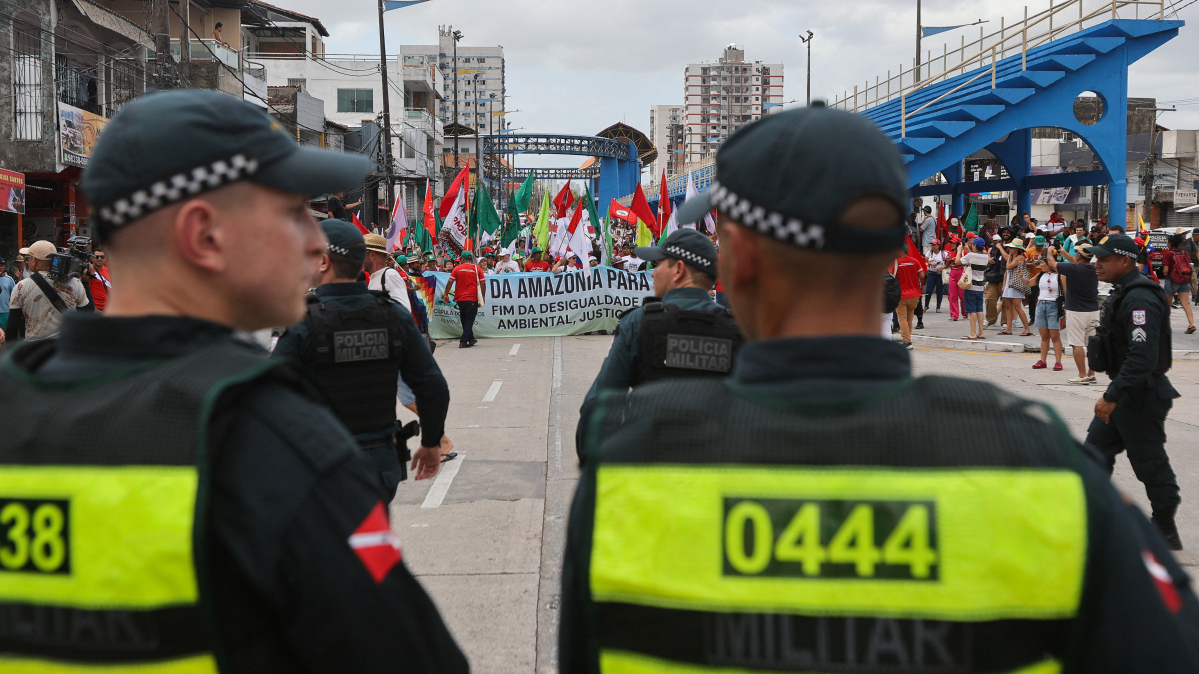
Thousands of climate demonstrators filled the streets of Belém on Saturday, marching loudly and peacefully to demand stronger action to protect the planet and to voice frustration at governments and the fossil fuel industry.
Just a short distance away, negotiators at the COP30 climate summit reached the halfway stage of talks aimed at turning long-standing commitments into concrete measures to curb rising global temperatures and support those most affected by climate change.
Indigenous communities, youth activists and civil society groups joined forces, singing, playing instruments and waving banners under midday heat of around 30°C (86°F). With high humidity, it felt closer to 35°C (95°F), according to Brazil’s National Institute of Meteorology.
“This is the place for us to march and outline the roadmap for what must be done at this COP: a transition away from deforestation and fossil fuel use,” Brazil’s environment minister Marina Silva told the crowd.
Indigenous protester Cristiane Puyanawa said she joined the march to demand stronger land rights. “Our land and our forest are not commodities. Respect nature and the peoples who live in the forest,” she said.
COP30 has already seen numerous demonstrations, including an attempt by Indigenous protesters to force entry into the summit venue on Tuesday, which led to clashes with security.
On Saturday, officially the summit’s protest day, there was a heavy security presence around the venue, with military police in riot gear, although the march did not pass directly by the site.
Negotiators presented an update on their work at a plenary session on Saturday before handing over unresolved political issues to national ministers in week two.
“As negotiators approach the second week, they must remember that climate action is not about abstract numbers or distant goals, it is about people,” said Katharine Hayhoe, chief scientist at The Nature Conservancy. “Every choice we make today shapes the future we share.”
The summit’s vast agenda seeks to build on previous agreements, progress that has been steady but slow over the past three decades.
The outcome of this year’s talks remains uncertain, especially as some of the most contentious topics, such as scaling up climate finance, phasing out fossil fuels and addressing the global gap in emissions-cutting efforts are being discussed informally outside the core negotiating tracks.
Brazil’s COP30 presidency, which is steering these parallel discussions, will need to decide whether to attempt a high-stakes political compromise that all countries can endorse, known as a “cover decision”.
Asked on Saturday whether such a decision was being considered, COP30 President Andre Corrêa do Lago said: “I have long said we are not planning a cover decision, but if countries move towards proposing one, the presidency will take it into account. Let’s see how things develop.”
Elsewhere at the summit, countries announced new alliances and initiatives.
The Premium Flyers Solidarity Coalition, proposing taxes on premium air travel and private jets, said Djibouti, Nigeria and South Sudan had joined the initiative, alongside France, Spain, Kenya and Barbados.
With Western governments reducing overseas aid, “solidarity levies” on high-polluting sectors are gaining momentum as a way to generate debt-free funding for climate action.
“If this COP has shown anything, it is that the next decade must be one of acceleration powered by non-debt finance,” said Selwin Hart, special adviser to the UN Secretary-General.
Meanwhile, the Utilities for Net Zero Alliance announced it had raised its annual investment target from roughly $116 billion to nearly $150 billion, including $66 billion for renewable energy and $82 billion for electricity grids and battery systems.












What is your opinion on this topic?
Leave the first comment