Around 25 miles (40 km) from the advancing Russian frontline, a Ukrainian Catholic community in the eastern city of Zaporizhzhia is offering spiritual and material support to people fleeing occupied territories.
Church members are delivering humanitarian aid to troops and frontline villages, while nuns provide emotional care to families and children displaced by war.
"When kids come, especially little ones, they feel safe and cling to us, needing hugs and warmth. New kids always need that embrace," said Sister Lukia Murashko, the mother superior at the Order of Saint Basil the Great monastery in Zaporizhzhia.
The monastery offers a welcoming atmosphere, decorated with Ukrainian flags and greeting cards from soldiers.
In June, Sister Lukia and two other nuns baked a cake for the 15th birthday of Evhen, a boy who fled Russian-occupied Melitopol and now lives in a run-down hostel in the city.
Catholic growth amid war
The Ukrainian Greek Catholic Church — a Vatican-loyal denomination with eastern Orthodox-style rites — has over 4 million adherents and is the country’s largest branch of Catholicism.
While Orthodox Christianity remains dominant, it has seen a decline over the past decade amid tensions related to its ties with Moscow. In contrast, the Catholic Church has grown, now accounting for 12% of Ukraine’s population, according to a 2024 study by the Razumkov Centre.
Catholicism, traditionally rooted in Ukraine’s west, has been expanding eastward — into areas Russia claims as its own, including those occupied in 2014 and during the full-scale invasion in 2022.
Zaporizhzhia, while not under Moscow's control, has become a major hub for internally displaced Ukrainians. With a growing congregation, the city’s wooden St. Volodymyr chapel is undergoing expansion.
Roman Catholicism also has a small but present community there.
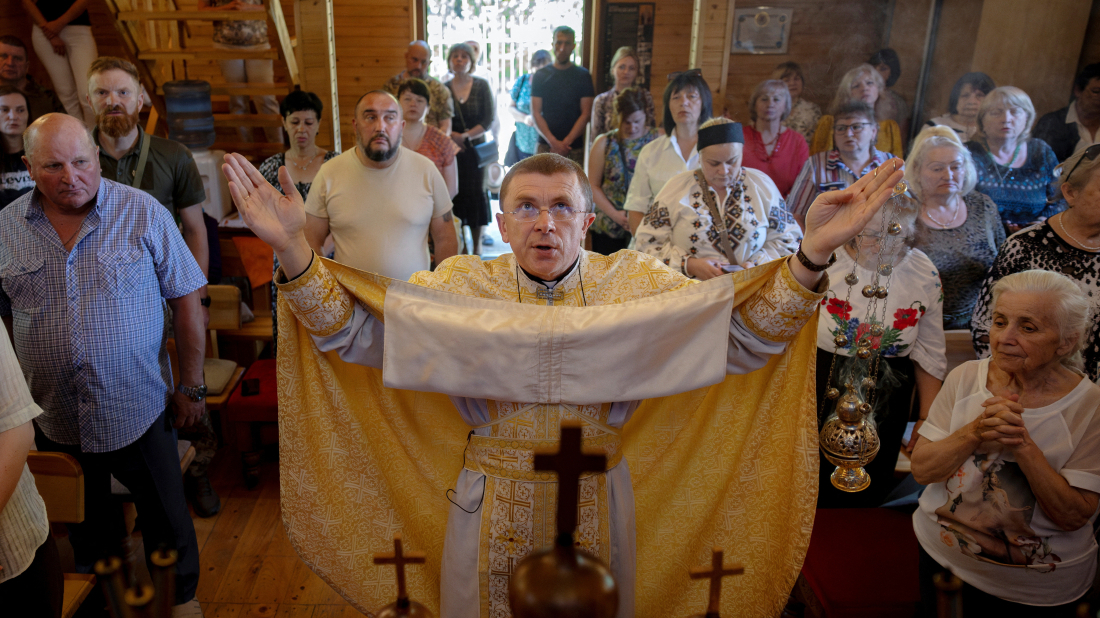
In June, a Divine Liturgy was held at the chapel by Father Andriy Bukhvak, attended by about two dozen worshippers and three priests in gold-brocade vestments, most of them displaced by the war.
Crackdown on Ukrainian Catholic Church
After Russian forces occupied most of the Zaporizhzhia region in 2022, local authorities banned the Ukrainian Catholic Church and affiliated charities. A 6 December, 2022 decree accused the Church of working with foreign intelligence services and storing weapons.
The decree also alleged that parishioners had participated "in riots and anti-Russian rallies in March-April 2022."
The office of the Russia-installed governor in occupied Zaporizhzhia did not immediately respond to a detailed request for comment.
Priests expelled, churches raided
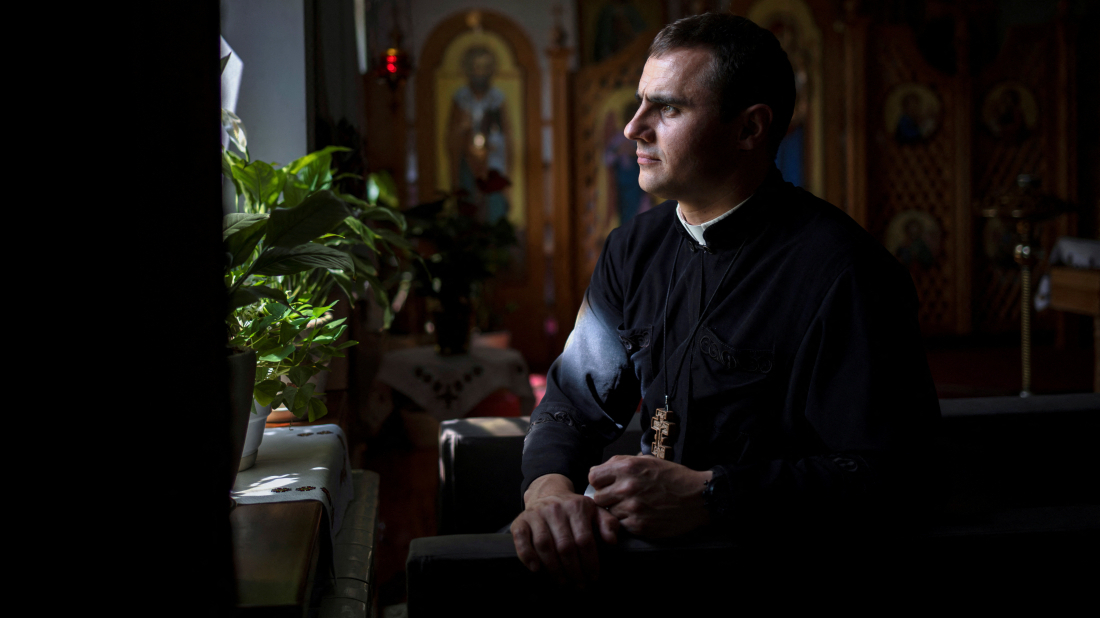
Father Oleksandr Bohomaz, 36, served in Melitopol — a coastal city in Zaporizhzhia region — for nine months after its capture by Russian forces on 1 March, 2022.
Alongside two other priests, he continued to serve four parishes and support those unable to flee.
"We travelled around, serving as much as possible until they eventually deported us," he said.
During his time under occupation, authorities disrupted services and collected worshippers’ fingerprints.
In December 2022, Bohomaz was interrogated and escorted to a checkpoint where he was told to cross into Ukrainian-controlled territory.
Other clergy have faced worse.
In November 2022, Russian troops raided a Greek Catholic church in Berdiansk, around 100 km from Melitopol.
Two priests — Ivan Levitsky and Bohdan Geleta — were arrested on charges of illegally possessing weapons.
According to a December 2024 report by the U.N. Human Rights Monitoring Mission in Ukraine, they were released in a June 2024 prisoner exchange.
The Church has denied the charges.
Religion and war
Religion has become increasingly entangled with the conflict.
Russian Orthodox Patriarch Kirill has endorsed the invasion, calling it a Holy War.
Last August, Ukrainian authorities banned the Ukrainian Orthodox Church branch loyal to Moscow.
Its leader, Patriarch Pavlo, was placed under house arrest in 2023.
The U.S.-backed International Religious Freedom and Belief Alliance (IRFBA) has accused Russia of widespread religious persecution in Ukraine.
In a February report, the alliance claimed Russian troops had killed 67 clergy of various denominations and damaged more than 630 religious buildings, including 596 churches.
Russia’s Foreign Ministry dismissed the report, calling it biased and stating that any actions taken were lawful.
Church in exile
Since 2014, the Ukrainian Catholic Donetsk Exarchate — responsible for much of eastern Ukraine — has operated from exile in Zaporizhzhia.
Of its 77 parishes, 36 are currently under Russian control.
Stepan Meniok, 75, led the Exarchate until his retirement in 2024. He was driven from Donetsk when Russian-backed separatists seized the city in 2014.
"Many displaced people pass through here, and I’ve heard countless stories of loss: property, lives," Meniok said.
He added that he hopes for peace talks between Kyiv and Moscow.
Father Bohomaz believes the Ukrainian Catholic Church is targeted for its resistance to occupation.
"We see our people being beaten, killed, robbed, and destroyed," he said. "We stand with the people."












What is your opinion on this topic?
Leave the first comment