Clashes erupt in central Tunisia after death following police chase
Street clashes broke out for a second night in the Tunisian city of Kairouan after a man died following a police pursuit, raising fears of wider unres...
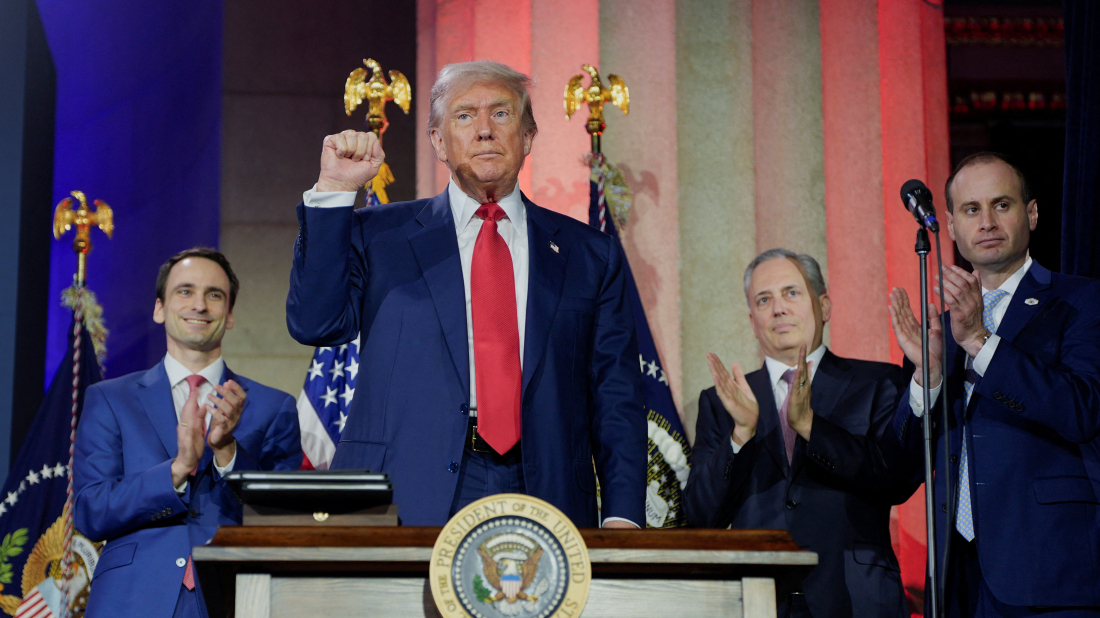
President Donald Trump has unveiled a sweeping national Artificial Intelligence (AI) strategy on Wednesday, signing three executive orders aimed at securing U.S. dominance in the global AI race by accelerating innovation, cutting red tape, and easing regulations on critical data infrastructure.
Speaking at a summit with tech and government leaders in Washington, Trump emphasized that U.S. tech firms must "put America first," promising to reshape domestic conditions to favour rapid AI development.
“My administration will use every tool to ensure the United States builds and maintains the most powerful AI infrastructure on the planet,” Trump stated, outlining plans for new data centres, semiconductor manufacturing, and energy facilities — all implemented with "certainty" and environmental oversight.
The orders aim to speed up permitting for AI data centres, promote the global export of U.S. AI models, and ensure ideological neutrality in government-supported AI technologies.
Just before signing, the White House revealed Trump’s broader “Winning the Race: America’s AI Action Plan.”
The strategy lays out a three-pillar approach - boosting domestic AI innovation, constructing expansive infrastructure, and leveraging diplomacy to counter rivals such as China.
The document describes AI supremacy as a national security imperative and opposes 'radical climate dogma' seen as obstructive to growth.
Formulated by top officials including AI and Crypto Czar David Sacks and Secretary of State Marco Rubio, the plan underscores Washington’s intent to dominate the future of technology.
“Winning the AI race is non-negotiable,” Rubio affirmed, calling the policy a framework to ensure American tech remains the global gold standard.

The Oligarch’s Design is an investigative documentary exploring how financial power, political influence and carefully constructed narratives can shape conflict and public perception.
Turkish President Recep Tayyip Erdoğan reiterated his offer to host Ukraine-Russia peace talks in Ankara, at his meeting with Russian President Vladimir Putin. The talks took place on the sidelines of the international Forum for Peace and Trust in Ashgabat, Turkmenistan, on Friday (12 December).
Iranian authorities have seized a foreign tanker carrying more than 6 million litres of smuggled fuel in the Sea of Oman.
Russian forces struck Ukraine’s southern port city of Odesa for a second consecutive day on Saturday (13 December), deploying Kinzhal hypersonic missiles for the first time in the conflict, Ukrainian authorities said.
A bulk carrier owned by a Turkish company was struck during a Russian attack on Ukraine’s southern coast on Friday.
Street clashes broke out for a second night in the Tunisian city of Kairouan after a man died following a police pursuit, raising fears of wider unrest as the country nears the anniversary of the 2011 revolution.
Turkish Foreign Minister Hakan Fidan says international cooperation is essential for Syria’s recovery as investment slowly begins to return despite the scale of destruction after years of conflict.
Thailand’s caretaker Prime Minister Anutin Charnvirakul said on Saturday (13 December) that Thai forces would continue military action along the Cambodia border until Bangkok believes there is no longer a threat to Thai territory or civilians.
U.S. stock markets closed lower at the end of the week, as investors continued to rotate out of technology shares, putting pressure on major indices.
EU foreign policy chief Kaja Kallas has warned that without concrete concessions from Russia, such as limiting its military forces or curbing its defence budget, new conflicts could erupt elsewhere, even if Ukraine receives security guarantees.
You can download the AnewZ application from Play Store and the App Store.
What is your opinion on this topic?
Leave the first comment