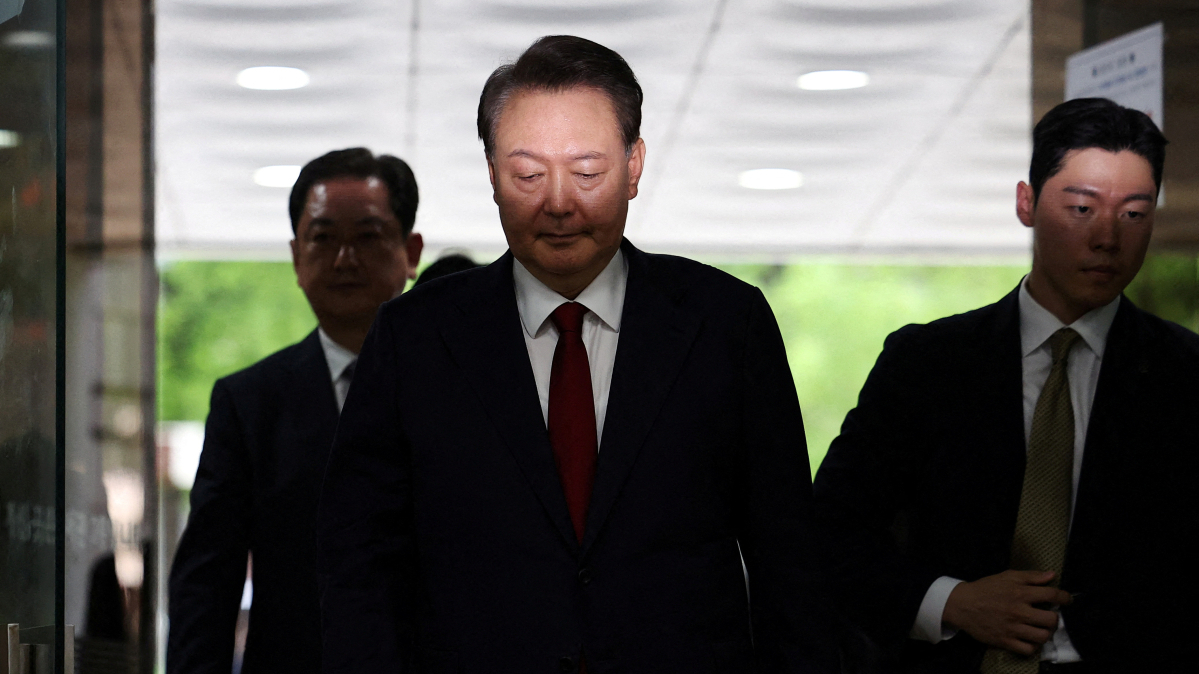
A South Korean court hearing the case of former President Yoon Suk Yeol on charges of insurrection postponed the sentencing request until next week after a lengthy session. This case could potentially lead to a death penalty verdict for Yoon due to his failed attempt to impose martial law in 2024.
Yoon, accused of masterminding an insurrection, faces the possibility of the death penalty or life imprisonment under South Korean law if convicted. Although South Korea has not executed a death-row inmate since 1997, it has not abolished the death penalty.
A special prosecutor was expected to present their sentencing request to the Seoul Central District Court for Yoon and seven other defendants on Friday. However, the court decided to resume proceedings on January 13 after more than 12 hours of arguments.
Prosecutors claim that Yoon, along with then-defence minister Kim Yong-hyun, began planning in October 2023 to dissolve parliament and assume legislative powers. They allege that Yoon sought to label his political opponents, including then-opposition leader Lee Jae Myung, as "anti-state forces" and detain them.
Prosecutors also accused Yoon and Kim of attempting to create a pretext for martial law by escalating tensions with North Korea through a covert drone operation. While the failed martial law attempt lasted only about six hours, it shocked South Korea, Asia's fourth-largest economy and a key U.S. security ally, which had long been seen as one of Asia's most resilient democracies.
Yoon, 65, has denied the charges. The conservative former career prosecutor contends that, as president, he had the authority to declare martial law, and that his actions were aimed at drawing attention to the opposition parties' obstruction of government.
Defence lawyers have yet to complete their arguments
Wearing a dark suit and white shirt, and looking noticeably thinner than at the start of the trial in February, Yoon sat alongside the seven other defendants, including Kim, and their legal counsel.
The session began earlier than usual for the defence arguments, followed by the prosecutors' final remarks and sentencing requests for each of the defendants.
However, by late Friday evening, the defence lawyers had not yet finished presenting their arguments, leading the court to schedule a new session for January 13. In South Korea, the court determines whether a defendant is convicted and sets the sentence.
The court is expected to deliver its verdict in February, marking the conclusion of over a year of political turmoil following Yoon's martial law declaration on December 3, 2024. The declaration was revoked within hours after lawmakers scaled fences to break through a security cordon around the National Assembly in order to vote.
Yoon was later impeached and removed from office by the Constitutional Court, and a snap presidential election in June of the previous year brought liberal-leaning Lee Jae Myung to power.
Yoon is also facing a series of other criminal charges, including obstruction of the execution of an arrest warrant and abuse of power.













What is your opinion on this topic?
Leave the first comment