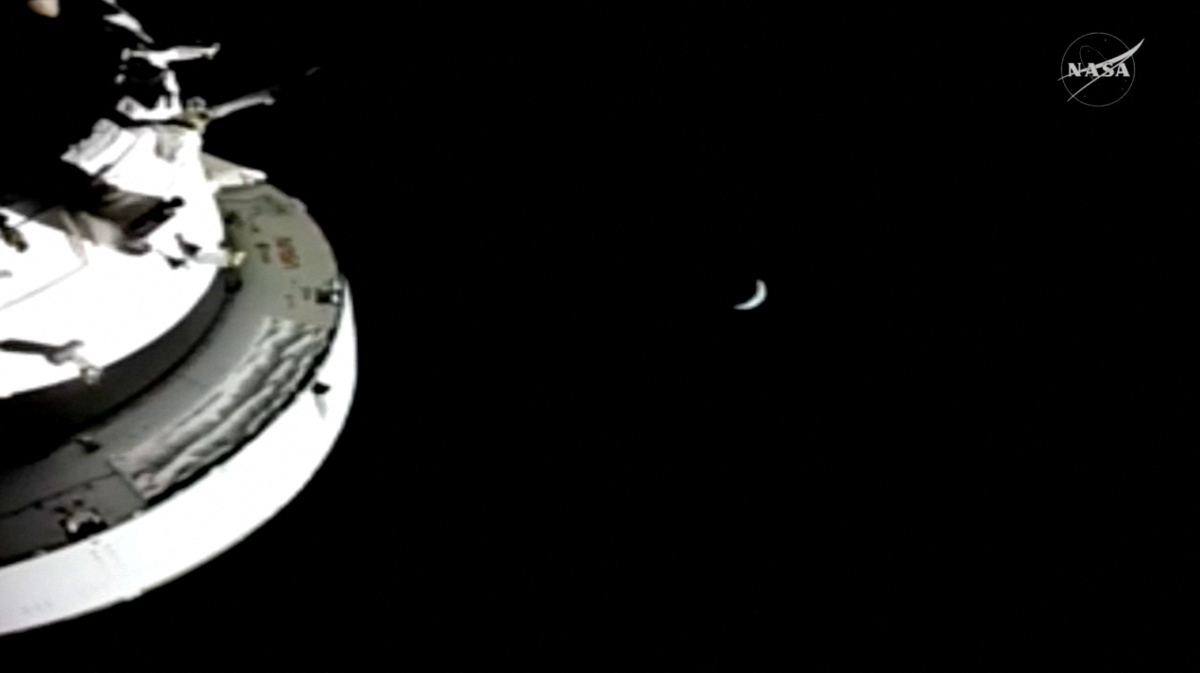
The four astronauts aboard Artemis II briefly lost contact with Earth while flying behind the Moon, then regained it during a dramatic lunar far-side flyby.
The crew - Reid Wiseman, Victor Glover, Christina Koch and Canadian astronaut Jeremy Hansen - reached a record distance of more than 252,700 miles (around 406,700 kilometres) from Earth, surpassing a milestone set during Apollo 13 more than half a century ago.
Their six-hour pass around the Moon’s far side - a region never visible from Earth - offered a rare and striking view of a battered, cratered landscape. As their Orion spacecraft slipped into darkness, the astronauts witnessed flashes of light on the surface below, caused by meteors striking the Moon.
Scientists at NASA’s Johnson Space Center in Houston followed the observations closely, recording the crew’s real-time descriptions. The fleeting bursts of light, similar to those reported by Apollo astronauts, are expected to provide valuable new insights into lunar activity.
The flyby, which brought the spacecraft within just more than 4,000 miles (around 6,437 kilometres) off the lunar surface, marked the first time since the Apollo era that humans have travelled so close to the Moon. Between 1969 and 1972, six Apollo missions successfully landed astronauts on the lunar surface - the only time humans have walked there.
Rare sights and human stories from lunar orbit
Although Artemis II is a test mission, designed as a rehearsal for future landings, it is already delivering significant scientific returns. The crew has been capturing detailed photographs and offering vivid descriptions that complement robotic data gathered in recent decades.
The journey was not without its tense moments. As the spacecraft passed behind the Moon, communication with Earth was lost for around 40 minutes - a planned blackout caused by the lunar body blocking radio signals. When contact was restored, relief was evident.
“It is so great to hear from Earth again,” said Koch, speaking from orbit.
Earlier in the day, the crew were greeted with a recorded message from the late Apollo astronaut Jim Lovell, who famously commanded Apollo 13. “Welcome to my old neighbourhood,” he said, encouraging them to take in the view.
The astronauts also took time to personalise their journey, suggesting informal names for previously unnamed craters. In an emotional moment, Hansen proposed naming one bright feature after Wiseman’s late wife, Carroll.
Meanwhile, their descriptions brought the Moon vividly to life. Glover spoke of the “terminator” - the shifting boundary between lunar day and night - calling it the most rugged he had ever seen. Koch likened sunlit craters to “a lampshade with tiny pinprick holes”, glowing brightly against the darkness.
Praise from Earth as mission captures global attention
The mission has also drawn attention back on Earth. U.S. President Donald Trump congratulated the crew, praising them as “modern-day pioneers” and hailing the mission as a moment of national pride.
Artemis II is part of NASA’s broader Artemis programme, which aims to send humans to the Moon later this decade and establish a sustained presence there. The long-term goal is to use the lunar surface as a testing ground for future missions to Mars.
For now, however, the focus remains on this historic voyage - one that has not only broken records, but also offered a powerful reminder of the human perspective in space exploration.





















What is your opinion on this topic?
Leave the first comment