A robotics startup says it has built an AI “brain” that can teach humanoid robots new physical skills in days rather than months, as the race to deploy human-shaped machines in factories and warehouses accelerates.
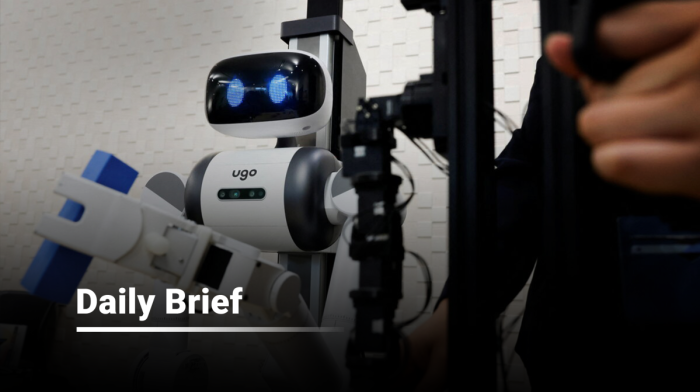
In the London office of UK-based startup Humanoid, a robot rolls across the floor, raises its arms and grips objects with mechanical hands.
Humanoid says machines like this could one day work in warehouses, factories and car plants, carrying out repetitive tasks in spaces built for people.
Founded in 2024 by entrepreneur Artem Sokolov, Humanoid is one of a wave of robotics companies betting that advances in artificial intelligence (AI) can make humanoid robots useful outside the lab.
Company says AI is the key advantage
Sokolov says the company’s “secret sauce” is not just the robot’s body, but the AI system inside it.
“We train, we build our own proprietary VLA model - vision-language-action model - to help the robot do different tasks in the real world with human speed,” he said.
Humanoid calls that system KinetIQ, an AI “brain” designed to help the robot understand what it sees, process instructions and control its body.
“The AI systems are the most important aspect here,” Chief Technology Officer Jarad Cannon told Reuters.
Robot trained to walk through simulation
One example, Cannon says, is walking.
Humanoid says it trained its Alpha biped prototype to walk in 48 hours, not by manually coding each step, but by creating a detailed digital version of the robot and allowing it to learn through simulation.
“So we could train only in sim, then deploy it onto the robot,” Cannon said. “The physical robot has learned, in simulation, 10,000-plus years of walking just in those two calendar days.”
Cannon says a similar approach can be used to teach workplace tasks, with a human demonstrating a job using the robot’s cameras and grippers before the data is used to train the AI system.
"And this is a different paradigm than where these robots were in the past decade," he said.
Humanoid targets industrial sectors
Humanoid is targeting industrial uses first, including logistics, manufacturing, warehousing and automotive suppliers.
The company has demonstrated wheeled humanoid robots as well as a two-legged version. It says production systems are expected later in 2026.
Sokolov says Humanoid’s edge is that it is building the full stack itself, from hardware and AI models to software applications.
“Our advantage is that we build a full stack,” he said. “We are the youngest company in the field, but we are the fastest.”
Competition grows in humanoid robotics industry
Humanoid says it plans to begin mass production in 2027.
But it is entering an increasingly crowded field, with companies including Agility Robotics, Figure AI and Tesla also racing to put humanoid robots into workplaces.
For Humanoid and the wider humanoid robotics industry, the challenge is moving from controlled demonstrations to real workplaces, where robots must prove they can work safely, reliably and at commercial scale.





















What is your opinion on this topic?
Leave the first comment