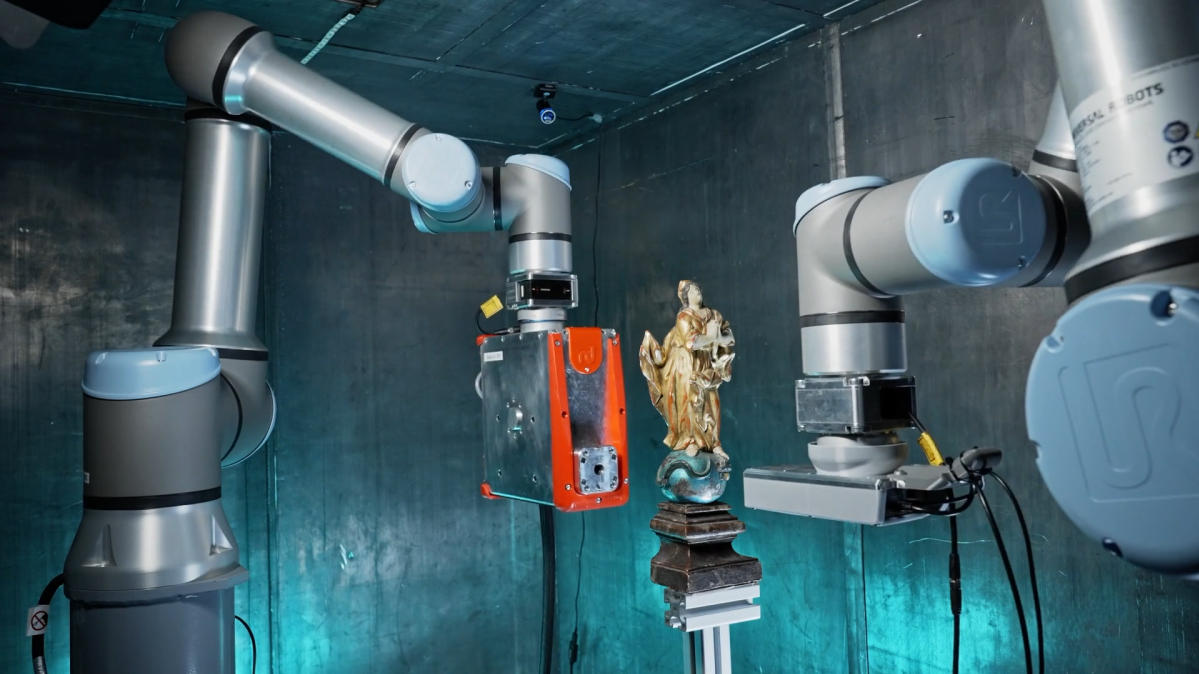
A new robotic system developed for the Czech Police is reshaping how complex investigations are carried out, bringing laboratory-level precision directly to crime scenes.
The device, described by its creators as unique worldwide, can examine evidence from crimes, accidents, or fires in fine detail without the need for transport to specialised facilities.
Engineers behind the project say it works as a compact robotic CT scanner capable of breaking down the full composition of an object, estimating its age, and identifying the forces or substances that may have acted on it. What once required several separate instruments can now be done in a single session. The entire unit can be dismantled in around two hours, packed into portable cases, and transported in a normal passenger car.
For investigators, the shift means faster results, more reliable reconstruction of events, and fewer opportunities for contamination.
Lubos Kothaj, director of the Criminalistics Institute, said the breakthrough lies in the system’s ability to run multiple examination methods simultaneously, producing X-ray and spectral imagery in one place and linking them for precise evaluation. He noted that the team initially focused on analysing paintings to find a non-destructive way to detect forgeries, but the technology quickly proved capable of handling far broader tasks, from defect inspection in technical equipment to specialised CT scans in anthropology.
The practical gains are significant. Marek Kotrly from the institute’s Department of Science and Innovation said the system allows large or complex objects to be processed far faster than before, eliminating the need for stitching together fragmented images and reducing errors. Forensic staff also stress the protection it offers, with most examinations now done on a single machine rather than across multiple devices.
Ease of use has been another unexpected advantage. Display specialist Jana Zalisova said the operation is straightforward enough to be learned within a day, an important factor for deployments outside traditional lab environments.
The system is already playing a role in verifying seized paintings, a field where the institute estimates that as many as 60% to 70% of works on the market may be counterfeit. Experts say pigment composition and underlying layers can now be assessed with a level of certainty that leaves little room for manipulation, even as online sales create new risks for unsuspecting buyers.
Developers note that the technology’s appeal extends well beyond policing.
Business director David Malancuk said industries from aviation to automotive, as well as universities and medical researchers, are using similar systems to study composite materials, 3D printing outputs, and biological samples. According to him, the range of potential applications continues to grow as the technology evolves.
The project has already reached the finals of a major European innovation competition, highlighting how one of the region’s most portable forensic tools is now pushing the boundaries of on-site analysis.






















What is your opinion on this topic?
Leave the first comment