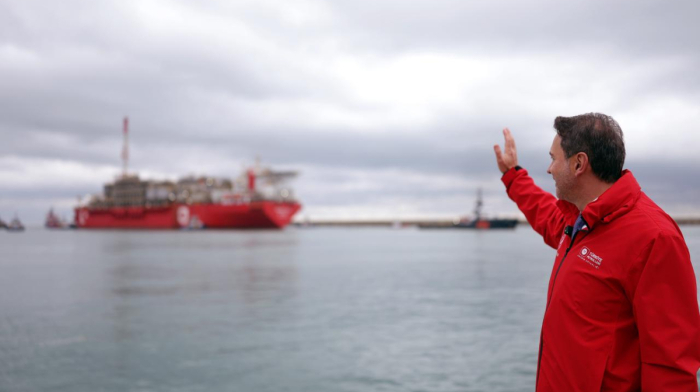
Georgia’s International Maritime Forum has closed in Batumi with officials setting out investment targets, timelines and technical plans aimed at expanding the Middle Corridor and strengthening the country’s role in global trade.
More than 300 delegates from dozens of countries attended the two-day forum, alongside the International Maritime Organization (IMO), with discussions focusing on the infrastructure, digital systems and workforce needed to expand the corridor’s capacity.
Investment behind the ambition
Georgia plans to invest roughly $7 billion in transport infrastructure by 2032 as it seeks to double the country’s transport throughput capacity.
Deputy Minister of Economy and Sustainable Development Tamar Ioseliani outlined the government’s plans for upgrading the transport network.
“Georgia is an indispensable partner in the context of the Middle Corridor... By 2032, around 7 billion U.S. dollars should be invested to upgrade our transport system and double its throughput capacity.”
The investment is intended to address one of the Middle Corridor’s main challenges: capacity. The route, which connects China and Europe while bypassing Russia, has attracted growing attention as an alternative trade link, but bottlenecks, inconsistent cargo handling and slow digitisation have constrained its development.
Railway upgrades are already under way in Georgia, while the Anaklia deep-sea port is expected to receive its first ships by 2029. The project is intended to increase the depth and cargo capacity available at the country’s Black Sea ports.
Digital systems key to efficiency
Another focus of the forum was the exchange of data between ports, ships, customs authorities and shipping companies, which officials and industry representatives identified as critical to reducing delays along international transport corridors.
Niko de Cauwer, Secretary General of the International Association of Ports and Harbors, moderated a discussion on Maritime Single Window systems and Port Community Systems, which allow customs authorities, ports and shipping lines to exchange information digitally and in real time.
Participants included Christophe Joubert of Prodevelop and representatives of the Swedish Maritime Administration and Asian Development Bank. Speakers said investment in physical infrastructure needs to be accompanied by modern digital systems if ports are to operate efficiently.
For the Middle Corridor, improving these systems could be particularly important as the route competes on transit times and reliability with established shipping and overland alternatives.
Maritime sector faces workforce challenge
The forum also examined the global shortage of trained seafarers and the need for maritime education and certification systems to keep pace with changes in the industry.
Professor Takeshi Nakazawa of the International Association of Maritime Universities, Professor Norman A. Martínez Gutiérrez of the International Maritime Law Institute and Bingbing Song of the IMO’s maritime training division discussed certification standards, digital credentials and the modernisation of maritime education.
The issue is also relevant to Georgia’s transport ambitions. Increased traffic through the Middle Corridor and the development of Anaklia port will require a larger qualified workforce, with joint education programmes involving international partners among the measures being considered.
Georgia’s plans presented in Batumi point to a strategy combining infrastructure investment, greater transport capacity, digitalisation and workforce development as the country seeks a larger role in trade between Asia and Europe.











What is your opinion on this topic?
Leave the first comment