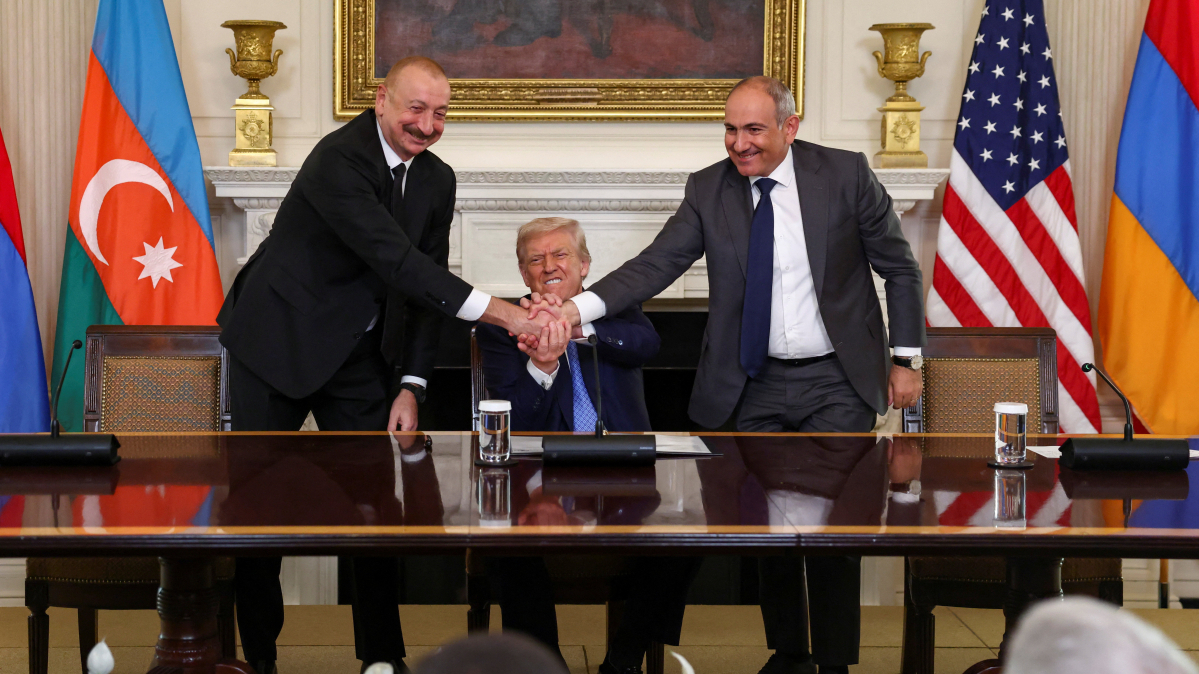
U.S. President Donald Trump has shared an article by his special envoy Steve Witkoff, marking one year since Azerbaijan and Armenia signed a joint declaration aimed at advancing a peace agreement between the two countries.
According to Witkoff, the U.S.-led peace process began in March 2025, when Trump’s team visited Baku. He said President Ilham Aliyev impressed the U.S. delegation as a “strong, decisive leader” willing to make difficult decisions for peace.
He further described Aliyev as someone who understood both Azerbaijan’s interests and the wider importance of regional stability:
“Azerbaijan’s president was a strong, decisive leader prepared to make the hard choices necessary for peace, yet weak leaders like those in the previous administration had allowed ties to atrophy. President Aliyev impressed us as a man who understands both his nation’s interests and the broader stakes of regional stability.”
Witkoff also praised Armenian Prime Minister Nikol Pashinyan, describing him as a leader capable of making decisions in the interests of his people even when they may initially prove unpopular.
He said the initial visit was followed by frequent meetings in Baku and Yerevan over the next five months, as Washington worked with both sides to advance a settlement.
Trump Route for International Peace and Prosperity
The U.S. later proposed the Trump Route for International Peace and Prosperity (TRIPP), a transit initiative intended to connect Azerbaijan and Armenia and promote regional economic cooperation.
Witkoff described the concept as a model for addressing long-standing conflicts through “creativity, strength and mutual interest” rather than prolonged negotiations.
After more than three decades of conflict, Azerbaijan and Armenia signed two documents. The first was a joint declaration setting out a path towards permanent peace, economic cooperation and full normalisation of relations.
The second was a joint nomination of Trump for the Nobel Peace Prize.
Witkoff said the U.S. has since worked with both countries to turn the agreement into a practical reality through railway engineering surveys, public-private coordination and investment mechanisms.
He added that Washington expects the TRIPP concept to eventually extend across the Caspian Sea and potentially be applied in the Middle East.
Read more:


















What is your opinion on this topic?
Leave the first comment