Turkmen President Serdar Berdimuhamedov has concluded a two-day state visit to Georgia, signing a fresh package of agreements with Prime Minister Irakli Kobakhidze and putting concrete figures behind the two countries' drive to strengthen the Middle Corridor trade route.
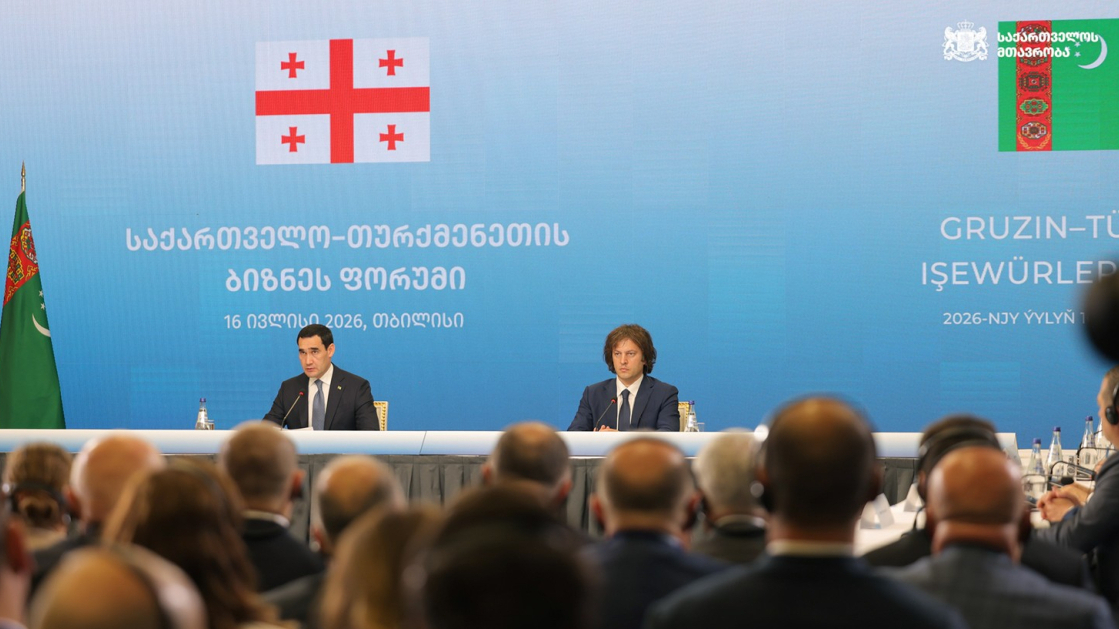
The visit, only the second by a Turkmen head of state to Georgia since 2015, began on Thursday with a formal welcome at Tbilisi's Presidential Palace, where Berdimuhamedov met President Mikheil Kavelashvili before laying a wreath at the Heroes' Memorial alongside Georgian Defence Forces Commander Giorgi Matiashvili.
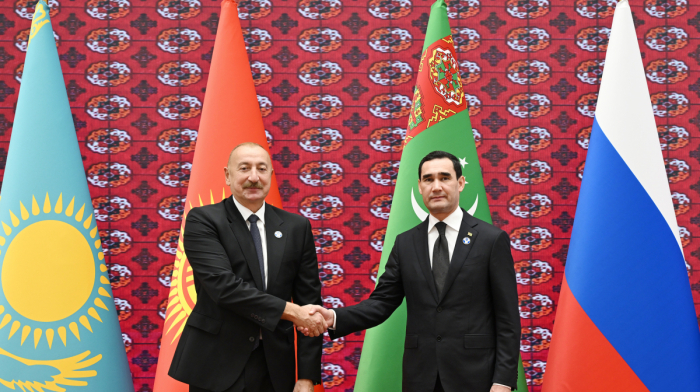
The visit concluded on Friday with expanded-format talks between Berdimuhamedov and Kobakhidze, followed by a joint press conference and the signing of a joint statement, together with a package of agreements and memoranda covering trade, transport and other sectors.
Speaking afterwards, Kobakhidze described Turkmenistan as a reliable partner and said Georgia was closely following its economic and infrastructure development. Berdimuhamedov described Georgia as Turkmenistan's main economic partner and said the visit was intended to take bilateral relations to what he called a "qualitatively new level".
What each side is claiming
Economic figures formed the centrepiece of Thursday's Georgia-Turkmenistan Business Forum, attended by around 250 companies.
Kobakhidze told the forum that bilateral trade turnover had increased by 26 per cent last year, surpassing $100 million. He also cited government data showing Georgia's economy expanded by 7.8 per cent during the first five months of 2026, alongside an IMF projection of average annual growth of around 5.4 per cent through to 2031.
He also pointed to $8.7 billion in foreign direct investment in Georgia since 2021 and said container traffic along Georgia's section of the Middle Corridor rose by 33 per cent in 2025, while cargo volumes on the Baku-Tbilisi-Kars railway increased almost sixfold.
Berdimuhamedov cited figures from his own government, highlighting a 2026 investment programme targeting GDP growth of 6.3 per cent in Turkmenistan, with 77 per cent of the state budget allocated to social spending. He identified energy, chemicals and textiles as priority sectors for expanded cooperation with Georgia and said Turkmenistan was seeking warehousing facilities and a dedicated terminal on Georgia's Black Sea coast.
The two leaders also toured an exhibition of Turkmen products before the business forum concluded.
Anaklia's planned deep-sea port, to be developed under a "landlord" model in which the state retains ownership of the land and core infrastructure, featured prominently as a flagship project underpinning Tbilisi's Middle Corridor ambitions.
Independent analysts have noted, however, that the wider Middle Corridor continues to face practical constraints, including limited Caspian Sea ferry capacity, railway bottlenecks and uneven customs coordination between participating countries. As a result, the pace of future cargo growth is likely to depend on how quickly those challenges are addressed.
Where this fits regionally
The visit is the latest in a series of Georgian initiatives to strengthen ties with Central Asia.
Tbilisi signed a strategic partnership with Kazakhstan in June, with Kazakh trade already accounting for 12.8 per cent of Georgian exports. It followed this with another strategic partnership with Uzbekistan in July, when the two governments set a target of increasing bilateral trade turnover from $270 million to $1 billion.
Turkmenistan is the third Central Asian country to sign such an agreement with Georgia in as many months, with each partnership centred on strengthening the Trans-Caspian route linking China and Central Asia with Europe.
For Ashgabat, closer ties with Georgia provide another route to European markets and an opportunity to diversify its foreign economic relationships. With the agreements now signed, the key question is whether they lead to measurable increases in freight volumes, investment and trade, something that is likely to become clearer over the coming months.
Viewed in a broader geopolitical context, however, Georgia's Central Asia strategy also faces a more difficult challenge. The Middle Corridor's core purpose is to move goods and energy towards Europe while bypassing Russia, a goal that depends on sustained political and financial support from the EU and its Western partners.
Yet Georgia's relationship with Brussels has continued to deteriorate. The EU froze Tbilisi's accession process in 2024, more than 250 Georgian officials remain under Western sanctions, and tensions between the Georgian government and the EU have continued to deepen rather than ease.
Strategic partnerships with Kazakhstan, Uzbekistan and now Turkmenistan demonstrate Georgia's ability to build the diplomatic and commercial relationships needed on the corridor's eastern flank. However, the corridor's western gateway lies in Brussels, and that relationship remains the more difficult challenge to repair.










What is your opinion on this topic?
Leave the first comment