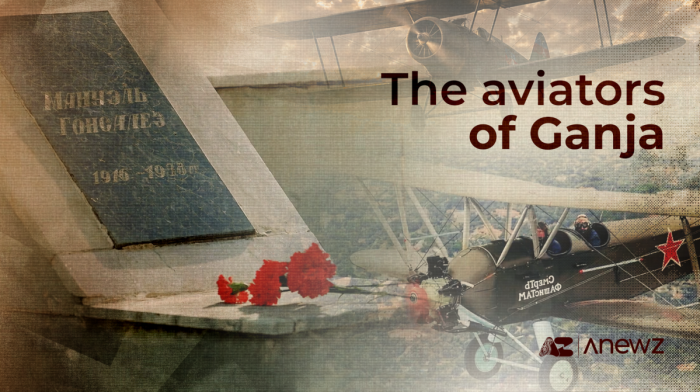
The Aviators of Ganja explores how young Spanish volunteers travelled to Soviet-era Azerbaijan to train as military pilots before being drawn into the defining conflicts of the 20th century.
A secret journey to Ganja
In 1936, Spain was breaking apart.
General Francisco Franco’s coup against the democratically elected Second Republic opened one of Europe’s darkest chapters. The Spanish Civil War was not only a domestic conflict. It became a testing ground for the ideologies, weapons and alliances that would soon shape the Second World War.
The Republic needed pilots - fast.
Its own flight schools were overwhelmed. Instructors were already at the front. France offered only basic training. Britain refused. So the Spanish Republic turned east, to the Soviet Union.
That decision brought hundreds of young Spaniards to Azerbaijan.
They travelled across Europe in secret by ship and train, passing through Leningrad, Moscow, Kharkiv and Odesa before arriving in Kirovabad, the Soviet-era name for Ganja. There, far from home, a military aviation school was established to train them for war.
The documentary shows how the operation was hidden from public view. Spanish names were replaced with Russian ones. If anyone asked, they were simply Soviet students. But secrecy had its limits. They were young. They were Spanish. They talked, laughed, flirted and crossed paths with local people. Before long, their presence had become an open secret.
The school itself was not the grand aviation academy many had imagined. It was improvised. The airfields were rough. Students had to clear stones from the ground before they could fly. The barracks were basic. Training was intense.
A programme that would normally take years was compressed into months.
The trainees began on the Polikarpov U-2, a simple aircraft built from wood and fabric. It offered little comfort and no modern ergonomics. Its braking system was unlike anything pilots would recognise today. But it was easy to maintain, simple to repair and well suited to teaching young men who had never flown before.
For many, the shock was enormous.
They were teenagers or barely in their twenties. They were in a foreign country. They did not speak Russian. Their instructors did not speak Spanish. The language barrier was so severe that students, interpreters and instructors had to build a practical aviation vocabulary from scratch. A Russian-Spanish aviation dictionary was compiled. Basic commands became essential tools for survival.
This was not only training. It was a race against time.
From trainees to combat pilots
The documentary follows how these young men progressed from basic aircraft to more advanced Soviet machines, including the Tupolev SB-2 bomber and the Polikarpov I-15 and I-16 fighters. These aircraft later became central to Republican aviation in Spain. The I-16, known by Republicans as the Mosca and by its enemies as the Rat, gave the Republic a new level of speed and manoeuvrability.
The pilots trained in Ganja returned to Spain not as boys with dreams, but as men prepared for combat.
Some became aces. José María Bravo, one of the central figures in the documentary, was among the Republic’s most accomplished pilots. Through the memories of his daughter, Ludmila Bravo, the film reveals not only the air battles but also the human burden behind them.
The pilots did not speak of war as glory. They spoke of fear, duty and survival.
They flew reconnaissance missions. They attacked bombers. They fought German- and Italian-backed aircraft in the skies over Spain. The documentary describes aerial combat as chaos, with aircraft climbing, diving, turning and scattering within seconds. In that world, hesitation could prove fatal.
A second war and a life in exile
But the story did not end with the Spanish Civil War.
When Franco won, many Republican pilots could not return home. Some went into exile. Others remained in the Soviet Union. According to the documentary, 185 pilots who completed their training in 1939 were unable to return to Spain. Eighty-four eventually moved to Mexico, while 101 remained in Azerbaijan.
Then came another war.
When Nazi Germany invaded the Soviet Union in 1941, some of these Spanish aviators were drawn into the Soviet war effort. The documentary places Azerbaijan at the centre of that struggle. Baku’s oilfields were not merely industrial assets but strategic lifelines. The wars of that era depended on engines, and engines needed fuel.
The film recounts how Spanish pilots helped defend airspace and airfields across several regions, including the Caucasus, Moscow, Odesa and Baku. Bravo served in a unit protecting the oilfields around Baku, where German reconnaissance aircraft had to be prevented from identifying key targets.
The documentary also follows darker paths.
Some Spaniards were denied the right to serve as pilots because Soviet authorities did not trust them. Others passed through labour camps, prisons and detention centres. Some took part in sabotage operations. Some fought. Others disappeared into the machinery of war and exile.
Remembering a forgotten chapter
For those who eventually returned to Spain, recognition did not come easily.
They arrived in a country that did not know what to do with them. Their qualifications had been earned in the Soviet Union. Spain and the Soviet Union had no diplomatic relations. Their ranks went unrecognised for decades. Some were questioned by Spanish authorities, while others were interrogated by foreign intelligence services. Many rebuilt their lives quietly, relying on one another.
The Aviators of Ganja is not only a story about aviation.
It is a story about memory.
It asks what happens when young people are swept into history before they fully understand its cost. It follows men who crossed continents to fly, only to discover that war rarely releases those who witness it. It also restores Azerbaijan’s place in a forgotten chapter of European history, not as a backdrop but as the training ground where part of Republican Spain’s air force was forged.
Some of those who died during training were buried in Ganja. Others who fought in the Second World War were buried in Baku. Their names remain part of a wider story linking Spain, Azerbaijan and the great conflicts of the last century.
One line in the documentary captures the tragedy clearly: the best years of their youth were lost in war.
But it also reveals something else.
Through war, exile and silence, these aviators left behind a record of courage, contradiction and survival. They came to Ganja to learn to fly. What they carried home - if they ever returned home - was something far heavier: the memory of a century that trained its young men in the sky before leaving many of them to fall through history.
Watch the Spanish version: Los aviadores de Ganja https://youtu.be/d7vloI4zaBQ?si=TKO4YspaFgvxFgeM














What is your opinion on this topic?
Leave the first comment